
Oatly has posted a 9.1% increase in Q3 revenue, but lowered its profit forecast for the full year due to “stronger and faster than expected” inflation in North America, where it will launch fibre oat milks in January.
In a quarter that saw it shore up its sustainability credentials, launch fibre-rich oat milks, and publish its latest beverage trend report and recipe lookbook, Oatly continued on its growth trajectory.
The plant-based giant saw revenues hit $243M in the July-to-September period this year, a 9.1% hike from the corresponding quarter in 2025. In fact, its overall sales for the first nine months of 2026 were up by 13.2% year-on-year.
The company’s gross profit swelled by 25% to reach nearly $83M in Q3 2026, while net losses shrank by 58% to $27.5M. Its adjusted EBITDA for the period (revenue excluding all non-operational and one-time expenses) totalled $9.4M, a threefold hike from a year ago.
And although Oatly has maintained its revenue growth forecast for the full year (expected to be 8-10%), it has significantly lowered its adjusted EBITDA estimate from $25-35M to $16-20M.
“We are impacted by the latest wave of fuel and freight inflation in North America, which has been stronger and faster than expected. We possess multiple levers to offset this pressure, but timing delays will adversely impact our profit in the fourth quarter,” explained Oatly CEO Jean-Christophe Flatin.
Oatly prioritises North America for growth ahead of concluding China review

As expected, Oatly’s performance was strongest in the Europe and International segment, where revenues swelled by 19.5% to reach $147.2M, thanks to volume growth of 17.6% primarily driven by its barista portfolio.
The company is outperforming both the oat and overall plant-based milk categories at twice the pace in terms of retail takeaway growth, while also deepening household penetration and accelerating out-of-home expansion.
“On-trend innovation drives growth. We believe that our new products are capturing incremental demand both for Oatly and the plant-based category, while attracting younger consumers,” Flatin told investors in an earnings call.
In North America, revenues increased slightly by 2.8%, totalling $63.8M. Here, too, Oatly’s retail takeaway sales have increased by 7.7%, outpacing dairy’s 4% growth and flipping the decline being experienced by the wider oat milk (-4.5%) and plant-based milk (-12.2%) segments.
Flatin said the macro backdrop in this region remains challenging, but the company is “activating on the controllables” to speed up its retail expansion: “Now at the record-high number of distribution points, we continue to narrow the market share gap in pursuit of category leadership.”
The Greater China region has been full of uncertainty for Oatly over the last few years, and the firm is conducting a strategic review, set to be completed by the end of 2026, to evaluate its options. This could result in the sale of its China business. Bloomberg has previously reported that executives handling its operations in the East Asian country are considering buying out this business.
Against that backdrop, the oat milk maker’s revenue in Greater China fell by 14.6% to $32M, primarily due to increased competition in the foodservice market. “Our goal is to accelerate growth, enhance operational focus, and improve our consolidated cash returns while maximising the value of this business,” Flatin said.
“We view North America and other international expansion markets as our priorities for growth and commend our management team in Greater China for navigating challenging local headwinds in recent years.”
Fibre oat milks come to North America amid Oatly’s bid to become ‘the world’s culturally favoured drink’
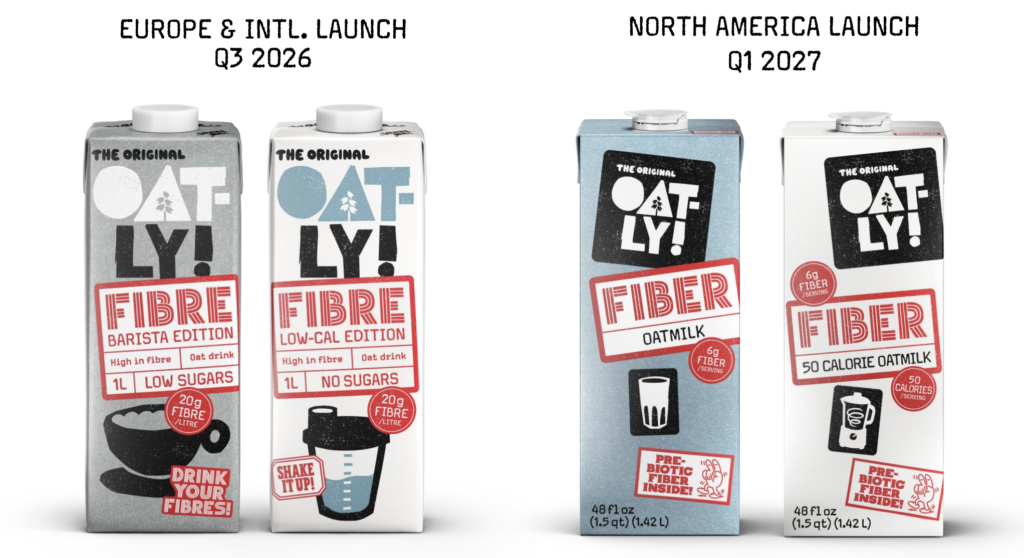
While many competitors race to add protein to the mix, Oatly is homing in on an often overlooked macronutrient: fibre. That formed the basis of the new high-fibre oat milk line, its most prominent product launch this quarter.
“As many populations consume less fibre than recommended by dietary guidelines, creating what we refer to as the ‘fibre gap’, our fibre platform is designed to offer consumers a convenient and delicious way to incorporate more fibre into their everyday diets,” Flatin explained.
The Nasdaq-listed company entered this space with barista and low-calorie oat milks delivering 5g of fibre per 250ml serving, thanks to the addition of chicory and soluble corn fibre. The range debuted in Europe through the UK, the Netherlands, Sweden, Belgium, France, Germany, Austria, and others, and is set to be available in 11 markets across the continent by the end of the year.
Oatly COO Daniel Ordoñez noted how the low-cal claim is “highly relevant for the world of wellness, fitness, and sports”. While the company has been resistant to adding protein to its lineup, he nodded to this trend, too, saying: “Oatly fibre can also be combined with protein powder, bringing fibre and protein together in a creamy and convenient format, making for a versatile base for shakes and other functional beverages.”
It’s a response to the fact that most Europeans fall short of the recommendation to consume 30g of fibre a day. That is true for Americans, too, which is why Oatly is bringing the two fibre oat milks to North America in January 2027, where they’ll be sold in 48oz packs.
“We see consumer demand for fibre on the verge of a multi-year acceleration, and internet search data indicate fibre is already closing the gap with protein. Fuelled by the growing use of GLP-1 medications, consumers are increasingly scrutinising the quality and quantity of nutrients, and we expect these structural tailwinds to drive fibre demand,” Ordoñez said.
“We expect Oatly to be among the leaders in reducing the fibre gap through taste and our expertise in oat processing, which is an important part of our approach to developing fibre-focused products.”
Plus, he highlighted how the firm’s new cold foam barista milk represents one of the “strongest trends” in the out-of-home sector, particularly among younger demographics. The product is “specially designed for out-of-home professionals and suitable for hot and iced drinks, cold beverages, and cocktails”. And as with the fibre range, the company intends to “develop it into a full global platform at speed”.
“What we hear from consumers today is that we are a choice, and we are really moving away from this binary ‘dairy versus plant-based’ debate. And we are really, really moving into what’s the right flavour, texture, performance, and nutrition for what people drink,” said Ordoñez. “We are not stopping until we’ll become the world’s culturally favoured drink. That’s what we are seeing in building a beverage company.”