By Autumn Demberger, AgInvesting Media
If there’s one topic that remains top of mind for those in the ag space, it’s natural capital—the world’s stock of natural assets that combine to yield goods and ecosystem services essential for human life and economic activity.
“Natural capital gives people the essential means for life. It supports society and the economy,” said Antonio Curia, founder and managing partner at Mieli Capital in London. “The inclusion of Natural Capital within our [Mieli Capital] Real Assets expertise reflects our commitment to addressing both traditional and emerging themes that are shaping the future of investing.”
Curia, along with a panel of experts, will be speaking at the upcoming Global AgInvesting Europe 2026 event. During the conversation, “Setting Expectations for Natural Capital in an Institutional Portfolio,” Curia and team will expand on natural capital’s role today, its increasing institutional demand, and the opportunities and challenges ahead. Here’s a look at what attendees can expect to hear.
Global AgInvesting: To get us started, tell me a little bit more about you and your role. How did you find yourself working in the agribusiness sector?
Antonio Curia: As Head of the Family Office, a key aspect of my role is to provide clients with a comprehensive and informed perspective on the Firm’s extensive expertise across Real Assets. Within this framework, Natural Capital represents a strategically important component of our broader investment and research capabilities.
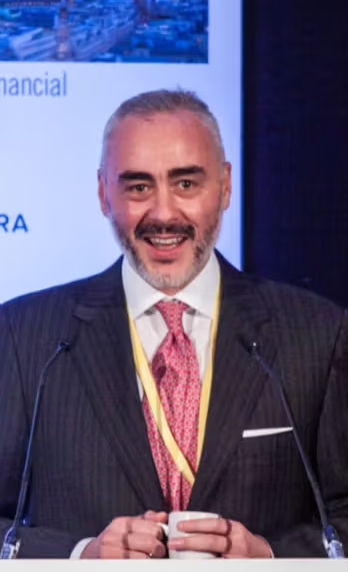
Our approach goes beyond traditional asset allocation by delivering both macroeconomic and microeconomic insights across global markets, to help the private clientele in better informed decision taking. We combine top-down analysis of economic, geopolitical, regulatory, and market trends with bottom-up sector expertise, enabling private clients to develop a deeper understanding of the forces shaping investment opportunities and risks. Through direct engagement with leading industry specialists, subject-matter experts, fund managers, and thought leaders, we offer independent perspectives and specialist knowledge across the Real Assets spectrum, including Natural Capital, Infrastructure, Real Estate, and other alternative investment sectors. This allows us to translate complex market developments into actionable intelligence that is relevant to the needs of sophisticated private investors and family offices.
GAI: You will be speaking on a panel at GAI Europe on natural capital. Why is this an important topic for European audiences? What is happening today that gets you excited to speak on it?
AC: We continue to believe that providing both access to and education around the Natural Capital asset class is highly relevant and increasingly important for sophisticated private investors. Natural capital gives people the essential means for life. It supports society and the economy. As part of our broader Real Assets expertise, we approach this sector through two distinct but complementary themes: agribusiness and forestry.
On the agribusiness side, we focus on opportunities that benefit from long-term structural trends, including population growth, food security, resource scarcity, and the increasing demand for sustainable production practices, we are working with a player in Brazil that just does organic/bio plantation.
I’ve just spent 45 days in Brazil myself. Within forestry, we see a compelling combination of attractive investment characteristics, environmental stewardship, and long-term value creation.
We are currently involved in an exciting new project in Brazil, where we play an active role in a large-scale reforestation initiative within the Atlantic Forest (Mata Atlântica) ecosystem. This project represents a particularly compelling opportunity as it seeks to deliver both financial returns and meaningful environmental benefits. Beyond its investment merits, the initiative contributes to biodiversity restoration, carbon sequestration, and the regeneration of one of the world’s most important and threatened natural habitats. We believe such investments are becoming increasingly relevant in light of the profound environmental and climate-related challenges facing the global economy.
As investors and stewards of capital, there is a growing recognition that financial objectives and positive environmental outcomes can coexist. Supporting projects that contribute to ecological restoration while generating attractive risk-adjusted returns enables investors to participate in solutions that address some of today’s most pressing sustainability concerns. In addition, we are supporting a leading forestry operator in Northern Brazil that manages and develops a forestry platform in excess of 100,000 hectares. This large-scale operation provides exposure to a strategically important sector benefiting from growing global demand for sustainable timber and forestry products, while also contributing to responsible land management/ restoration of land and broader environmental objectives. Through these initiatives, we aim to provide our private clientele not only with access to high-quality investment opportunities, but also with a deeper understanding of the role Natural Capital can play within a diversified portfolio. We view the asset class as an increasingly important component of long-term investment strategies, offering the potential to combine attractive economic returns with measurable environmental and social impact.
Europe is increasingly experiencing the direct and measurable consequences of climate change across both the agricultural and forestry sectors. The severe wildfires that affected large parts of Southern Europe during the most recent summer provide a compelling illustration of the challenges facing natural ecosystems, local communities, and economic activity. These events highlight the growing vulnerability of natural resources to changing climatic conditions and reinforce the need for long-term, sustainable solutions. In this context, climate resilience and sustainability have become central considerations for professional investors rather than optional themes. The ability of investments to withstand environmental, regulatory, and economic pressures is increasingly recognised as a key determinant of long-term value creation and risk management.
As climate-related events become more frequent and severe, investors are placing greater emphasis on strategies that contribute to the protection, restoration, and sustainable management of natural capital. We believe that investments in forestry, reforestation, and sustainable land management can play a meaningful role in enhancing climate resilience. Well-managed natural capital assets not only have the potential to generate attractive long-term financial returns but also contribute to carbon sequestration, biodiversity preservation, soil regeneration, water-resource protection, and ecosystem restoration.
These characteristics make them particularly relevant in an era where environmental sustainability and economic performance are becoming increasingly interconnected. Furthermore, the transition towards a more sustainable global economy is creating significant opportunities for investors to support solutions that address pressing climate challenges while participating in long-term structural growth trends.
By allocating capital to projects that promote ecological restoration and responsible stewardship of natural resources, investors can contribute to building more resilient landscapes and communities while aligning their portfolios with the principles of sustainable investing. We view Natural Capital as an asset class that sits at the intersection of financial returns, environmental responsibility, and climate resilience.
As awareness of sustainability challenges continues to grow, we believe it is essential to bring these discussions to the forefront of professional investment conversations. Through carefully selected investments in forestry, agriculture, and ecosystem restoration, we seek to provide our clients with opportunities that combine long-term value creation with a tangible and positive contribution to the resilience and sustainability of our planet.
GAI: What are one or two opportunities and/or challenges facing investors today around natural capital?
AC: In terms of opportunities, there is 1) working landscapes & regenerative agriculture and 2) tightening carbon & biodiversity markets.
For challenges, first there’s regulatory & metric uncertainty: investors face persistent barriers due to shifting disclosure standards, complex valuation frameworks, and high perceived risks or liquidity constraints. Then under-capitalization & geographic gaps: Investment remains fragmented, with less than 2% of global climate finance directed to nature-based solutions, and critical ecological regions like Africa and Asia remaining severely underfunded. A third is uneven confidence: Long-term economic sense is widely acknowledged, but confidence in exact return delivery mechanisms and standardized monitoring tools remains uneven across markets.
GAI: What trends are you watching in this area and why?
AC: One of the most significant long-term themes we continue to monitor and analyse is climate change, which we believe will remain a defining investment trend for decades to come.
Beyond its environmental implications, climate change is increasingly influencing economic activity, regulatory frameworks, capital allocation decisions, and the long-term resilience of industries and asset classes worldwide.
Within this broader theme, our primary areas of focus are biodiversity preservation, sustainable land management, and ecosystem restoration. We view these as critical components of the transition towards a more sustainable and resilient global economy. As awareness grows around the degradation of natural ecosystems, the loss of biodiversity, and the increasing frequency of extreme weather events, investors are recognising that natural capital is not only an environmental consideration but also a strategic investment opportunity. Biodiversity is emerging as a key pillar of long-term sustainability. Healthy ecosystems provide essential services that underpin economic activity, including soil fertility, water regulation, carbon storage, and climate adaptation.
The protection and restoration of these ecosystems are therefore becoming increasingly important for governments, businesses, and investors alike. We believe that investments supporting biodiversity conservation and ecological restoration are well positioned to benefit from growing public and private sector commitments to environmental stewardship.
Equally important is the sustainable restoration and management of land resources. Across many regions of the world, agricultural land and forest ecosystems are facing mounting pressure from climate change, deforestation, soil degradation, and changing land-use patterns. Investments that promote reforestation, afforestation, regenerative agriculture, and responsible forestry practices have the potential to deliver measurable environmental outcomes while creating long-term economic value.
From an investment perspective, these themes are closely linked to climate resilience. Well-managed natural capital assets can contribute to carbon sequestration, biodiversity enhancement, watershed protection, and improved ecosystem health, while also providing exposure to long-term structural growth trends. As climate-related risks become increasingly material to investment portfolios, we believe that strategies focused on restoring and protecting natural assets will play an ever-greater role in portfolio construction and long-term wealth preservation.
For professional investors, the conversation around sustainability is no longer centred solely on compliance or responsible investing objectives. It is increasingly about identifying resilient investment opportunities that can generate attractive risk-adjusted returns while contributing positively to environmental and societal outcomes. The integration of biodiversity, sustainability, and land restoration into investment frameworks reflects a broader recognition that long-term financial performance and environmental resilience are becoming inextricably linked.
As a result, we continue to dedicate significant attention to these areas and themes, seeking opportunities that align capital with projects capable of generating both economic value and positive environmental impact. We believe that supporting biodiversity, restoring natural ecosystems, and promoting sustainable land management represent not only responsible investment principles but also compelling opportunities within a rapidly evolving global investment landscape.
GAI: What are one or two takeaways you hope attendees gain from your discussion at GAI Europe?
AC: Natural Capital is a key asset class that sits at the intersection of financial returns, environmental responsibility, and climate resilience and should be part of any long term portfolio.
Climate resilience and sustainability have become central considerations for professional investors rather than optional themes, even more nowadays.
Furthermore, the transition towards a more sustainable global economy is creating significant opportunities for investors to support solutions that address pressing climate challenges while participating in long-term structural growth trends.
To hear more from Curia and fellow panel members, register for GAI Europe 2026 today. To see the full agenda, visit here.
The content put forth by Global AgInvesting News and its parent company Arc Network LLC is intended to be used and must be used for informational purposes only. All information or other material herein is not to be construed as legal, tax, investment, financial, or other advice. Global AgInvesting and Arc Network LLC are not a fiduciary in any manner, and the reader assumes the sole responsibility of evaluating the merits and risks associated with the use of any information or other content on this site.