
The true climate impact of cow-derived leather is 70% higher than previously estimated, and more than 12 times that of vegan alternatives (including plastic-derived materials).
Leather is notorious for its environmental impact, generating more methane emissions than any other material used by the fashion industry. However, its true effect on the planet is vastly understated, according to a new study.
Researchers from Cornell University and New York University analysed life-cycle assessments of bovine leather and vegan alternatives, including plastic, plant-based or mycelium-derived versions.
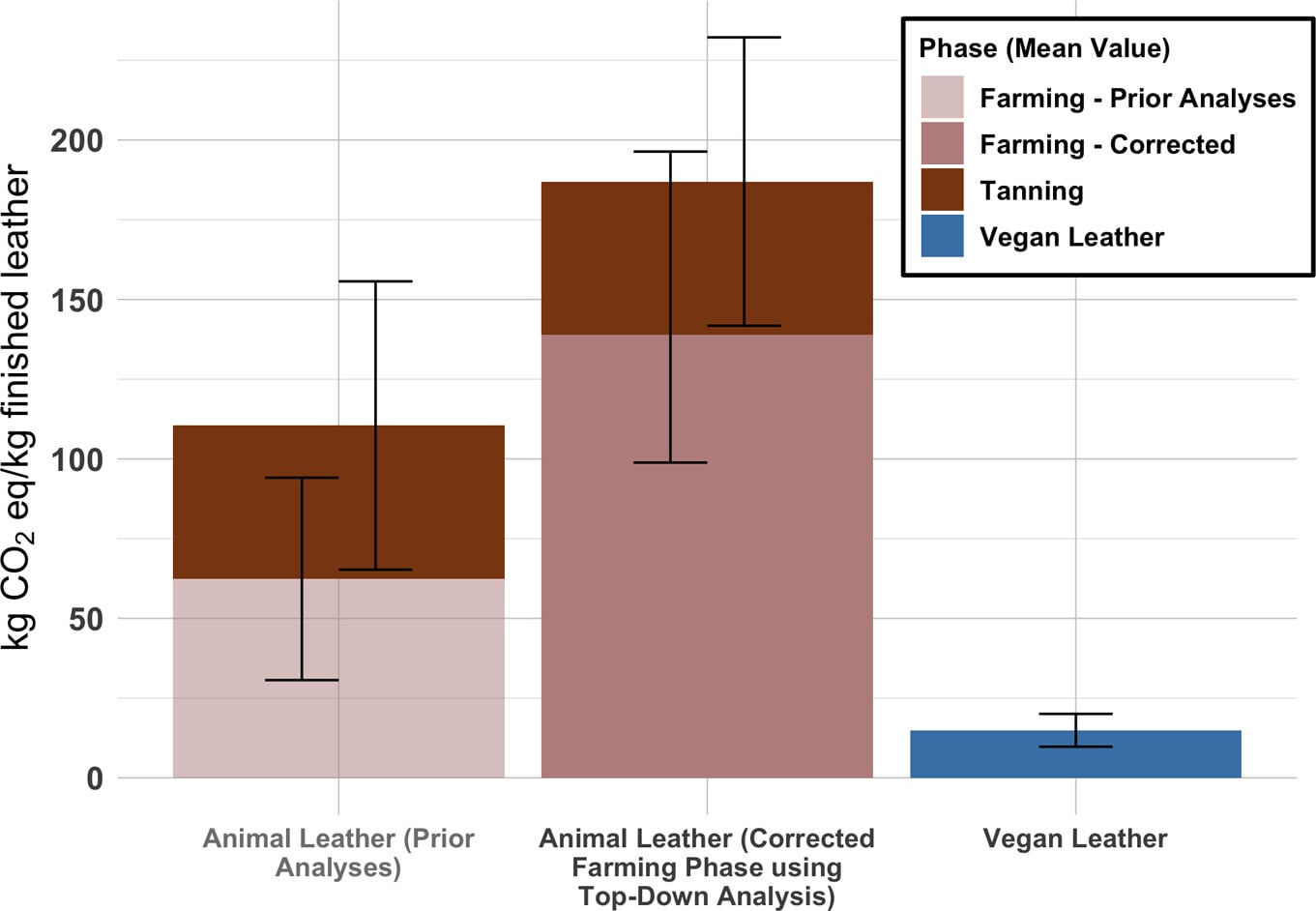
Adopting a top-down approach using data from the UN Food and Agriculture Organization and the economic allocation literature, they found that conventional leather’s greenhouse gas emissions are 70% higher than previous estimates.
Published in ACS Sustainable Chemistry & Engineering, the research revealed that cow-derived leather has a carbon footprint of 187kg of CO2e per kg of finished material, 12.5 times higher than that of vegan leather (15kg of CO2e).
In fact, even the highest-emitting vegan alternative has a footprint 54% lower than that of the average for the tanning phase of animal leather alone.
“Because bio-based leather alternatives have comparatively low emissions, this draws into question animal leather’s reputation as a ‘natural’ alternative to fossil-based textiles,” Matthew Hayek, a co-author of the study, said in a LinkedIn post.
Study debunks leather industry’s co-product claims
The paper found that estimates of tanning and finishing emissions differ significantly across regions, primarily due to differences in energy mix. High coal usage drives substantially higher emissions – India, for instance, reports 165.11kg of CO2e per kg of finished leather. In contrast, European tanning emissions are estimated at 18.6kg of CO2e.
It’s the farming phase that contributes most to leather’s climate impact, accounting for a 56% share across the studies analysed. Still, the footprint varies geographically. In Europe, on-farm leather emissions reach 101kg of CO2e; this falls to 75kg of CO2e in Canada and 27.4kg of CO2e in New Zealand.
Vegan leather’s emissions are in stark contrast, ranging from 6kg to 22kg of CO2e across alternatives made from mycelium, plastic, and a plastic-plant blend.
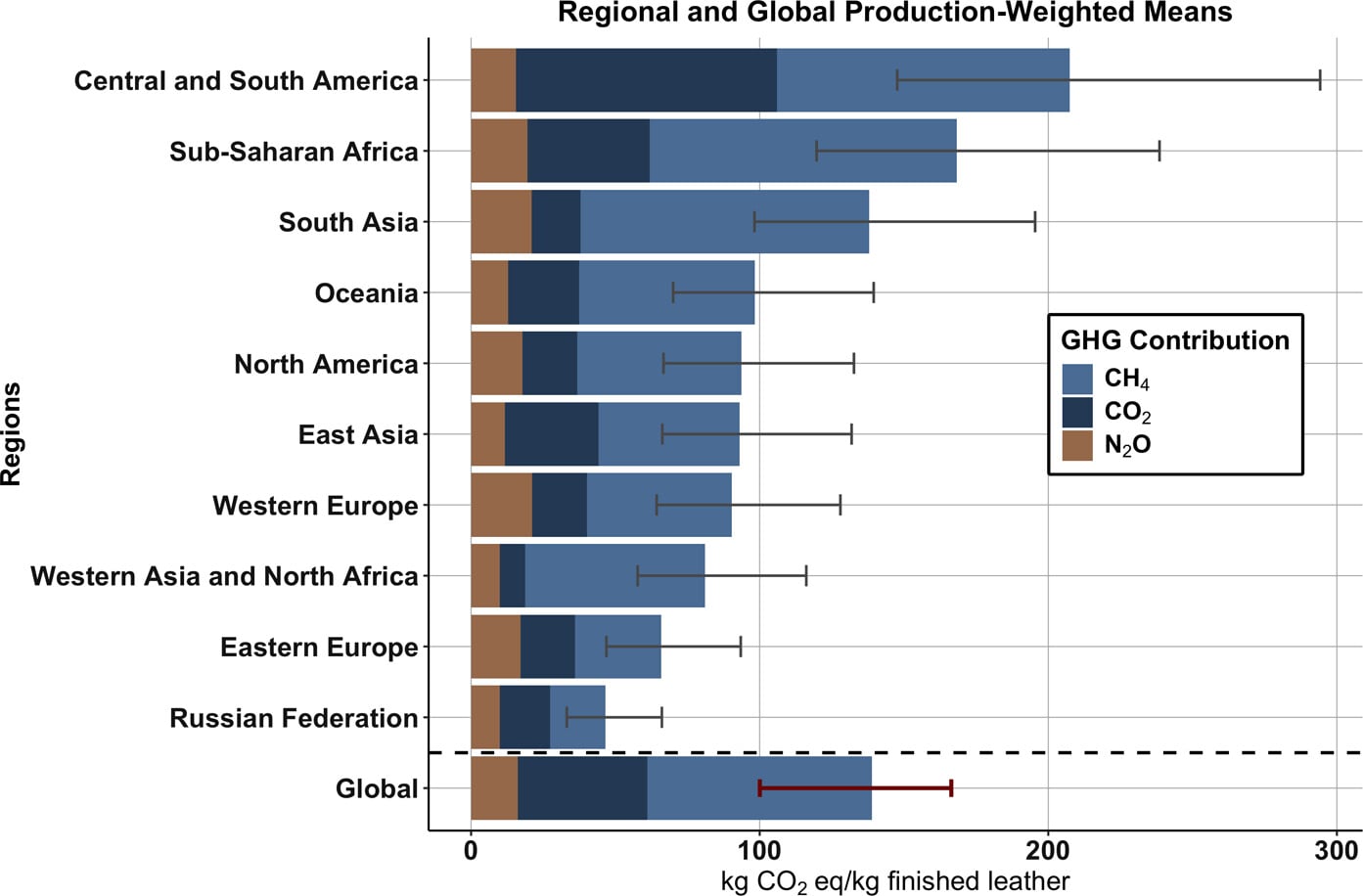
The top-down analysis shows that the Central and South America region has the highest GHG footprint for finished leather, at 207.5kg of CO2e per kg, and Russia ranks among the lowest with 47kg of CO2e. Sub-Saharan Africa has a mean of 168kg of CO2e per kg of finished leather, which falls to 81kg of CO2e for Western Asia and North Africa.
Many advocates of the conventional leather industry argue that the material is a co-product of the meat and dairy industries, so its climate footprint isn’t actually as high. This study debunks that idea, noting how turning hide into a usable product generates significant waste.
Producing 100 sq m (about 92kg) of finished leather generates around 200kg of non-biodegradable solid waste during the tanning phase. Moreover, the “assertion that 88% of impacts at the farming phase of leather must be allocated to dairy products fails to sufficiently consider that globally, the majority of leather is procured from cattle, which produce little to no milk for human consumption”.
“Hide prices, globally, are about 8% of the animal’s sale. That might not sound like a lot, but typical finishing operations and slaughterhouses operate on far smaller profit margins than that,” said Hayek.
Researchers call for greater investment in bio-based leather alternatives
Research has consistently shown that producing leather is an energy– and water-intensive process linked to deforestation and biodiversity loss, and it generates many hazardous chemicals during tanning, which are detrimental to human health.
The new study says tanning is essential to make the hide usable, but this process is “responsible for large amounts of chemically-laden waste”. And though vegetable tanning produces less harmful effluent than chrome-based processes, it can come with trade-offs in supply chain efficiency and functional properties.
“Vegetable tanning requires months of processing while chrome tanning can be completed in minutes, which makes vegetable tanning less efficient with respect to energy use, potentially increasing GHG emissions in certain cases, while chrome tanning can be more time- and cost-effective in manufacturing on a large scale,” the study notes.
“Leather has a ‘natural’ or environmentally friendly reputation and public perception. This may in part be a response to effective leather industry sustainability marketing, as the leather industry frequently communicates that leather contributes to waste reduction by processing animal hides that would otherwise be wasted, allegedly removing greenhouse gas emissions by sparing materials from landfills.”
Last year, one estimate suggested that the fashion industry generates 8.3 million tonnes of methane annually, and that leather alone accounts for 54% of this. The main source of its methane output is enteric fermentation, the process by which methane is released when cows and sheep belch and pass gas.
That report also pointed out that bio-based alternatives are much more eco-friendly. Uncaged Innovations‘s grain-based leather, for example, has a 97% lower GHG footprint than the conventional counterpart, and MycoWorks‘s mycelium material has a 98% lower impact.

Plastic-derived alternatives are still controversial, thanks to issues like “non-renewability, environmental contamination, and disposal”, as the latest study points out. Many animal leathers use fossil-derived synthetic tannins and thermoplastic coatings. The researchers added that novel bio-based leather products “continue to be developed and improved upon”.
“Vegan leather emits much less still than the farming stage of animal production for leather, even when empirically accounting for the fact that meat and dairy products represent most of the commercial value (and economically allocated emissions) of cattle production, while the hides represent a smaller but still meaningful proportion,” the study concluded.
“While options for bio-based leather alternatives are currently sparse, they are growing. Based on our results, we recommend that companies invest in sustainable, bio-based alternatives to conventional animal leather,” said Hayek.