
Protein Protects Against Tau Tangles, Synaptic Loss in Mouse Model of Tauopathy
Alzheimer’s disease (AD) and many other forms of neurodegeneration share a common culprit. In these diseases, tau proteins that normally stabilize neuronal microtubule filaments within nervous system networks instead form noxious knots and gradually disrupt the circuits they would otherwise preserve.
Scientists at Sanford Burnham Prebys have now shown that a different protein known as SORLA offers protection against the effects of these lethal loops. The results of the researcher’s’ study in mice suggests that future research may yield new treatments capable of boosting this protein’s ability to defend the brain.
Timothy Huang, PhD, assistant professor in the Center for Neurologic Diseases at Sanford Burnham Prebys, is senior and corresponding author of the team’s published paper in Science Advances, titled “SORLA up-regulation suppresses pathological effects in aged tauopathy mouse brain,” in which they concluded “These findings reveal a protective role for SORLA in multiple aspects of tauopathy pathogenesis and highlight its potential as a therapeutic target.”
Normally, tau proteins are found throughout the brain and nervous system, helping to maintain the shape and structure of our neuronal wiring. But in certain diseases, including Alzheimer’s disease, tau proteins clump together inside nerve cells, forming what are known as tau tangles. These toxic tangles are linked to cognitive impairment and nerve cell death in diseases known as tauopathies. “In AD, amyloid-β (Aβ) plaques and neurofibrillary tangles (NFTs) comprising hyperphosphorylated tau accumulate in brain,” the authors explained.
The new study focused on the safeguarding capabilities of protein known as SORLA. “A role for the trafficking receptor SORLA (Sortilin-related receptor containing LDLR class A repeats) in reducing Aβ levels has been well established,” the investigators continued. “… however, relatively little is known with respect to whether and how SORLA can potentially affect tau pathology in vivo.”
Timothy Huang added, “In the last 15 or 20 years, considerable data has come out from our lab and other groups showing that SORLA can suppress one of the hallmarks of Alzheimer’s disease—amyloid-beta generation and accumulation. Very little was known, however, about whether SORLA affected the tau tangles reflected on the other side of the coin in Alzheimer’s disease.”
SORLA is expressed in both neurons and glia in mouse and human brain, the authors noted. For their newly reported study the team began by crossbreeding mice that produce extra human SORLA protein, with PS19 (P301S) mice that develop tau tangles, brain atrophy and cognitive deficits. This new mouse model enabled experiments to determine SORLA’s effects on tau protein buildup and its resulting harms.
Their studies showed that an overabundance of SORLA protein protected against a number of biological processes linked to the formation of tau tangles and progression of neurodegeneration. These include reducing the addition of too many phosphate groups to tau—known as hyperphosphorylation—and the ability of misshapen tau to serve as “seeds” that attract more tau and form clumps. This protection also extended to preservation of the synapses at the junction between neurons and the brain’s ability to adjust these connection points—which is called synaptic plasticity. “Using complementary approaches, we show that SORLA overexpression attenuates ventricular enlargement, tau phosphorylation and seeding, synaptic loss, impaired synaptic plasticity, and glial hyperactivation in the PS19 mouse brains,” the team wrote in summary.
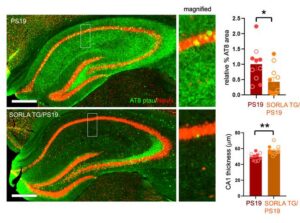
“When you upregulate SORLA, you can suppress the negative effects found in tauopathies,” said first author Huijie Huang, PhD, a staff scientist in the Huang lab at Sanford Burnham Prebys. “We found there was less brain atrophy and less tau accumulation, which was very exciting to see.”
Because some people have mutations that disable the gene carrying the code for SORLA, Sorl1, the scientists wanted to compare the outcome of having extra SORLA to having none of it at all. Tests of mice genetically modified to lack Sorl1 told a very different story. “The opposite turned out to be true when we deleted the ability to produce SORLA proteins,” said Timothy Huang. “A lack of SORLA exacerbated the harmful effects observed in tauopathies.”
To address how extra SORLA or a lack of SORLA were either ameliorating or aggravating diseases featuring tau tangles, the research team used a combination of sequencing techniques capturing the levels of all proteins and gene expression in each cell, as well as mapping the spatial relationship of RNA and proteins within brain tissue. The scientists found that upregulated SORLA prevented problematic protein production changes in the synapses between neurons while also suppressing other drivers of tauopathy disease progression. They also observed that extra SORLA tamped down on disease-related gene expression patterns in brain cells known as glial cells that support and protect neurons in many ways. “One particularly notable finding that we can build on is the upregulation of a member of the plexin-B family of receptors in the absence of SORLA,” said Huijie Huang.
“There are unique drugs that can target this class of receptors that we may be able to apply to tau-related dementia disorders,” suggested Tim Huang. “One potential future direction is to repurpose these drugs to target overactivation of glial cells and perhaps reverse some of the phenotypes in tauopathies.”
The scientists also want to better understand what happens in each individual cell type when they upregulate or downregulate SORLA. “While it is not possible to specifically determine how cell-specific modulation of SORLA can affect tau using the global transgenic overexpression/deletion models used here, we are interested in further characterizing specific effects of SORLA on tau in neurons, and the extent of SORLA modulation on glia in influencing overall tau pathology,” they stated. The team plans to graft human neurons or glial cells into the mouse brain to study the effects of different SORLA mutations.
“Mouse cells and human cells are different,” said Tim Huang. “Because we’re looking at human disease, it’s more informative if we can observe the modulation and dysfunction of SORLA in the context of a human cell inside of a diseased brain environment.”
This continued research will reveal more knowledge about the ability of SORLA to safeguard against the toxic effects of tau tangles, and how to develop new treatments or repurpose existing therapies to benefit patients suffering from Alzheimer’s disease and other tau-related dementia disorders.