
A new analysis suggests that plant-based meat and legumes in India can deliver comparable or higher bioavailable protein than meat, opening up a new opportunity for plant protein manufacturers.
As India’s population grapples with protein deficiency and weighs up the benefits of plant-based sources, a major analysis makes the case for greater adoption of the latter to tackle the former.
Researchers from the Good Food Institute (GFI) India and the CSIR-Institute of Himalayan Bioresource Technology (CSIR-IHBT) set out to examine the protein quality and bioavailability of Indigenous crops like millets and pulses, as well as plant-based meat products, in India.
They found that meat alternatives available in this market can deliver comparable or higher absorbable protein than animal-derived versions.
Further, the findings suggest that processing doesn’t inherently compromise protein quality, but can “substantially alter protein solubility, digestion, and the fraction potentially available for absorption, without corresponding changes in total protein content”.
“By building a stronger evidence base on protein quality in foods consumed, we can support better-informed product development and future nutrition assessment,” said co-author Padma Ishwarya, a senior scientist at GFI India. “India’s plant-based sector also can benefit from marketing nutrition claims beyond just grams of protein.”
Cooking and pre-processed proteins give plant-based meat a boost
The report found that wet fractionation results in higher protein concentration and bioavailable fraction for nutrition-focused applications, and dry fractionation better preserves solubility and can support functionality-driven, clean-label applications.
And cooking either increases or retains the bioavailable fractions of protein in plant-based meats, while reducing it in certain conventional meat products. This is because cooking can unfold proteins and reorganise the surrounding matrix, and in products made from hydrated textured proteins or protein granules, frying can disrupt the structured network and increase accessibility of digestive enzymes.
The use of protein concentrates that have undergone prior processing and partial structural modification can cause protein unfolding, disrupt native cellular structures, and inactivate or reduce anti-nutritional factors, potentially increasing enzyme accessibility and enhancing protein digestibility in vegan meat alternatives.
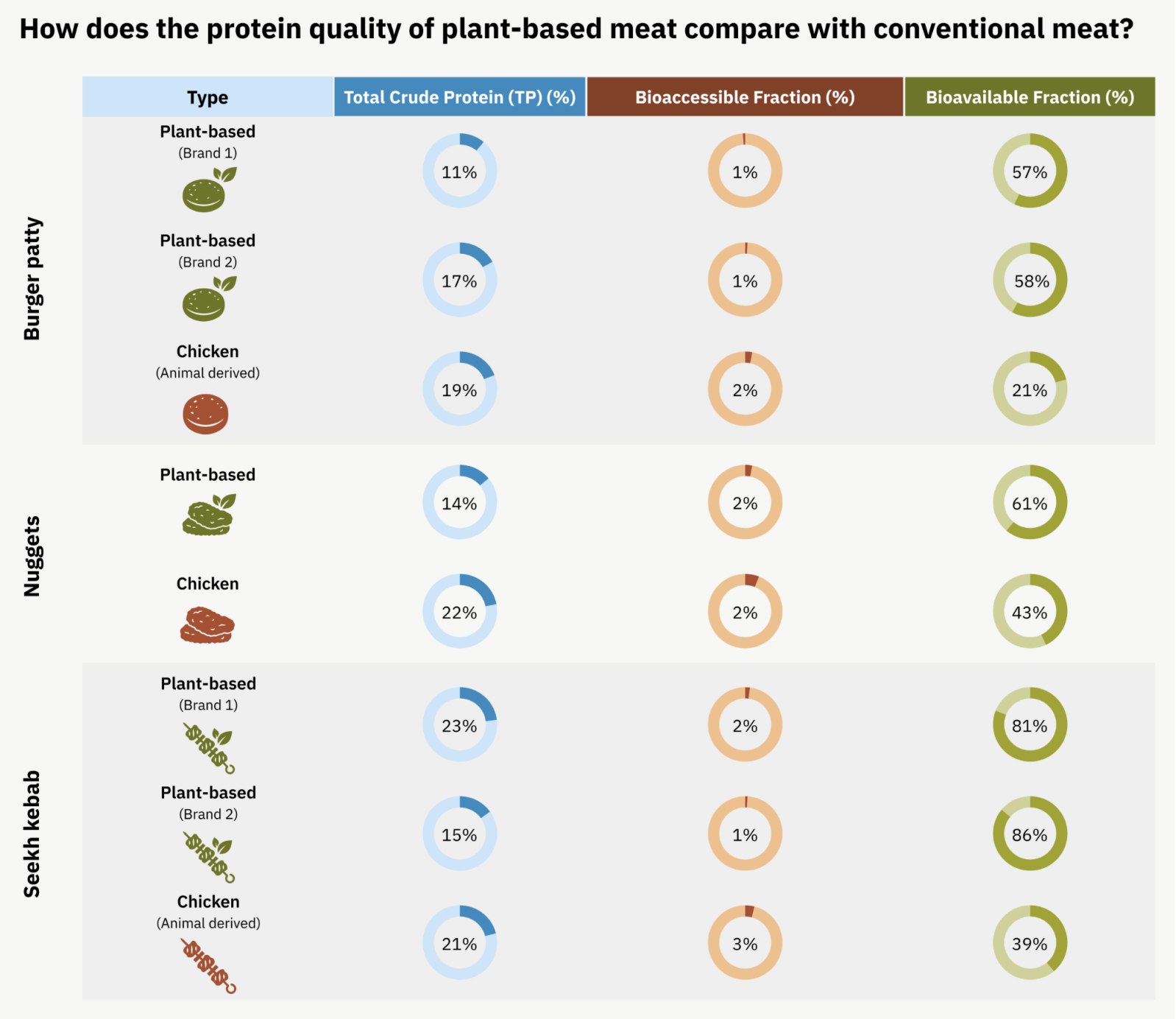
The researchers tested five commercially available plant-based meats against conventional counterparts. After cooking, two plant-based seekh kebabs recorded 81% and 86% bioavailability, compared to 39% for those made with chicken.
Likewise, despite beef burgers containing more crude protein (19%) after cooking than two plant-based patties (11-17%), the former’s protein bioavailability stood at just 21%, in contrast to 57-58% for the meat-free products. A similar pattern occurred with vegan nuggets, which contained 61% bioavailable protein, versus 43% for a chicken-derived version.
The optimal processing approach, for its part, varies from crop to crop, and depends on the specific factors limiting protein digestion and the mechanism by which processing mitigates these barriers.
Biological processing, for instance, shows promise for millets, with sprouting and fermentation boosting the bioavailable fraction. And pulses benefit from both thermal and biological processing, as pressure cooking enhances the bioavailable fraction in chickpeas and cowpeas, and fermentation performs favourably across the board.
How manufacturers and policy support can fill the protein gap
Research indicates a protein deficit in India, with one survey suggesting that 73% of citizens don’t get enough of the nutrient. Shantanu Das, VP and head of science at conglomerate ITC, offered a more nuanced picture. “India meets the requirement of over 50g of protein but accounting for digestibility, it is less than 40% of what we need,” he said.
The country’s per capita protein consumption is set to triple from 9.5kg in 2025 to 30kg in 2070. And a 2025 poll showed that 37% of Indians want to add more plant proteins to their diets, and a greater share want to increase their protein intake from plant-based sources than from animal products.
However, as CSIR-IHBT director Sudesh Kumar Yadav noted, India imports the majority of its plant protein concentrates and isolates, despite being the world’s largest producer of millets and pulses. “There is a strong need to generate robust scientific evidence to position Indigenous crops for meaningful nutritional outcomes,” he said.
In India, nearly 50% of dietary protein intake comes from cereals with incomplete amino acid profiles, so considering quantity alone is no longer enough. For manufacturers, advancing protein optimisation from a compositional target to a “whole-product design strategy” is crucial, the report stated.
Nutritional design targets should incorporate amino acid quality, digestibility and bioavailability to inform product development, and considerations of cost, sensory performance, ingredient availability, and processing yields can translate nutritional improvements into affordable and scalable products.
Product development should also account for the cooking and preparation methods consumers are most likely to follow, while validated protein quality metrics, like essential amino acid scores and measures of protein digestibility or bioavailability, could be included in the certificate of analysis of protein ingredients.
These efforts could be furthered by greater public R&D and translational funding to support crop screening, protein fractionation, processing optimisation and scale-up of local protein-rich crops, as well as the establishment of government-funded programmes to consider plant protein quality, anti-nutritional factors and nutritional performance after processing.
In fact, targeted studies could evaluate promising Indigenous crops and products under realistic recipes, cooking conditions and serving contexts, and procurement frameworks could incorporate protein quality and nutritional value alongside protein quantity. Moreover, public institutions could support the development of a guidance document translating general regulatory requirements into practical guidance for manufacturers.