Californian startup Savor, known for its carbon-derived fats, has teamed up with Helios AI to quantify the climate risks of conventional fats and oils and give its customers a clearer reason to choose its alternatives.
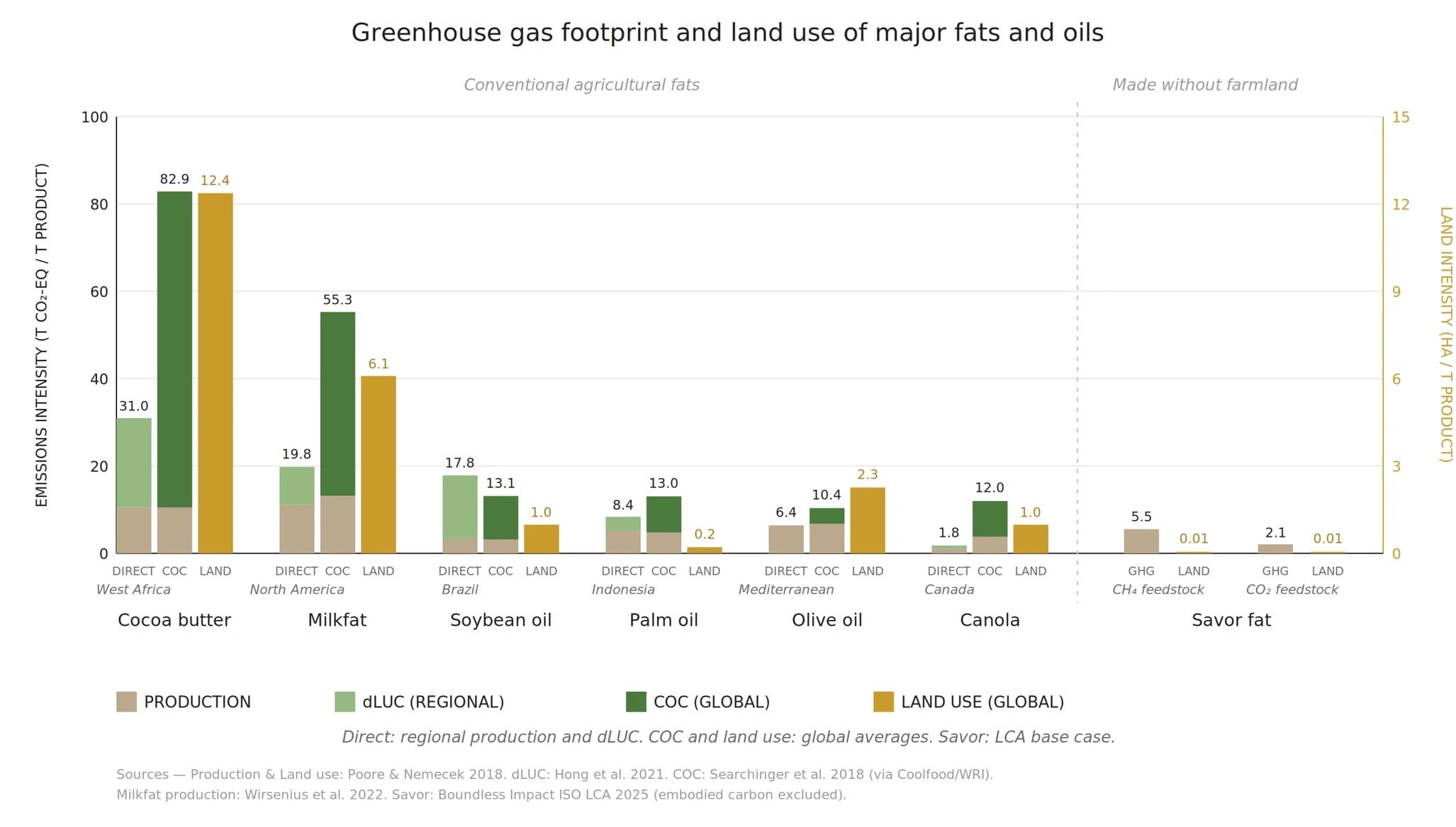
In August, US startup Savor published the results of a third-party life-cycle assessment, which found that its carbon-derived fats can lower emissions by 50-98%, depending on the lipid they’re replacing and the carbon source they’re using.
Now, the company is hoping to use these sustainability credentials to help manufacturers get a clearer view of the climate risks associated with conventional fats like palm oil.
To do so, it has teamed up with Helios AI, a commodity intelligence platform that pairs climate and price forecasting, to quantify the true environmental threats to incumbent fat and oil supply chains.
“For a long time, the cost of a chocolate bar or a croissant has depended on the weather in a handful of places most consumers will never see,” said Savor co-founder and CEO Kathleen Alexander. “Helios AI gives food companies an early, specific read on that exposure and our job is to give them a supply that isn’t exposed to it in the first place.”
El Niño to damage palm and cocoa supply chains further in 2027
Savor employs a thermochemical process to convert point-captured carbon, green hydrogen, and methane into climate-friendly short-, medium-, and long-chain triglycerides to replace incumbent fats and oils in food and cosmetic applications.
Its first product, EcoButter, has been self-affirmed as Generally Recognized as Safe (GRAS) in the US and appears in baked treats and confections at establishments in San Francisco. It can lower greenhouse gas emissions by over 80% compared to conventional milkfat, using over 800 times less land and 10 times less water.
And earlier this year, the startup also launched a beauty and personal division with four ingredients targeting carbon-intensive tropical fats like palm oil.
These alternatives tackle a fickle supply chain. Just two countries supply roughly 87% of the world’s traded palm oil, and two others are responsible for nearly two-thirds of the world’s cocoa. When a supply base is this concentrated, a single dry season can become dramatically more destructive to manufacturers.
That has been proven over the last five years. Helios AI’s data found that cocoa prices rose sixfold between mid-2022 and the end of 2024, while crude palm oil is up by 54% since 2023 and palm kernel oil (used in coatings and fillings) has more than doubled.
And although cocoa prices have fallen by around 50% from their peak and palm has steadied, the climate risk behind the previous surge hasn’t quietened. The ongoing “super” El Niño is set to peak between November and January. Since oil palm and cocoa are tree crops that lag the weather by nearly a year, the damage from this peak will land in the 2027 harvest.
Plus, the underlying pressure will run for the rest of the decade, as trees age, replanting falls off, suitable growing land shrinks, and supply bases run out of room to absorb shocks. Helios AI’s forecasts suggest no return to pre-2022 prices anywhere on the horizon it models.
Savor offers fat alternatives friendlier – and more resilient – to climate change
The partnership between Savor and Helios AI pairs the former’s agriculture-free fats with the latter’s climate, price and supply disruption forecasts to show food companies exactly how risky each commodity is by region and timeline and offer them a truly greener alternative to avoid these shocks.
Savor will use Helios AI’s intelligence to quantify these risks and help its partners bring that evidence into their resilience planning. Companies using its fat alternatives will benefit from earlier warnings about where their fat supply is most exposed, and the option to shift that volume to a source priced on process instead of weather.
This will also help move the food industry towards a supply chain that remains affordable and dependable while taking fewer resources from the planet, which is a joint aim for both these companies.
“Our work is turning climate complexity into supply chain foresight, showing food companies where the system is under strain before it reaches their shelves,” said Francisco Martin-Rayo, co-founder and CEO of Helios AI. “Savor is building one of the answers to that strain. Pairing our intelligence with their approach puts the risk and the response in front of buyers in one place.”
Savor has secured $65M to date, with investors including Bill Gates, with $32M of this coming in a funding round earlier this year, with which it’s scaling up production from a few tonnes to a couple hundred per year.
Among the investors in that latest financing effort was Swedish specialty fats leader AAK, which has struck a two-year joint development agreement to commercialise the startup’s fats for use in dairy alternatives and baked goods. Savor eventually plans to raise a Series B round to build a 10,000-tonne facility.
It is among several food tech firms looking to decarbonise fats for the food and cosmetics industries, including Äio, C16 Biosciences, Nourish Ingredients, Clean Food Group, Melt&Marble, NoPalm Ingredients, Sun Bear Biofuture, Terra Oleo, and MicroLub.