
54
Some ideas are born out of frustration, while others out of necessity. For Cubeseed Africa, it was both.
Before it was a company, it was a problem Elohor Rita Ebieroma lived through firsthand. As a broiler farmer in Nigeria, she knew what it meant to raise healthy birds and still struggled to sell them at a fair price.
But the instinct to fix that problem didn’t come from farming alone. Elohor had spent years working in companies like Jumia and M-KOPA. During those moments, she built systems where data, performance, and revenue are tightly linked.
Today, as Chief Product Officer and Co-founder at Cubeseed Africa, that background shows up in how the company was built. Not just as a marketplace, but as a product with the same execution discipline developed through years in tech.
Why Execution Beats Ideas
Getting into the market early was, in Rita’s words, the single most important call Cubeseed Africa made. Elohor Rita Ebieroma built that call together with Chinonyelum Mbanefo, the company’s CEO, and Akeem Suara, its CTO. Featuring on the 50th episode of Agritech Founders Diary, Rita reeled out lessons on why agritech founders must avoid building products entirely on assumptions.
In her words, “Agricultural tech enables. It is not the tech itself that matters.” What matters is whether that technology solves an actual problem for the people it is built for.” Founders often assume farmers will pick up a new tool simply because it is well built from the jump. That assumption, she says, is where most agritech products stumble.

We are excited to share with you
This FREE E-Book of 50 Agritech Pioneers & Their Game Changing Innovations.
Download the Ebook now
The best market execution isn’t about having the most polished product on day one. Good market execution means getting into the market early, before it becomes saturated, and refining the product for both the farmers supplying and the buyers purchasing.
And that was what Cubeseed Africa did.
Prioritising Value for Farmer Technology Adoption
As Chief Product Officer, one of the biggest challenges Rita faced was watching the gap between what a team builds and what the reality of farmers are. You build the product expecting immediate uptake, and then reality shows up in small, telling ways.
Her answer to that gap is simple: go and see for yourself. Are farmers actually adapting to the product? That is the question to ask, more than whether the product itself is good. A team can build something genuinely useful and still find that farmers aren’t ready to pick it up, for reasons that have nothing to do with the product’s quality.
So, the need to go back to the market is crucial to understand the terms, rather than staying stuck on assumptions made in a boardroom.
Navigating Farmer Technology Adoption
For Rita, adoption alone won’t cut it, but building a system farmers can trust, one that solves their problems around protein prices, agricultural supplies, and the dozens of frictions between a farm and a market.
Agriculture, she points out, has never really been a production problem. It’s a supply problem, how the end user actually gets the produce, and how the farmer gets paid fairly for growing it.
Cubeseed’s answer is a network that connects bulk buyers and farmers directly, alongside a layer that gives both sides access to capital. Farmers get access to financing. Bulk buyers get access to capital to purchase produce on the platform. Both pieces exist because trust, cash flow and not just connection are intentionally implemented.
Challenges in Implementation
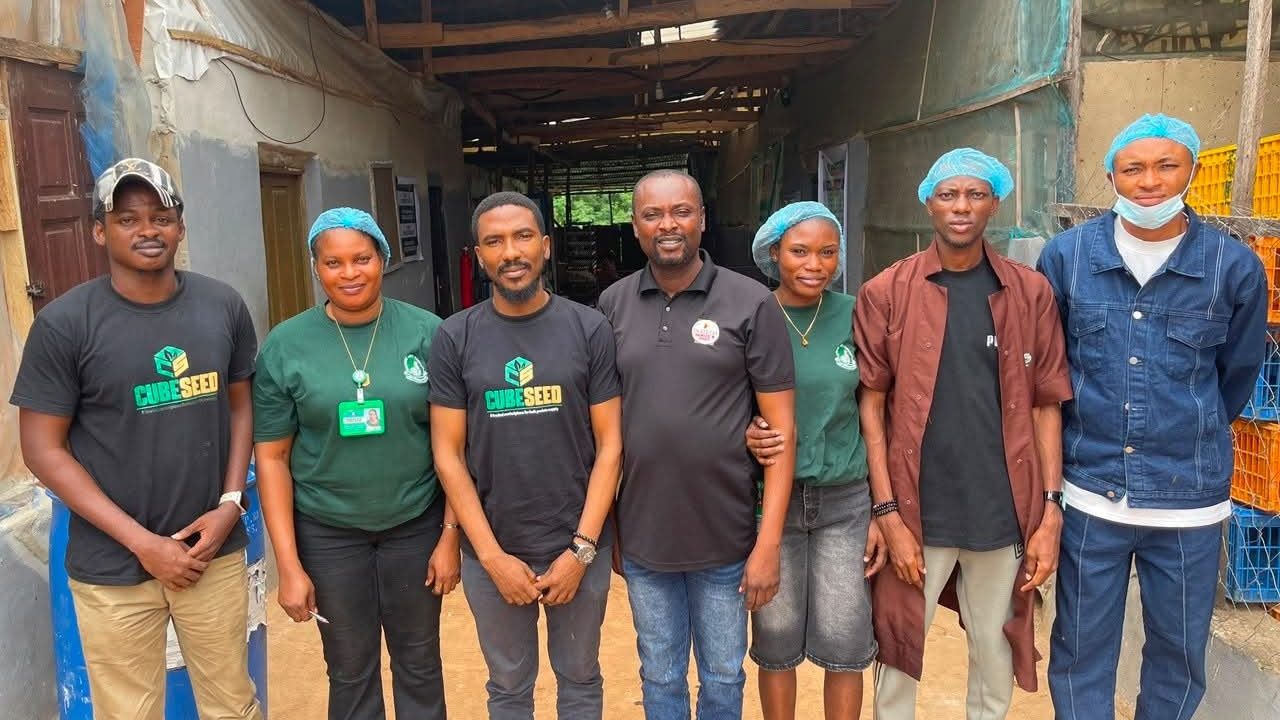
While narrating the experience, Rita recalled a humbling lesson from when Cubeseed partnered with the Lagos State Government to bring farmers together and connect them to financing.
The team discovered the trade was far more informal than they had assumed. Many of the farmers they wanted to onboard didn’t have the right documentation, and it had nothing to do with a lack of access to technology. The barrier was paperwork standing between farmers and the systems being built for them.
“We were building for the right people, but we weren’t building with what they actually had on ground,” Rita says. It’s a gap the team hadn’t anticipated at all.
Their fix was to go back to the drawing board. Too many compliance requirements upfront meant farmers abandoned the process before seeing the platform’s value. Cubeseed simplified the first stage of KYC, allowing farmers to onboard and experience the platform before gradually introducing the documentation needed to scale. That change reshaped how its systems work today.
Does Funding Solve or Amplify Business Problems?
Speaking about funding, Rita argued that funding doesn’t fix a business. It only magnifies whatever is already there.
Her advice to founders who get financed is to resist spending on things that feel important but aren’t essential. Things like hiring a large team before understanding where the actual bottleneck sits. If the real problem is field execution, hiring should go toward people who can be out with farmers, extension-style workers, rather than people who sit behind a desk.
Finance should be channelled first toward the people the solution is being built for.
Leveraging Bootstrapping, Grants and Smart Team Building
Before chasing outside capital, Rita’s advice to founders is to bootstrap first. Understanding your business with your own resources, or with grants and family funds, forces a discipline that outside funding can’t teach. It’s how a founder learns what the business actually needs, before scaling with someone else’s money or funding opportunities.

Image Source: Cubeseed Africa
Market understanding also shapes how Cubeseed approaches partnerships and team building. Partnerships can open doors that a founder cannot open alone, while the right team brings expertise and capacity the founders may not have. For Rita, the goal is not simply to add more people, but to bring in people who understand the market, can take ownership, and can help the business move faster.
Milestones
- Lagos Innovate Top Prize: Selected as the top startup from over 1,000 applicants.
- Lagos State Employment Trust Fund (LSETF) Partnership: Secured a strategic partnership with the Lagos State Government to run a ₦5 million cooperative broiler funding programme for local poultry farmers at a 9% interest rate.
- July 2026: Reached 120 active verified users trading through its data and escrow models.
More Than a Marketplace
Cubeseed Africa’s story is ultimately one of execution. From testing assumptions in the market to refining its onboarding process and responding to users behaviour, the company has grown by adapting and staying focused on the problem it set out to solve.
The company is still growing, but remains focused. Solving a structural problem in Africa’s livestock industry is no small task, but Cubeseed Africa has chosen to start with what it can solve, one part of the value chain at a time. And that may just be what it takes to make a mark.