
Legumes, tofu and tempeh are driving the resurgence of the UK’s plant-based protein sector, with conventional and vegan meat falling out of favour due to health and price concerns.
As meat prices continue to climb and vegan alternatives suffer from the ultra-processed tag, whole-food and minimally processed plant proteins are surging in the UK.
Madre Brava’s analysis of NielsenIQ data shows that, in the first half of 2026, unit sales of beans, pulses, tofu and tempeh grew by 7.3% compared to the same period a year ago, with value sales also up by 10.1%.
Plant-based meat alternatives, however, continued their slide with a 4.3% decline in units and 2.7% in value, though there was respite for mycoprotein (whose unit sales increased by 2.7%) and vegetable-led analogues like sausages and pies (+24.6% from a small base).
It’s not just vegan alternatives that suffered – sales of conventional meat products dipped by 1.8% during this period, according to Madre Brava’s review of Euromonitor International figures.
“Shoppers are not abandoning plant proteins – they’re shifting toward simpler, higher-fibre foods, whose prices are rising more slowly than food inflation, widening the price gap with meat. This indicates that, while food inflation and affordability remain key factors, nutrition and health benefits are also driving purchasing decisions,” the report noted.
Growth across budget and premium bean categories
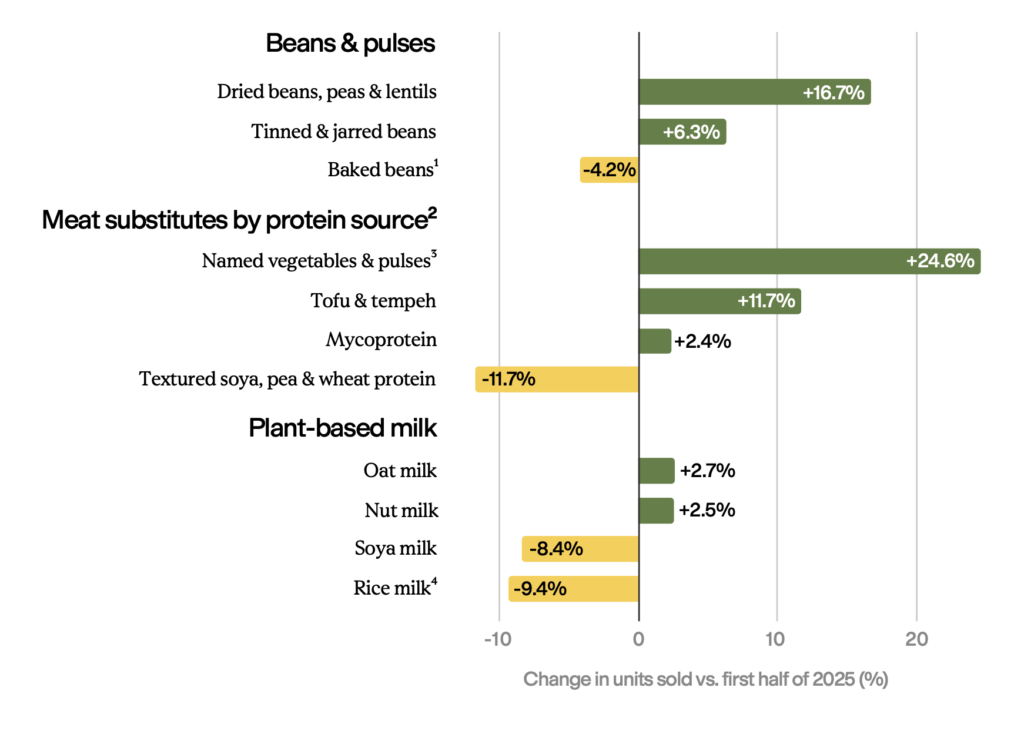
Within the traditional plant protein category, retailers sold 16.7% more units of dried beans, peas and lentils, with similar increases for canned and jarred beans (6.4%), tofu (7.2%), and tempeh (71.5%).
Textured vegetable proteins made from soy, wheat or pea experienced an 11.7% reduction in unit sales, while baked beans saw a 4.2% drop. The latter came as Brits switched from individual to multi-pack purchases, while the overall reduction came from beans that contained sausages or other processed meats.
While standard baked bean options declined in value, organic versions grew by 9.7% in unit sales. “These exemplify consumer shifts more generally, as shoppers seek healthier products, budget savings, and the success of ‘premium beans’ at the higher end of the market,” Madre Brava said.
Health may just be the top driver, considering that the bean category is expanding at both the budget and premium ends. For four of the six canned and jarred bean segments (including chickpeas and butter beans) that saw a hike in demand, the price per unit lifted faster than inflation, indicating that people are spending more on premium options in these categories.
Brits’ appetite for premium beans has been driven by the popularity of London-based Bold Bean Co, which has witnessed a year-on-year growth of 117% since its launch in 2021. Such has been its success, retailers have begun coming out with jarred beans under their own-label brands.
“The canned pulses category is undergoing a real transformation,” said Beth Latham, the brand’s head of category and strategic projects. “It was previously a dusty, highly commoditised aisle in the store that lacked innovation. However, over the last few years, the premium end of the category has reshaped how consumers think about beans, proving they are delicious and can be the hero of a meal.”
Chloe Mackean, food business transformation manager at the UK’s Food Foundation (whose Bang in Some Beans initiative aims to double national legume intake by 2028), said she wasn’t surprised to see beans’ ascendancy.
“Beans are a triple win for health, sustainability and our wallets. They are a healthy and affordable protein source, high in fibre and emit far fewer greenhouse gas emissions than animal protein,” she pointed out. “But beans are also tasty, and it is thanks to brands like Bold Bean Co, who pepper social media with photos of delicious bean recipes, that have helped to change people’s perception.”
Oat milk dominates as supermarkets urged to embrace plant proteins
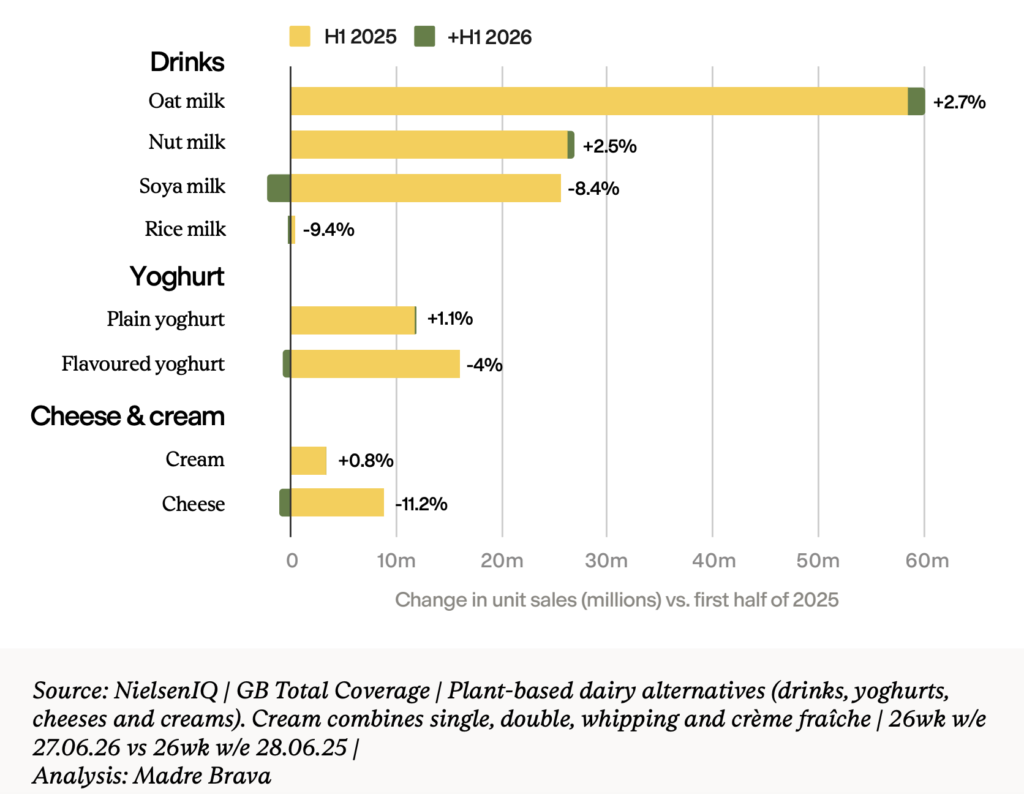
Moreover, the report looked at the performance of plant-based dairy, which decreased by just under 1% in unit sales but increased in value by 4.4%. Milk alternatives now account for 7% of the overall milk market, although sales flatlined in the first six months of 2026.
Oat milk continues to dominate with a 2.7% hike in unit sales, just as nut milks sold 2.5% better too. But purchases of soy and rice milk fell by 8.4% and 9.4%, respectively. Meanwhile, the performance of plain vegan yoghurt and non-dairy cream improved by 1.1% and 0.4%, respectively, with declines for flavoured yoghurts (-4%) and cheese (-11.2%).
Plain yoghurt is sold in larger packs in the UK, so the shift is likely to be larger in volume than unit demand. “The switch is an indication that some consumers are prepared to pay for healthier products, as the price per unit rose 4.5% for flavoured yoghurts, which contain added sugar, and 8.1% for plain yoghurt, which is lower in sugar,” the report stated.
Madre Brava has been working with other groups to urge retailers to embrace plant proteins and to ensure they account for 30% of their protein sales by 2030. A recent report co-authored by the organisation found that this would achieve 64% of supermarkets’ supply chain emissions reduction targets, while saving money on climate measures.
Lidl blasted past its target to increase alternative meat and dairy sales by 400% by 2025, recording a 694% hike since 2020. It also rolled out 20 own-brand plant-based products to encourage more consumers to eat more such foods. Tesco, which missed its sales goal for meat alternatives last year, reported that the sector was “back in growth”, with sales of vegan mince up by nearly 25% and whole-food proteins by 12%.
And Sainsbury’s has launched a Full on Fibre label to highlight high-fibre products, which include fruits, vegetables and plant proteins like beans and tempeh, building on the fibremaxxing trend that has engulfed the food industry.
“The bounce back in plant-based sales shows consumers are choosing foods that are a win for their health, their budgets and can compete on taste,” said Madre Brava’s UK director, Sara Ayech.
“Supermarkets account for more than 80% of our calorie intake. They can help drive this trend by ensuring a growing range of products that are the most convenient and appealing options for flexitarian customers, who want to eat more plants to fulfil nutrition goals. Setting targets for increasing the mix of plant proteins can also help retailers meet healthy sales and sustainability targets.”