
Scientists at ETH Zurich have developed a freeze-structuring technique to turn whole legumes into gels with a texture similar to animal muscle fibres, offering a minimally processed path to meat and seafood alternatives.
The bean renaissance is in full swing, thanks to their nutritional, affordability, and environmental advantages. And as the food industry dreams up more ways to get people to eat more legumes, one group of researchers is banking on a centuries-old technique to make them meatier.
In Japan, kōri-tofu is a sponge-like tofu product that has been around since the 16th century and made with a processing method called freeze-structuring. Now, scientists at ETH Zurich are leveraging this technology to give legumes like beans, lentils and peas a layered structure reminiscent of animal muscle fibres, in a bid to appeal to meat-eaters.
The process just needs legumes, water, and a freezer – it’s an idea that holds weight in a consumer landscape where the popularity of plant-based meat has been hit by concerns around ultra-processing.
“Our method works with legume species that together account for 96% of legume production worldwide,” said Andrea Bach, a doctoral student part of the research group, suggesting that the technique is so “simple that it can be performed easily by anyone in a household kitchen”.
How freezing and thawing can transform legumes
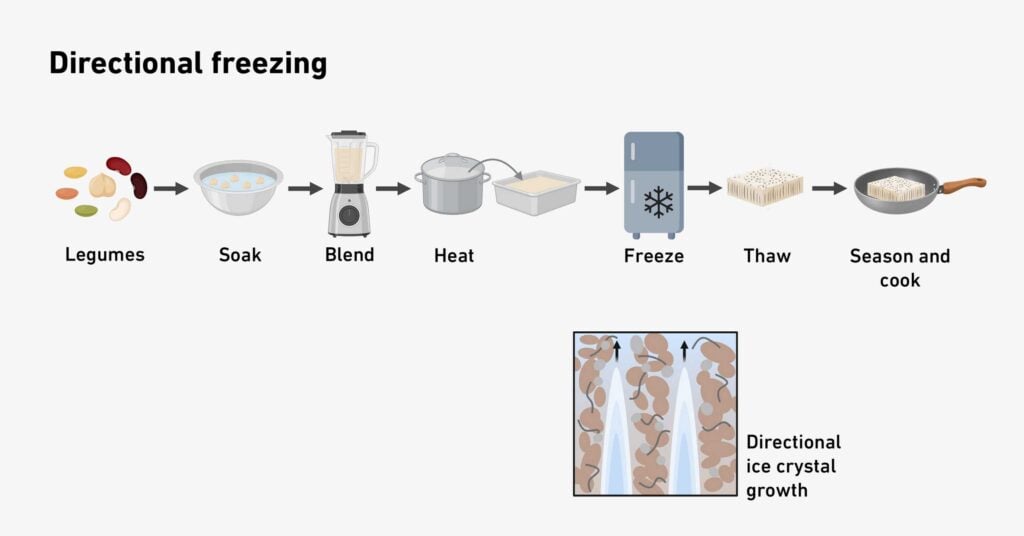
The scientists have been on the hunt for ways to use harvested crops in their whole form wherever possible, since this can reduce food waste and help retain as much of the plant’s nutritional value as possible. Combining freeze structuring, also called ice templating, with directional freezing is an ideal technique to achieve this.
The process involves soaking the legumes and blending them fine to create a uniform distribution of starch, proteins and cell wall fragments. In a step akin to the preparation of Burmese chickpea tofu, this purée is heated for 30 minutes at 90°C to gelatinise the starch with the other constituents.
The resulting gel is then frozen from one side in a targeted manner using a mould insulated on all but one side. That causes ice crystals to form in parallel and inwards within the uninsulated side, and as they grow, they squeeze and compress the legume gel into thin, parallel layers.
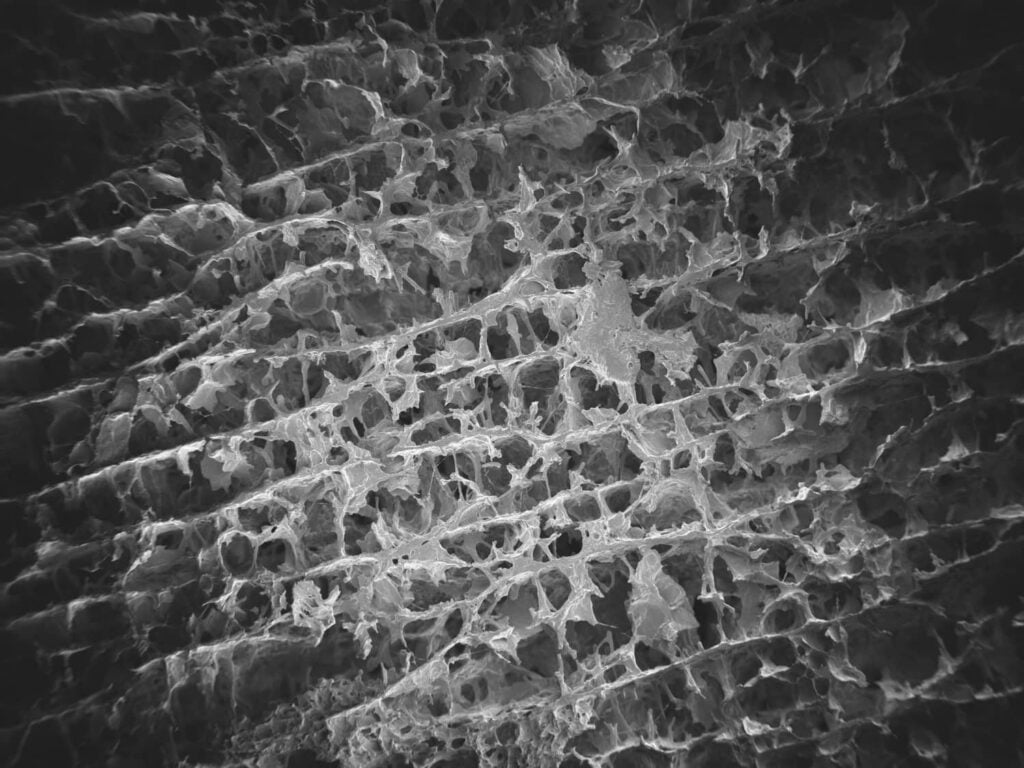
When this gel is thawed, the ice melts, but the gel retains its directional, fibrous structure. “During chewing, a directional, fibrous structure provides a distinctive bite that is familiar to – and enjoyed by – many people from meat or fish,” explained Patrick Rühs, a professor of food structuring and the research lead. “In meat and fish, this structure is formed by the directional arrangement of muscle fibres.”
The researchers observed certain differences among the legumes used. The fibres were particularly strong and stable with red and black lentils and mung beans, though slightly softer with soybeans or black beans. The final strength also depends on how much water was added to the legumes.
“It’s an advantage to have a range of consistencies,” said Elin Perler, a doctoral student and one of the study’s first authors. “It allows more flexibility in developing recipes, and it’s even possible to combine different legumes.”
A non-UPF solution to plant-based meat’s texture problem
The main reason why plant-based meat and seafood are falling out of favour is a perceived inferiority in taste and texture. A large survey of omnivores last year found that only around 30% of US consumers like the taste and texture of the average meat-free product, compared to two-thirds who say the same for the animal-based benchmark.
“Our research shows that the biggest opportunity for plant-based products to catch up to their animal counterparts is on texture,” Caroline Cotto, director of Nectar, the sensory insights initiative that conducted the study, told Green Queen at the time.
Further, consumers are shunning these products for their heavily processed nature. In the US, for instance, ultra-processed foods (UPF) now top consumers’ list of health concerns – 72% of them are trying to avoid these products in their diets, and 79% feel they’re a “significant threat” to public health.
That creates a whack-a-mole effect. Solving the texture issue is hard without additives such as emulsifiers or processing steps such as extrusion or 3D printing. The trouble is these ingredients put meat alternatives in the UPF category. On the other hand, stripping these products of texturisers or complex processes leaves a lot to be desired on the sensory front.
That’s why the ETH Zurich study offers an all-round solution, eschewing purification, additives, or specialised equipment to enable clean-label plant proteins with meatier textures.
The technique is widely used in home kitchens with tofu – thawing frozen tofu creates similar air pockets that deliver a spongy, more meat-like feel. However, the researchers here are using whole legumes to better preserve the inherent “nutritionally and functionally valuable components”.
“For example, tofu production requires the separation of okara, resulting in substantial macronutrient redistribution: approximately 85% of dietary fibre, 16% of lipids, and 23% of protein from whole soybeans are removed into okara and whey,” the study, published in NPJ Science of Food, explains.
“Similarly, extrusion-based processes commonly involve ingredient fractionation to obtain functional protein or starch fractions. These steps, although integral to those technologies, can result in nutrient losses and generate sidestreams.”
So by avoiding fractionation and refinement, freeze structuring can maintain the whole-ingredient composition and support “more resource-efficient and sustainable food processing”. The research team is now delving deeper into why different legumes produce varying consistencies, and collaborating with chef partners to develop specific recipes that add spices and marinades to better mimic the flavour of meat.