
A basic plant-based basket costs up to 30% less than one containing conventional meat and dairy across nine major supermarkets in the Netherlands, according to a new analysis.
If you’re in the Netherlands, a grocery cart filled with plant-based staples is now cheaper than one with meat and dairy.
Analysis by ProVeg International shows that Dutch consumers can save an average of 18% on basic groceries by buying plant-based foods, with savings as high as 30% at one supermarket.
A basket with vegan minced meat, burgers, butter, milk, yoghurt, and cheese is more economical at nine leading retailers in the country, with even small packages of plant-based products often more competitively priced than meat and dairy in large packages.
“This is remarkable, given that plant-based products themselves are often not yet available in large-format packaging,” ProVeg said, ascribing the breakthrough to targeted pricing strategies that promote sustainability through private-label brands, as well as inflation that more sharply drives up prices for animal products.
“The idea that plant-based products are expensive prevents many people from eating healthier and more sustainably,” said Martine van Haperen, food industry expert at ProVeg Netherlands.
“By pricing plant-based alternatives slightly lower than the animal variant, the sustainable choice also becomes the most affordable choice. We see that more and more supermarkets are consciously focusing on this as well.”
Vegan chicken, burgers and butter offer biggest savings
ProVeg surveyed prices at Albert Heijn, Aldi, Dirk, Ekoplaza, Hoogvliet, Jumbo, Lidl, Picnic, and Plus, comparing the prices of the cheapest vegan alternatives with the cheapest meat and dairy products in packages of up to 1kg.
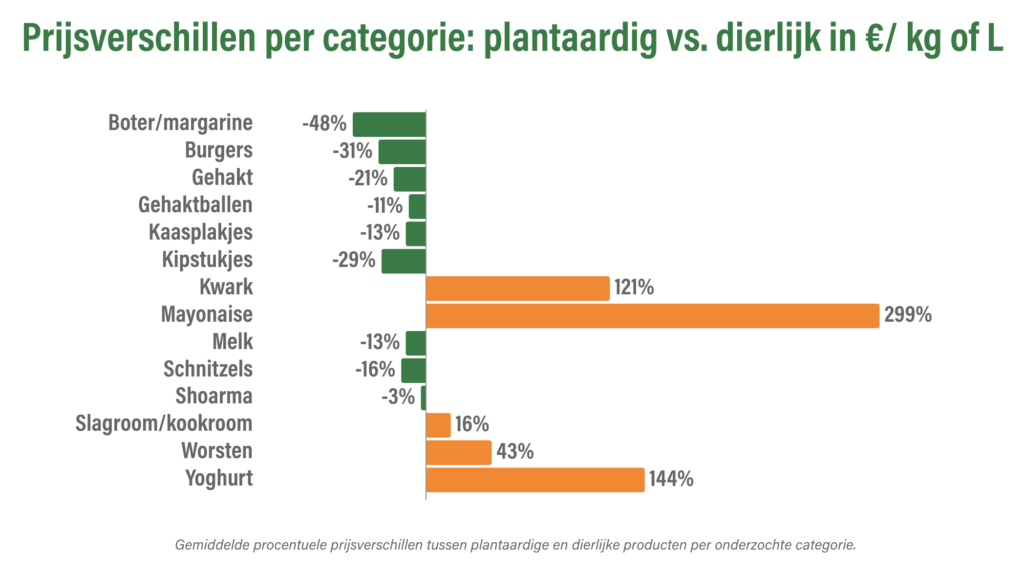
More than half (53%) of the plant-based products cost less than the lowest-priced animal version at the same store. Of the 14 plant-based categories examined, nine are less costly on average than their animal-derived counterparts, with consumers saving most on vegan chicken pieces and burgers, which are €4.55 and €4.38 cheaper than conventional options on a per-kg basis, respectively.
In percentage terms, vegan butter or margarine offers the biggest cost savings (48%), followed by burgers (31%) and chicken pieces (29%). The study found that all plant-based products with a lower price per kg are supermarket own-brand products.
Not all animal-free options are as affordable yet. In 13% of the cases, the vegan version was found to be at least twice as expensive – mayonnaise has a near-300% markup, yoghurt 144%, and quark 121%.
“This is partly because plant-based store-brand versions of these products are not yet available at all supermarkets. For example, Albert Heijn is currently the only retail chain offering a store-brand plant-based mayonnaise,” ProVeg explained.
“Another reason why affordable plant-based versions do not yet exist for every product category is that they have relatively low sales volumes compared to their animal-based counterparts,” it added.
“The cheapest animal-based mayonnaise, yoghurt, quark, and sausage are likely high-volume sellers, whereas their plant-based counterparts often do not yet sell in sufficient quantities to match those low prices.”
Private-label products buck decline for plant-based products
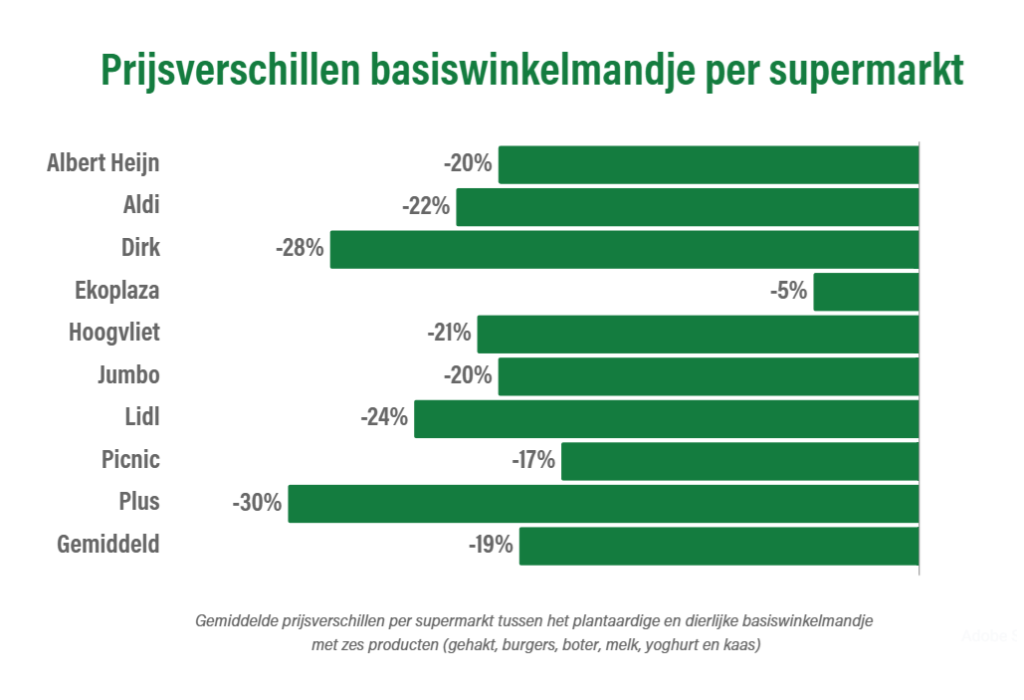
Of the nine supermarkets, Plus offered the largest savings for a vegan grocery basket (30%), followed by Dirk (28%) and Lidl (24%). On the other end of the spectrum was Ekoplaza, where plant-based carts were just 5% cheaper.
When looking at an expanded basket – which includes products that aren’t available at every supermarket chain – Aldi provides the best savings for plant-based options (18%), followed by Ekoplaza and Lidl (13% each). That said, Aldi has the most limited plant-based product range, lacking categories where vegan options are relatively expensive (like mayonnaise, quark and sausages).
Lidl is the only grocer to rank among the top three chains for both the basic and expanded shopping basket, aligning with its broad pricing policy that aims to achieve price parity between plant- and animal-based products. “Lidl operates on the principle that plant-based meat and dairy alternatives are at least as affordable as the animal-based versions in a comparable packaging size,” said van Haperen.
That, she noted, is an important step towards meeting the Dutch retail sector’s ambition to achieve a sales ratio of 60% plant-based proteins by 2030: “The more accessible and affordable plant-based products are, the easier it is for consumers to actually make that choice.”
Despite supermarkets in the country leading the protein transition with the ‘protein split’ ambition, plant-based products suffered a 4% drop in overall sales last year, totalling just €259M.
Market trends, however, confirm that pricing plays a major role here. While branded items – which tend to be more expensive – experienced a 12% decline in purchases, sales of cheaper own-brand products ticked up by 12%.
Van Haperen further noted that there is still progress to be made in categories that are still pricier than animal proteins. “Plant-based yoghurts are hardly available in litre cartons yet – that makes it harder to offer the same low price per kilo as with animal dairy,” she said.
“If plant-based alternatives are not purchased in large numbers, sales volumes remain low, making it more difficult for supermarkets to offer a competitive price,” she added. “There are still opportunities there for supermarkets to further expand the range.”