
Swedish food tech startup Millow has secured €2M ($2.3M) in funding to expand production of its low-water oat and mycelium protein, which it will initially launch in the Nordic foodservice channel.
Growing mycelium on oats to produce a low-water, low-emission meat analogue, Sweden’s Millow has raised €2M ($2.3M) to accelerate its path to market.
The round was led by angel investor Magnus Emilson. He was joined by Vitamin Well co-founder Jan Enhager, two food tech entrepreneurs with combined exits of over $2B, as well as strategic private investors from the Swedish food sector.
It adds to the startup’s €2.4M ($2.6M) grant from the European Innovation Council (EIC) in 2024, with up to €15M ($16.3M) available in blended finance from the European Investment Bank. Millow also received €643,000 ($720,000) in an EU Horizon grant last year, which is part of a €4M ($4.5M) grant for the Plantomyc consortium.
“To date, the company has been financed through a combination of EU funding, founder capital and private investors. We’ve been deliberately capital-efficient: private capital now goes into commercial execution,” CEO Fredrik Öhrn tells Green Queen.
It will use the funds to expand its capacity and build out its commercial team to launch its minimally processed, two-ingredient mycelium meat in the Nordic foodservice market, noting that its ingredients handle in the kitchen in the same formats chefs already use. International expansion, he says, is a “2027 to 2028 question”.
“Millow gives kitchens a clean-label product that does not ask them to change how they cook, and in my experience, that is what decides whether a category crosses over,” notes Enhager. “It is why I am backing Millow with both capital and time.”
Short cycles, minimal processing, and low water use
The startup was built on research by Mohammad Taherzadeh, a professor of bioprocess technology at the University of Borås and a renowned mycelium expert. He founded the startup with his son, CEO Esmaeil Taherzadeh, to commercialise the fermentation tech.
“We grow mycelium directly on Swedish oats through solid-state dry fermentation. There’s no liquid tank, no extraction, and no binders: the output of the fermentation is the food itself, made from two main ingredients (a small portion of the fantastic ingredient psyllium is added as well),” outlines Öhrn.
“A full cycle takes 16 to 24 hours in modular, AI-controlled units, and the process uses only three to four litres of water per kg of product. That low-water method is partly what our core European patent protects, and its nine-month opposition period has just closed with no oppositions filed.”
Millow also has the option of using industrial sidestreams as feedstock for the mycelium. For its oat product, the carbon footprint has been independently verified at 0.32kg of CO2e per kg of the ingredient, which is 98% lower than Swedish beef.
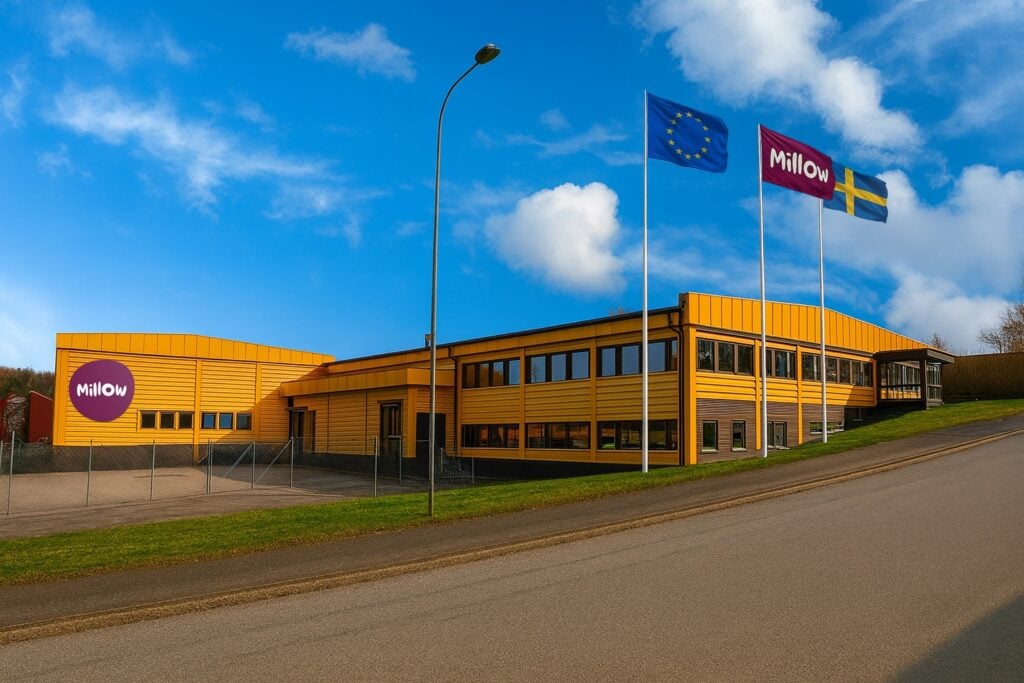
“We produce at our facility in Stenkullen, outside Gothenburg. All phase-one components, including our first advanced bioreactor, are installed, and we’re now running tests, with first commercial volumes reaching customers during the coming months,” says Öhrn.
“Three S-units give us roughly 430+ tonnes of annual capacity by the end of this year. The building already supports three additional units, so we can double capacity without a new facility.”
Millow isn’t disclosing unit costs, but its CEO suggests the structure – the short timeline, low water use, minimal downstream processing, and 2.5kg of output per kg of feedstock – tells the story.
“Compared with liquid fermentation players, we avoid the heavy capex and complex downstream steps. Compared with extruded plant proteins, we skip the extraction and the additives,” he says. “That can give us a cost position to compete with mid-range conventional proteins in foodservice, not just with other alternatives, and the economics work at the scale we’re building now.”
Consumers rejected underperforming products, not the idea of alternative proteins
Öhrn identifies “public sector kitchens, restaurant chains and wholesalers” in the Nordics as its first customers, where its allergen-free, clean-label profile solves many operational problems and where scope 3 requirements increasingly drive purchasing decisions.
“We’re in close discussions with major foodservice operators and distributors, but I’ll let partners communicate specifics when products hit their menus,” he says. “Retail may come over time through our ‘Made with Millow’ ingredient-branding model, where partners put their name on the pack and we provide the ingredient’s credibility.”
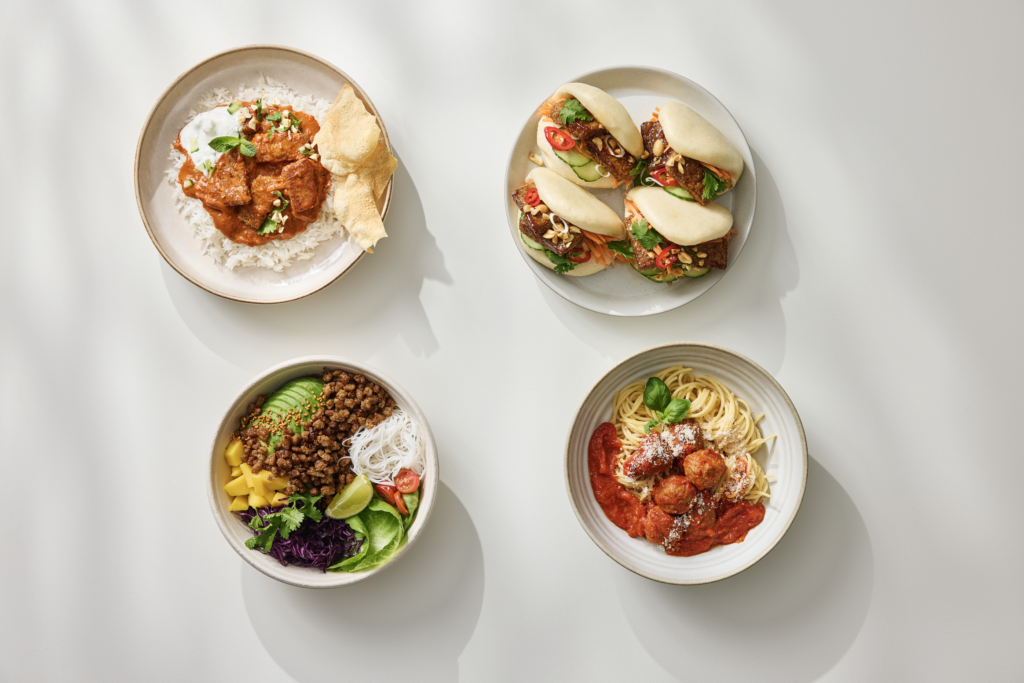
Millow’s ingredient contains 27g of complete protein from just 140 calories per 100g, alongside fibre, vitamins, and minerals. Further boosting its appeal is the fact that it’s far removed from the ultra-processed nature of most meat analogues, and can be used in a variety of applications, from meatballs and mince to döner kebab and even an alternative to paneer in Indian dishes.
One major opportunity lies in the burgeoning blended meat space, with supermarkets and foodservice operators combining animal and plant proteins to offer healthier and more planet-friendly meat products. “It’s a real opportunity, and the product blends extremely well with conventional meat, so we’re having several of those conversations,” reveals Öhrn.
“A blend lets a kitchen cut cost, climate footprint and saturated fat without changing how it cooks. We see hybrids as a natural and additional avenue, rather than outside the ‘only Millow’ strategy. At the end of the day, the market decides what’s best.”
Millow’s funding comes amid a continued downturn in category investment – in 2025, financing for alternative protein fell to a seven-year low. “With a large portion of humility, I do think the category partly did it to itself,” says Öhrn.
“Too many products asked consumers to accept long ingredient lists, compromised taste and premium prices at the same time, and too many companies raised capital on economics that only worked at a scale they never reached. Consumers didn’t reject the idea of alternative proteins; they rejected products that didn’t deliver,” he explains.
“Our conclusions are built into the model: few core ingredients, price competitiveness with meat, and a foodservice route where the chef decides and the product has to perform in a real kitchen.”
For Millow, the next 12 months are all about disciplined commercial execution. “Moving from test runs to commercial volumes over the coming months, ramping toward our 430-tonne annual run-rate, converting discussions into signed, recurring foodservice and wholesale customers, and proving that our unit economics hold at commercial volumes,” says Öhrn.