Most climate change estimates of AI focus on emissions from training large models, but they don’t account for the impact of running them, according to a UN report.
Barely any industry is growing at the breakneck pace of artificial intelligence (AI), and the technology leading the fourth industrial revolution has a colossal climate question looming over it.
The global AI market is set to expand 25-fold between 2023 and 2033, reaching $5T. That is one of several staggering figures outlining the technology’s impact.
Corporate investment in AI exceeded $580B last year, and 78% of organisations reported using AI in their work the year before. In fact, 40% of global employers expect to cut back their workforce for tasks that can be automated.
Generative AI tools like ChatGPT, Claude and Perplexity account for 20% of the global AI market, a share set to double by the end of the decade. As of this year, more than a billion people actively use OpenAI’s ChatGPT each month – that’s 12% of the global population.
This almost uncontrollable growth comes with enormous costs. There’s the ethical argument – AI chatbots have been found to drive psychosis and suicides and commit child sexual abuse, for starters.
An oft-debated impact of AI is its impact on the planet. Research suggests the technology is likely to increase energy use and fuel climate disinformation, while a Google report argues it could cut global emissions by 10%.
Reacting to criticism about AI’s climate harms, OpenAI co-founder and CEO Sam Altman infamously compared the tech to humans earlier this year. “People talk about how much energy it takes to train an AI model – but it also takes a lot of energy to train a human,” he said at a summit in India. “It takes about 20 years of life – and all the food you consume during that time – before you become smart.”
Even Altman conceded that the AI industry needs to “move towards nuclear or wind and solar very quickly”. That could come with its own challenges, and doesn’t take into account the entire picture, according to a new report by the UN University Institute for Water, Environment and Health (UNU-INWEH).
The research argues that AI’s environmental impact is systematically mismeasured. “If we keep judging AI sustainability by carbon alone, we might think that renewables make AI infrastructure clean, but that is solving one problem while creating other problems, often in places that didn’t ask for it,” said UNU-INWEH researcher Miriam Aczel, its lead author.
Here are the key takeaways from the UN’s research on AI and climate change.
1) There’s a ‘critical gap’ in AI’s environmental estimates

The report notes that most existing estimates of AI’s planetary effects focus on the carbon emissions associated with training large models. There are two issues with that approach.
First, every kilowatt-hour of electricity used to train or run an AI system carries a water footprint from cooling and power generation, and a land footprint from energy infrastructure and supply chains.
A switch to renewable power needs to be carefully considered. The UN states that transitioning from coal to bioenergy could cut the carbon footprint of electricity by 70%, but increase water use by more than 30-fold and land use by over 100 times, which could burden regions facing water or land stress.
“‘Low-carbon’ is not automatically ‘low-water’ or ‘low-land’, and evaluating sustainability through a single metric can hide trade-offs and shift burdens onto places already facing water stress or land pressure,” the report explains.
Secondly, training an AI model only accounts for a fraction of the tech’s energy use. Once it’s deployed, inference – the continuous running of models to answer everyday prompts – makes up 80-90% of AI’s energy footprint.
“The numbers grow drastically once the AI embedded in mass platforms (such as Google Search) is counted,” reads the report.
2) Video and image generation are the biggest culprits

How you use AI dictates the magnitude of resource use. A typical conversational chat with an AI model uses about 200 times as much power as basic text classification.
Things get worse with images. The energy required to generate a single AI image is about 1,450 times that of the baseline, enough to power a 10-watt LED bulb for 17 minutes and to use 2 tablespoons of water each time.
All this heightens with video generation. High-resolution long clips on large models draw more than 415 Wh of energy. In fact, the power required to create one AI video is enough to run that aforementioned bulb for 42 hours. And a complex video could use up to four litres of water, nearly the two-day drinking water requirement for one person.
The report nods to the Jevons Paradox, a rebound effect warning that as models become more efficient, they become cheaper and are used more frequently. Without explicit limits on tokens, resolution, or default output length, resource consumption is only set to lift faster.
3) The energy use of data centres is mind-boggling
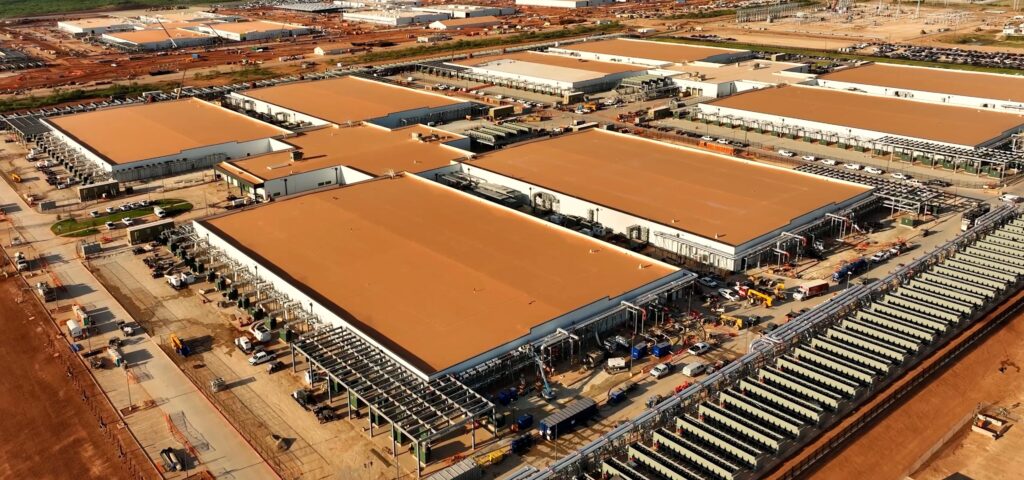
Globally, data centres consumed 448,000 GWh of electricity in 2025 – if they were a nation, they would be the 11th largest electricity consumer, ahead of Saudi Arabia.
By 2030, it could jump to sixth on that list as the figure is set to exceed 945,000 GWh, accounting for 3% of global electricity use. This is triple the combined annual energy use of Pakistan, Bangladesh, and Nigeria, which together host more than 650 million residents. In fact, this is enough to supply the residential power needs of all 1.3 billion people in Sub-Saharan Africa for five-and-a-half years.
The associated water footprint of the 2030 estimate is 9.3 million litres – that could supply the minimum annual domestic water needs of the Sub-Saharan African population for a full year.
Meanwhile, the associated land footprint of data centres’ electricity use in 2030 would be over 14,500 sq km, roughly 10 times the size of Mexico City, or twice the Jakarta metropolitan area.
4) Data centres are leeching resources from public infrastructure
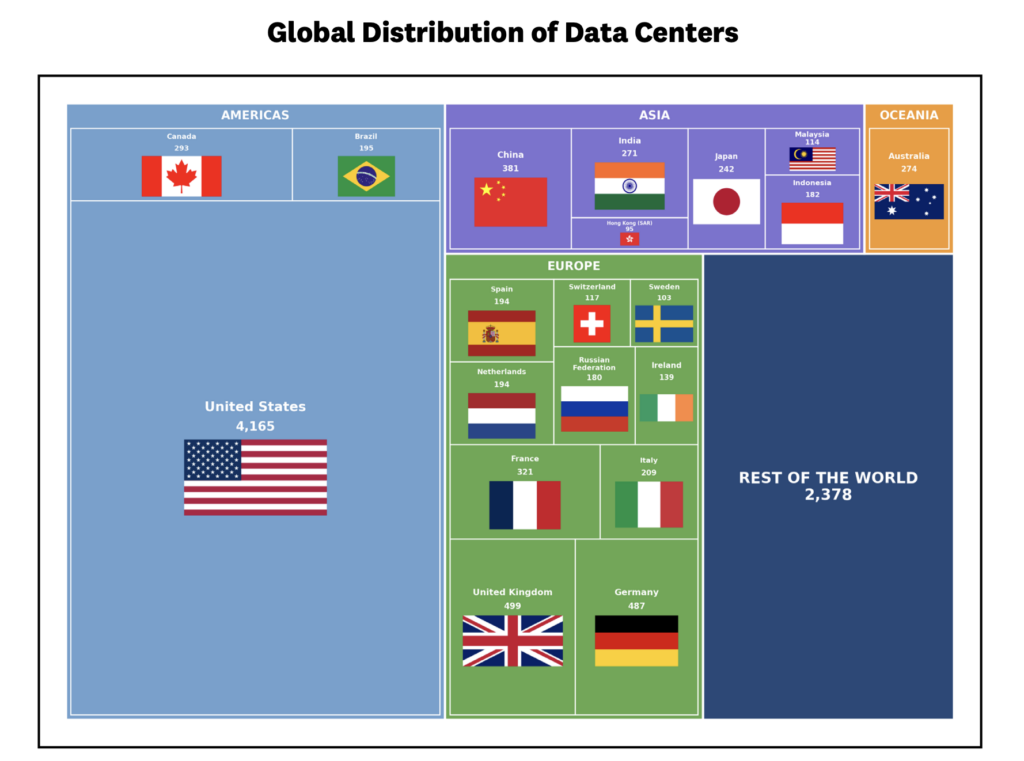
The UN accuses AI of creating a “digital divide”, with the impacts of its infrastructure not evenly distributed. In some countries, data centres account for a significant share of national electricity consumption, and in others, expanding facilities draw heavily on water supplies.
The production of critical minerals for AI hardware raises concerns about environmental degradation and social inequities in extraction regions. And site-level cases show how global distribution creates intense local pressures.
In Ireland, for instance, data centres made up over a fifth of total metred electricity in 2023, exceeding all urban households, prompting the national grid operator to pause new approvals around Dublin until 2028.
In Querétaro, Mexico, expanding computing infrastructure is taking up water supplies amid prolonged droughts. And in Uruguay, plans for a water-intensive data centre clashed with a 2023 drought depleting Montevideo’s freshwater reserves and making tap water unsafe for consumption.
The physical life-cycle of AI hardware presents a crisis, too, since it could generate up to 2.5 million tonnes of electronic waste a year by 2030, much of it processed in low-income nations with limited capacity for safe disposal and weak environmental oversight.
Further, the expansion of AI infrastructure creates disparities in access and influence, and raises environmental justice concerns. Only 32 countries host AI-specialised data centres, and 90% of them lie in just two: the US and China. More than 150 nations lack significant domestic AI infrastructure.
5) OpenAI and ChatGPT’s climate impacts are understated and outdated

The environmental implications of training the world’s most popular chatbot are immense. OpenAI’s GPT-3 model was estimated to require 1.3 GWh of electricity; its more powerful GPT-4 model, which ChatGPT runs today, consumed about 50-70 GWh during training.
The latter is estimated to have used 600 million litres of water, enough to meet the minimum annual domestic water needs of 81,000 people in Sub-Saharan Africa.
Projects for models like GPT-5, meanwhile, suggest training electricity requirements of 100 GWh, equivalent to the annual residential power usage of 770,000 residents in that region. It’s also set to have a carbon footprint of 42,000 tonnes of CO2e, and use a billion litres of water.
However, given the energy use of inference, these figures are outdated. ChatGPT processes around 2.5 billion prompts a day, roughly translating to 383 GWh of electricity per year for a single product.
6) AI within planetary limits is achievable
The UN asserts that carbon-only metrics are no longer sufficient for AI – disclosure standards should require water and land footprint disclosures for both training and inference. The latter, it added, deserves the same policy attention training has received.
Governance should focus on product defaults, model selection, and behavioural levers of AI models, and treat siting decisions and environmental decisions when granting permits. Local capacity planning also needs to keep pace with global computing geography.
Moreover, computing access is an equity issue, and international instituions can help by supporting capacity-building, harmonising disclosure, and reducing incentives for cross-border burden-shifting.
The report calls for the full value chain to be governed, from the extraction of critical minerals to the e-waste generated. Investors and financial institutions can lead the way by treating environmental impacts as material risks in their AI infrastructure due diligence.
The UN has proposed a six-principle framework for a responsible AI ecosystem, built around transparency, efficiency by design, equity and environmental justice, lifecycle responsibility, global cooperation, and sustainable use.
“This report is not a case against artificial intelligence, a technological transformation that is improving the lives of billions of people around the world,” insisted UNU-INWEH director Prof Kaveh Madani, the former deputy prime minister of Iran, who led the investigation team. “It is a call for using it responsibly and addressing its unintended impacts proactively to make it sustainable and equitable.”
He added: “We have a narrow window to ensure that the backbone of the technological revolution of our era develops within planetary limits, and that the communities who provide the critical minerals for advancing AI and the ones that host its infrastructure and e-waste are also among those who benefit from it.”