HappyVore is now the top-selling plant-based meat brand in France, surpassing Nestlé’s Garden Gourmet. Its co-founder and CEO, Guillaume Dubois, explains how it got here.
The French are eating less meat, and more plants – and one local startup is capitalising on this shift better than the rest.
Founded in late 2019, HappyVore sells a wide range of meat alternatives, including burgers, mince, sausages, nuggets, tenders, and a lot more. To date, it has sold over 100 million products and helped avoid more than 50 million kgs of CO2e.
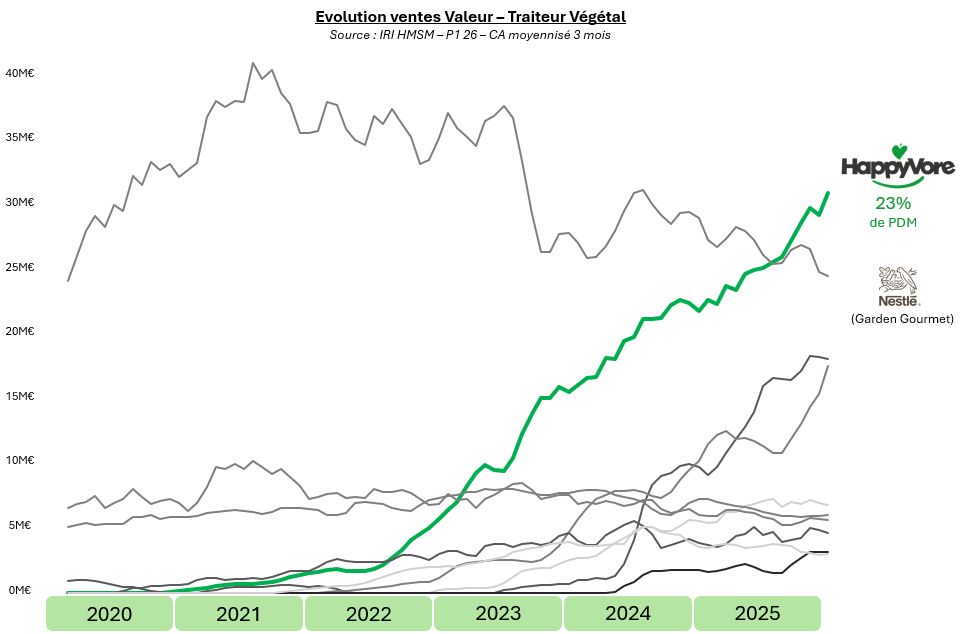
Now, it has hit its biggest milestone yet. For years, Nestlé’s Garden Gourmet has led the meat alternative space in France – but at the end of 2025, HappyVore dethroned the Swiss giant to become the best-selling plant-based meat brand in the country.
“Our current market share is 24.3%,” HappyVore co-founder and CEO Guillaume Dubois tells Green Queen. “In 2025, our revenue was €35M – we had 45% of growth compared to [the previous] year. It’s a clear indicator that the plant-based market is going really well.”
He adds that the company has played “a major role in the market’s expansion” since it overtook Garden Gourmet, and has driven half of the plant-based meat sector’s growth.
Taste, nutrition and distribution key to success
After achieving the feat last year, HappyVore has only been going from strength to strength. In Q1 2026, it was home to four of the 10 best-selling plant-based meat products in France. And in April, it witnessed a 62% year-on-year increase in sales.
“HappyVore is currently achieving record-breaking numbers, not seen since its creation six years ago,” says Dubois. Currently, its three top-selling products are the merguez sausages, chipotlatas, and chicken nuggets.
So how has the brand managed to outsell all others? “First of all, the taste of our product is our number-one priority. You can’t build customer loyalty if the product is not good, and we stand out thanks to our superior taste,” he argues.
“We also have very strict specifications regarding the nutritional composition of our products,” he adds. “HappyVore offers healthy products that are high in protein and fibre, with a ‘green’ rating on Yuka and an A on Nutri-Score. We’ve had an in-house nutritionist since we launched our first products – it’s very important to us.”
The nutrition focus is amplified when placed against the context of ultra-processed foods (UPFs), a category that has been criticised for being both harmful to health and too vaguely classified. Polling shows that 65% of Europeans are concerned about the health impact of UPFs, with 54% avoiding plant-based meats because they’re ultra-processed.
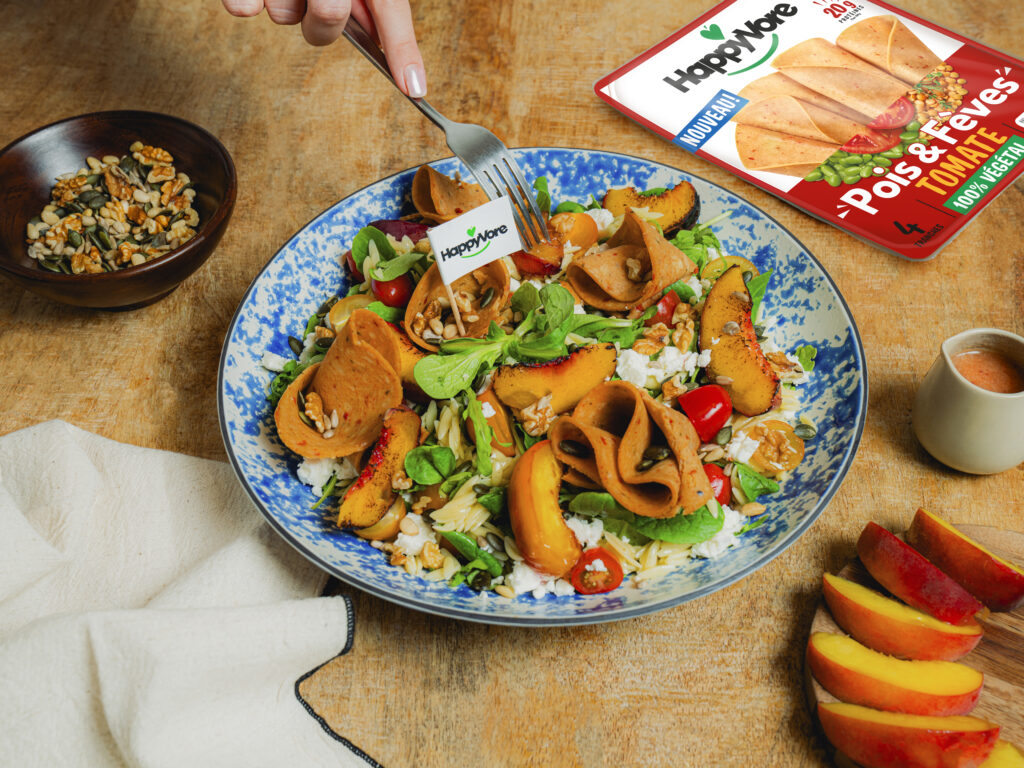
“It’s true that some vegetarian products are high in processed ingredients and unhealthy, but we shouldn’t blame the entire industry for that. At HappyVore, we believe that vegetarian products should be healthy,” says Dubois.
Another major factor behind its success is its distribution strength. “We are available at all retail locations where French people shop, as well as in many restaurants,” he notes.
This is helped by its vast production footprint. “We’re really proud to have our own factory in France (Chevilly), where we have an annual production capacity of 10,000 tonnes. By building our factory, we have revitalised the region and created more than 50 jobs,” the CEO says.
HappyVore driving France’s plant-based growth, forecasts €50M revenue
In France, meat consumption has been steadily declining over the last two decades. One survey revealed that 53% of its citizens have cut back on meat in the last three years alone.
The French government has been supporting this shift, updating the national dietary guidelines to recommend limiting meat and increasing plant-based protein consumption. Further, it invested €11.7M in 10 projects to expand domestic plant protein production, as part of the agriculture ministry’s National Strategy for Plant Proteins.
“The plant-based market is at a critical, hyper-competitive juncture, making it tough for brands to stand out. Because consumers still hold strong preconceptions, the first trial is make-or-break: a bad experience will alienate customers and damage the whole product line,” says Dubois.
“To succeed and maintain brand loyalty, companies must guarantee uncompromised quality standards across all products while continuously innovating to stay top-of-mind,” he outlines.
The industry also faces some legislative hurdles. This year, the EU voted to ban the use of 31 meat-related terms on plant-based product labels, including ‘chicken’, ‘beef’, ‘steak’, and ‘bacon’. Companies can continue to use the words ‘burger’, ‘mince’, ‘sausage’, ‘nuggets’ and ‘ham’ for vegan alternatives.
“We’re quite relieved, to be honest, because there are only a few prohibited terms which we did not use anyway. This EU’s decision proves that Europe views our industry as part of the future, not as a threat,” says Dubois.
“For HappyVore, changing the word ‘steak’ on a label is a minor adjustment. The most important takeaway is that terms like ‘burger’ and ‘sausage’ are safe, meaning we can continue to guide flexitarian consumers toward sustainable choices using the culinary language they already know and love.”
France is the third-largest market for plant-based food in Europe. In 2025, sales of these products increased by 9% (reaching €678M), with a near-11% rise in volumes, according to Circana. HappyVore has been the top growth driver here.
The firm has secured €45M to date, though it has no plans to raise capital anytime soon. “Our sales forecast for 2026 is to exceed €50M turnover,” reveals Dubois. “We believe that we’ll continue to grow and launch new products to continue greening France, and perhaps Europe. We still have a lot of flexitarians to convince.”