
Only three major dairy and coffee producers have published methane targets, despite recognising the link between agriculture, livestock and climate change, a new analysis reveals.
Danone, General Mills and FrieslandCampina are the only leading dairy and coffee companies in Europe and North America to have publicly set targets to reduce methane emissions, according to a new ranking by Changing Markets Foundation.
The non-profit looked at 23 businesses in these regions and found that 91% of them recognise the link between livestock farming and the climate crisis, but most still haven’t laid out goals to curb their emissions.
In fact, Danone is the only company aligned with the Global Methane Pledge’s target to reduce methane emissions by 30% by the end of the decade. General Mills and FrieslandCampina have set wider benchmarks to reduce their dairy emissions by 2030. Bel Group has privately disclosed a methane reduction target, though without a clear baseline.
It’s why Danone – owner of brands like Actimel, Alpro, Silk, and Oikos – tops the rankings with 75.5 points out of 108. It’s followed by General Mills (74.5) and Starbucks (65).
“Danone’s progress shows that targets focus minds when backed by regular reporting and accountability,” said Nusa Urbancic, CEO of Changing Markets Foundation.
Dairy Methane Action Alliance members perform better
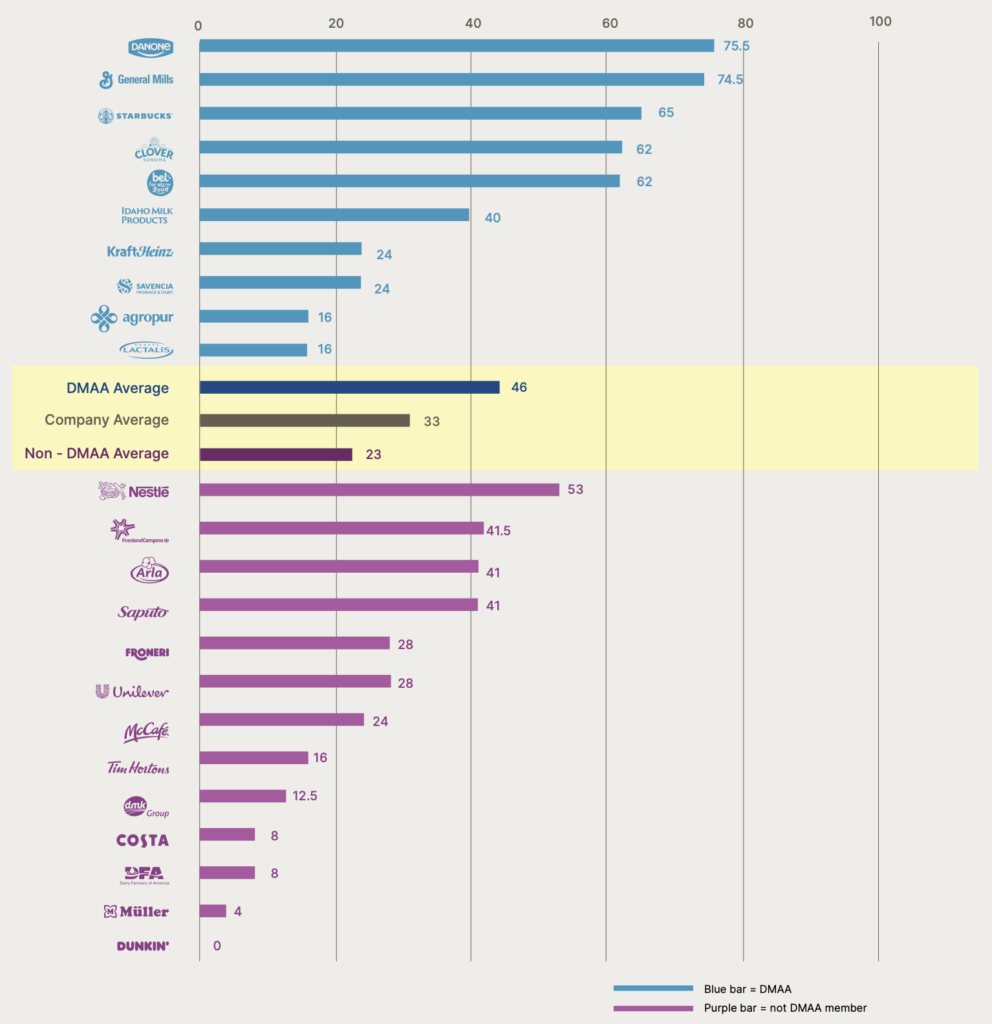
The analysis revealed that eight companies, including Starbucks, Nestlé, Clover Sonoma, and Danone, report livestock methane emissions either in CH4 or CO2e figures.
But the remaining 15 (from Unilever and Kraft Heinz to Dunkin’ and McDonald’s) didn’t disclose their methane emissions for 2024 or 2025, leaving a transparency gap.
Meanwhile, Danone, Nestlé and Bel Group were the only companies to report methane reductions in either of these years. Danone recorded a near-30% cut in methane emissions from its fresh milk, over 17% from procurement, and 11% from farm performance management. It means it’s already close to achieving its overall methane emissions goal by 30%, five years ahead of schedule.
Nestlé reported a 20% reduction without explaining how it achieved this feat, and Bel Group slashed methane by 23% (from a 2017 baseline). For all these companies, scope 3 emissions from milk purchases are the most important, accounting for 31.7% of the overall footprint.
Companies that are part of the Dairy Methane Action Alliance (DMAA) outperformed non-members, scoring twice as highly on average. Nestlé, a founding member of the association, left the association without explanation last year.
Starbucks, also a DMAA member, is the only coffee company that disclosed its methane emissions and scored high on the ranking. The rest – such as Tim Horton’s (16 points), Costa (eight), and Dunkin’ (zero) – ranked near the bottom. Germany’s Müller was second-to-last with four points, just behind Dairy Farmers of America (eight).
“Our rankings show that setting a science-based methane target is one of the most important levers to drive emissions reductions,” said Urbancic. “Methane is a crucially important climate emergency brake, and we need other food companies to ramp up ambition.”
Policy shifts will compel companies to improve methane reporting
Methane has an outsized impact on the planet in the short term. It’s responsible for around 0.5°C of global warming, and is 86 times more potent than CO2 over a 20-year period. The gas is the primary contributor to ground-level ozone, which causes a million premature deaths each year.
Its emissions are rising faster than ever before, growing by as much as 20% between 2000 and 2020. And without action, human-caused methane emissions will rise by up to 13% from 2020-30, taking the world in the opposite direction on the path to 1.5°C.
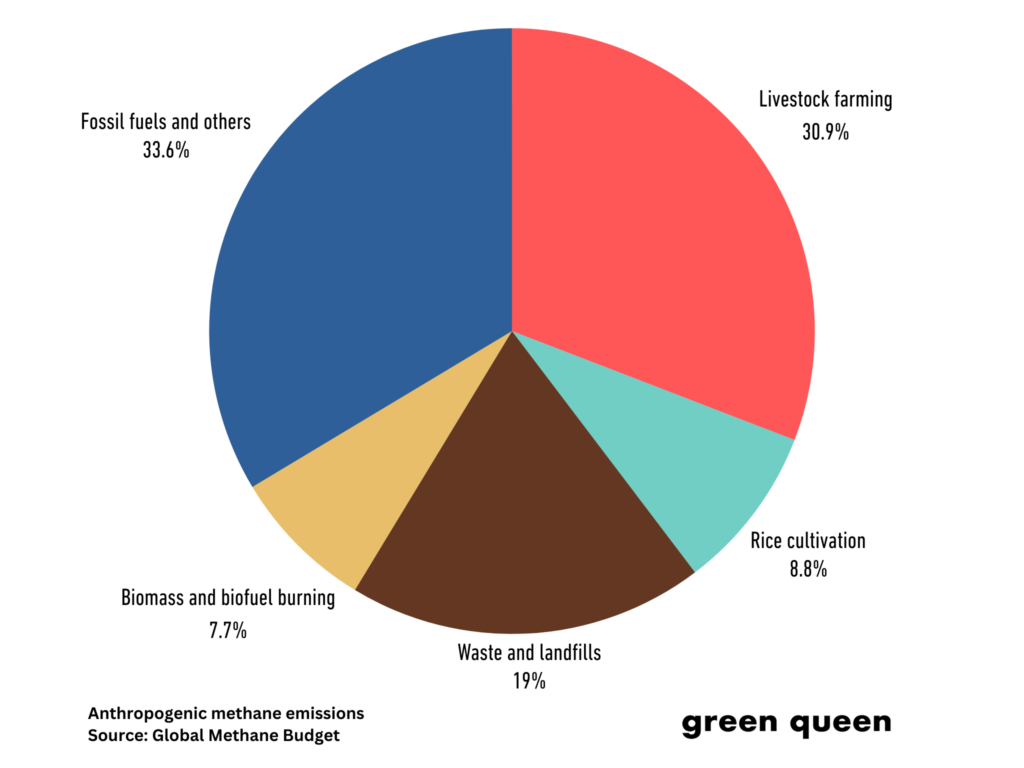
Agriculture, meanwhile, is the main source of human-caused methane emissions, with livestock farming accounting for the majority of these emissions. In fact, methane alone makes up 25-80% of livestock producers’ emissions, and according to Danone, dairy is responsible for 8% of global methane output.
This is thanks to cattle’s enteric fermentation. Since they are ruminant animals, they have specialised digestive systems, allowing them to digest foods that humans and most other animals can’t.
When food enters their stomach, microbes and bacteria break down the particles, which ferment in a part of the stomach called the rumen. As this process takes place, these food particles produce methane. Every time cows belch or flatulate, they emit methane into the atmosphere.
Research shows that 52 of the largest meat and dairy producers emit 22 million tonnes of methane a year – if they were a country, they would be the fifth-highest emitter. That makes the Global Methane Pledge “unachievable without a step change in action” from the livestock sector.
But policy shifts might help. The EU’s Corporate Sustainability Reporting Directive is set to ramp up the pressure on companies to improve climate disclosure. They will need to account for methane emissions more explicitly under strengthened reporting and double materiality requirements.
Despite dairy and coffee companies lagging with “weak disclosure, limited transparency and little evidence of meaningful methane action”, they’re still better off than supermarkets, with no major global retailer publicly disclosing methane emissions or targets.
“The direction of travel is clear: companies will need to put systems in place to account and report methane emissions,” the report said. “As scrutiny increases, companies that already have these systems in place, will be better prepared for incoming regulations.”