
US food tech startup Voyage Foods has withdrawn from retail to double down on B2B supply of sustainable ingredients such as beanless coffee and chocolate, with Cargill as a key partner.
Nearly a year after completing its 284,000 sq ft facility to manufacture cocoa-free chocolate, beanless coffee, and nut-free spreads, Voyage Foods is betting the farm on the B2B channel.
The food tech startup was founded in 2021 by Adam Maxwell and sells allergen-free, climate-friendly pantry staples. Its peanut butter and chocolate-hazelnut spreads, made with sunflower and grape seeds, chickpeas and buckwheat instead of nuts and cocoa, were available in more than 1,400 locations across the US.
The company has, however, bid adieu to its retail operations now. “We initially launched a retail/CPG brand to demonstrate our products can scale rapidly. Launching in Walmart was a great way for us to prove that as a young company,” Maxwell tells Green Queen.
“Now that we have more global partners, and have established our network to deliver our B2B ingredients globally, we pulled out from retail because it wasn’t our long-term vision where we can have the most impact,” he explains.
Instead, Voyage Foods has spent the last year or so “primarily working with commercial customers such as CPG companies and large foodservice operators”.
“We’re helping them deliver on their goals, whether it be supply chain stability, cost, margins, or sustainability,” Maxwell notes, adding that the spreads are still being produced for existing foodservice clients, like school districts. “As a mission-driven company, this is really about keeping the focus on where we can have the largest impact.”
‘Massive’ Ohio facility enables supply to ‘largest players in food’
Voyage Foods relies on cheaper, more stable raw materials and agricultural byproducts to lighten the climate impact of foods like chocolate and coffee, as well as cater to nut allergies.
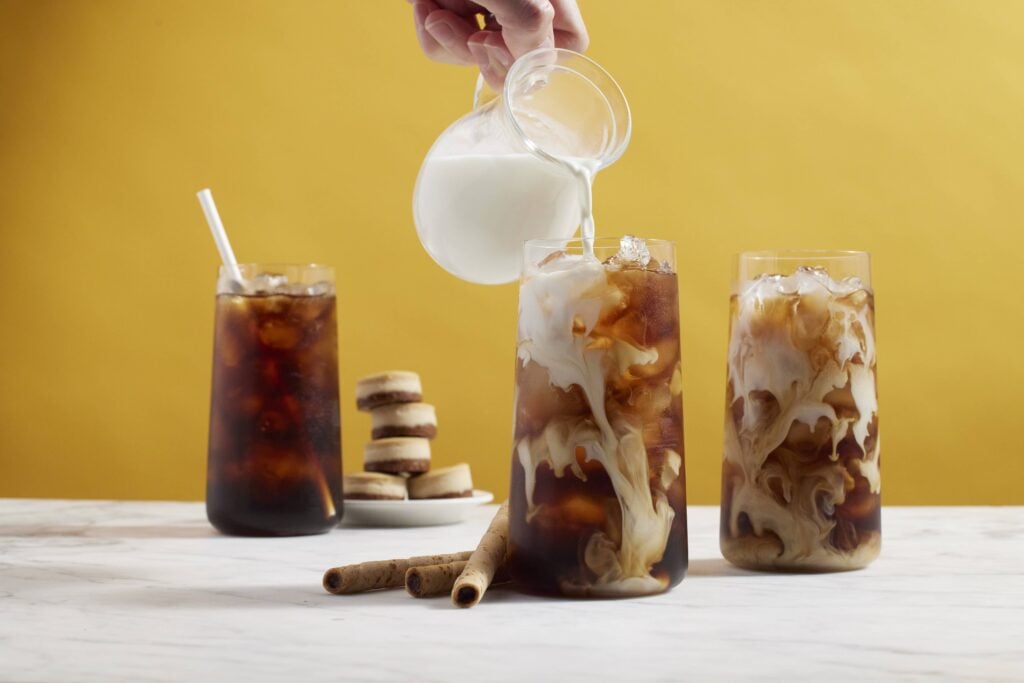
Its beanless coffee is made from roasted chickpeas, rice hulls, natural flavours and caffeine from green tea, and is available in ground, liquid, concentrate and instant formats. It can be up to 40% cheaper than conventional coffee, offering manufacturers stable prices and better margins.
To produce a chocolate-like compound product, the startup upcycles grape seeds from wine industry sidestreams, combines them with sunflower kernel flour, vegetable fats, sunflower lecithin, sugar, and natural flavours, and puts them through fermentation and roasting techniques.
Its key commercialisation partner has been Cargill, which has been working with Voyage Foods to scale up and distribute cocoa-free chocolates since 2024. Together, the two companies have developed NextCoa, which can reduce the water footprint by 95%, land-use impact by 90%, and carbon footprint by 67% compared to conventional chocolate.
This range is available in a milk-chocolate-like Mild format and a Dark Mild variant that falls between dark and milk chocolate. They’re being sold as bake-style drops, and tempering and non-tempering wafers in Europe and North America.
Polling by Cargill shows that 76% of people want to buy more sustainable chocolate or cocoa-based products but are unsure how to do so, and other research reveals that 71% of global consumers find upcycled ingredients appealing. Moreover, the alt-chocolate is free of the nine major allergens, a key focus for Cargill, since nearly 1 in 10 Americans (33 million) have at least one food allergy.
NextCoa launched in the US in May, where it’s being distributed by Batory Foods, Blendtek and Gillco Ingredients. This came months after Voyage Foods opened its industrial-scale facility in Mason, Ohio (its Oakland headquarters remains its R&D hub).
“It’s been fully operational since Q4 2025. The scale is massive, at nearly 300,000 sq ft, allowing us to deliver to the largest players in food,” says Maxwell.
Voyage Foods talks up hybrids amid and eyes global expansion

Voyage Foods’s technology targets two commodities ravaged by climate change. In 2024, cocoa stocks plunged to their lowest levels in a decade, while prices rose to all-time highs, and scientists warn that a third of the world’s cocoa trees could die out by 2050. Coffee prices also broke records in early 2025. And 60% of coffee species are already endangered, with the tropical area suitable for growing it set to be halved by 2050.
These two industries are themselves major contributors to climate change. Chocolate production emits more greenhouse gases than any other food except beef and is linked to widespread tropical deforestation; a kg of coffee beans generates more emissions than a kg of poultry and pork combined.
Bean-free alternatives can have a bad rap, with many viewing them as inferior (especially in the specialty coffee and chocolate space) and detrimental to farmers. That has prompted several startups, including Singapore’s Prefer and Belgium’s Koppie, to champion a hybrid approach that combines bean-free alternatives with their respective conventional commodities.
Voyage Foods is among them, having spent the past year working with customers to “extend” their coffee and chocolate formulations. This strategy works “due to volatility in commodities, whether that’s due to climate change, inflation, supply constraints, or other factors”, according to Maxwell.
“We give customers a way to extend their current formulas with Voyage ingredients, with no difference in taste, texture, aroma, or function. In the coffee world especially, there’s already an understanding of blends. Even a half-caf is a blend,” he points out.
The startup has raised $94M to date, along with a $25M USDA loan to construct its Ohio facility. Maxwell declined to comment on Voyage Foods’ runway or fundraising plans, while teasing upcoming “brand launches” featuring its ingredients.
“Our ingredients are available in Europe and North America, and now we’re seeing interest from Asia and other regions, so in addition to building on the existing distribution, I can see Voyage adding partners in new markets. We’ll also see more partner products in stores using Voyage ingredients,” he says.
“We’ve spent the last several months indexing on global partners and making our B2B ingredients available to companies around the world. So to me, the next 12 months [are] about launching more products on store shelves globally (the EU, the US, Latin America, Asia, etc).”