
A global transition towards healthy diets rich in plant-based foods could bring significant benefits, with scientists calling on governments to “rise to the challenge” and “make difficult decisions” for public and planetary health.
Study after study has extolled the benefits of the Eat-Lancet Commission‘s Planetary Health Diet, which calls for a shift to a plant-rich eating pattern to improve public health and lower the food system’s climate impact.
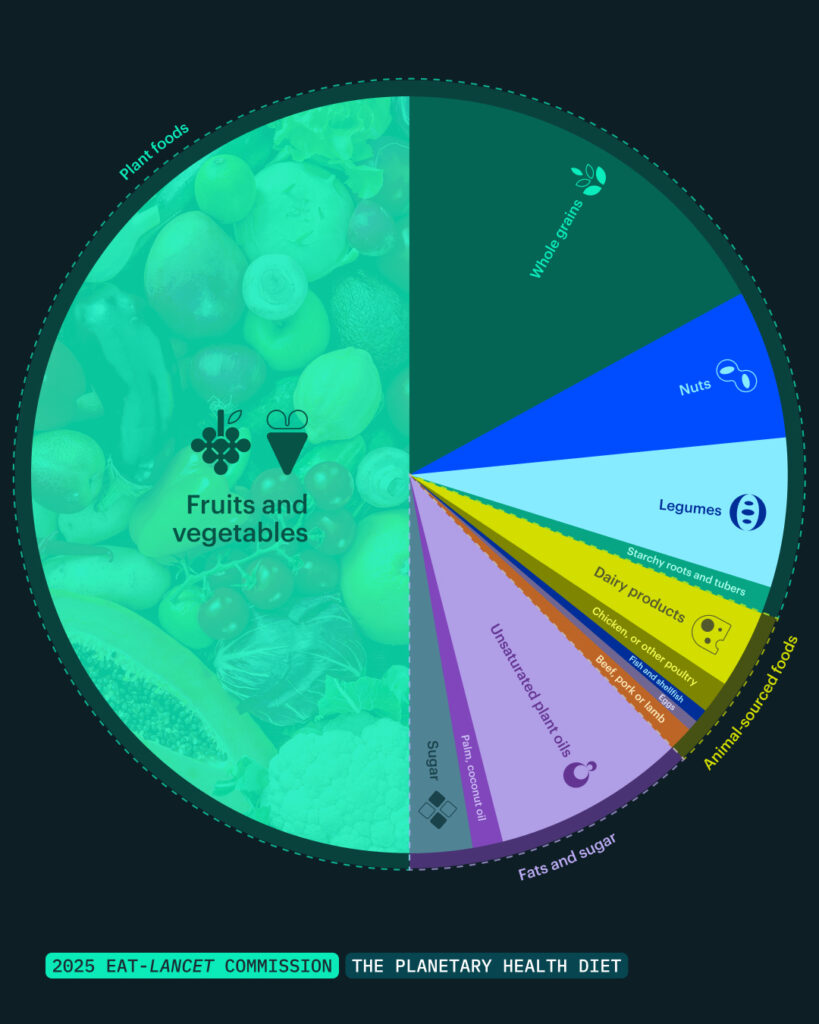
It recommends that fruits and vegetables should make up over half of people’s diets, while whole grains, plant proteins and plant oils should account for over a third. Animal proteins like dairy, meat and seafood should make up only 3.6% each.
According to the Commission, a transition to such a diet could help prevent 15 million premature deaths every year (more than a quarter of the total). And combined with goals to halve food waste and boost agricultural productivity, the Planetary Health Diet could lower emissions by 20% by 2050.
Now, a new analysis argues that the shift towards a plant-rich food system wouldn’t come without challenges, primarily for the livestock industry, which makes policy intervention critical.
“Transforming food systems would deliver enormous potential benefits to our health and the environment but, as our results make clear, they would also lead to fundamental changes to global agriculture and affect the lives of millions of farmers and food producers,” said lead author Matt Gibson, who began the research when he was at Cornell University.
“Rather than using these results as an excuse for inaction it’s critical that governments rise to the challenge and make difficult decisions for the good of our health and the planet. This means confronting powerful groups that profit from the status quo and a global food system that currently fails both those who produce our food and those who should be nourished by it.”
Decline in livestock production would be offset by plant-based food hike
The analysis, published in Nature, used 10 food system models to compare a business-as-usual eventuality until 2050 with a transformation scenario characterised by a shift to the Planetary Health Diet, improved agricultural productivity, and halved food waste (as outlined by the Eat-Lancet Commission).
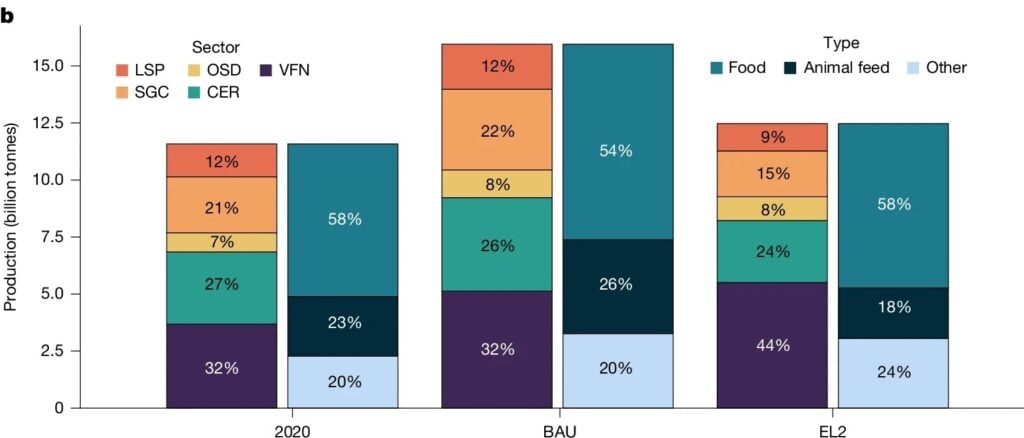
In all models, the business-as-usual scenario led to increased livestock numbers, larger harvested areas, higher production levels, and greater environmental impacts, like greenhouse gas emissions and nitrogen fertilisation.
Under the transformation approach, however, a larger share of agricultural products would be used directly for food, with a smaller amount going to animal feed. This would also lead to lower meat, dairy, cereal and sugar crop production, reduced animal inventories, less pressure on land resources, as well as reduced production costs and producer prices.
Compared to 2020 levels, the transition to healthy diets would lead to a 42% decrease in the production value of livestock animals (amounting to $630B), with ruminant numbers dropping by 400 million by 2050.
However, this would be contrasted by a 57% increase in the production of vegetables, fruits, nuts and legumes, totalling an economic value of $890B, which would more than offset the losses from livestock productivity.
The environmental benefits are a major draw, too. In contrast with a business-as-usual scenario, a food systems transformation could reduce agricultural land use by 9%, and lower the net carbon emissions from land use change by 76%. Direct non-CO2 emissions from agricultural production would fall by a third, too.
So although the adverse effects of such a shift would be concentrated towards livestock-oriented rural economies, the public health and environmental gains will be more widely distributed. “Continuing on the current path is the more expensive option,” said Hermann Lotze-Campen, research department head at the Potsdam Institute for Climate Impact Research (PIK), and co-author of the study.
“Providing healthy diets for a growing global population by 2050 would maintain the overall value of agricultural production near 2020 levels, while simultaneously reducing environmental and health costs compared to business-as-usual,” he added.
Scientists call for ‘coherent food and agriculture policies’
The researchers suggest that the impact of a food systems transformation on agriculture at a regional and national level would vary. For instance, in the US, overall farm production value would drop by 21% by 2050 (from a 2020 baseline), but within this, crop value would grow by 20% and livestock value would shrink by 73%.
In India, overall agricultural production value would increase by 46%, within which the value of crops would be boosted by 65% and livestock would decline by 8%. And in Europe, agricultural production would witness a 35% dip in value, with crops down by 8% and livestock by 66%.
“We should consider these scenarios not as a forecast of what will happen, but as a useful early guide of where challenges and opportunities may arise,” said co-author Daniel Mason-D’Croz from Cornell University.
“Which sectors would need to contract, and which would need to expand? A transformation of this magnitude cannot begin in 2050. Foresight modelling like that highlighted in this study is a valuable tool to inform actions today for more sustainable, healthy, and just food systems tomorrow,” he added.
The study, which was supported by the Gates Foundation, also assumes a costless consumer preference shift towards healthy diets – in other words, people would change their behaviour to demand this dietary shift. In reality, however, changing behaviours is a big challenge, with accessibility, affordability, food culture, and individual tastes all contributing to food choices.
Still, PIK highlights a “clear need to shift towards healthier and more sustainable food systems”. The authors concede that the potential socioeconomic and livelihood impacts of the transformation scenario “will probably mean that it is politically contested”, which is why they’re calling for “bold policy decisions” to support vulnerable groups, producers and consumers.
“While the environmental and health opportunities are huge, managing structural challenges within the agricultural sector will require coherent food and agriculture policies and inclusive stakeholder dialogues,” said PIK scientist and study co-author Felicitas Beier.
The analysis is the latest to highlight the potential benefits of the Eat-Lancet approach. Other research has shown that following the Planetary Health Diet could lower global emissions by between 17% and 29%, and reduce the risk of premature death by 30%.