
Europe’s farmers are calling for more support to accelerate a shift towards plant-based farming and diversify their incomes, something the agricultural commissioner has promised as part of the protein plan.
The EU has vowed to help farmers diversify their activities and grow more plants in its forthcoming protein strategy.
“We need to support farmers who are making EU agriculture more resilient through diversity,” Christopher Hansen, the agricultural commissioner, stated in a keynote speech at a cross-party European Parliament event last week.
“The next Common Agriculture Policy, the Common Market Organisation [regulation], and the soon-to-be-published Protein Plan will support this process. The political direction is clear,” said Hansen,.
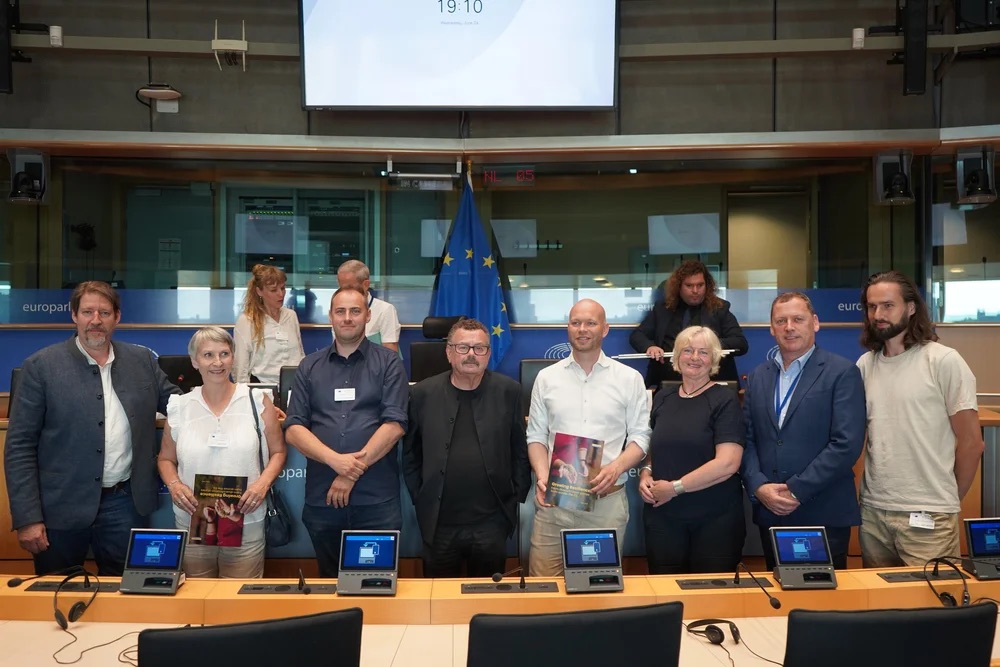
The event featured European farmers exploring new opportunities in the plant-based food sector, and was supported by a civil society coalition calling for an EU Action Plan for Plant-Based Foods.
The panellists at the event discussed findings from a new report by this group, which highlights dozens of cases of successful diversification initiatives by European farmers, as well as the barriers and opportunities for a large-scale shift.
It comes nearly two years after the publication of the Strategic Dialogue on the Future of EU Agriculture, in which farmer lobby groups and climate activists advocated for an EU-wide action plan for plant-based foods. Last year, Hansen confirmed that the EU would create a protein diversification strategy.
Diversification improves quality of life for two-thirds of EU farmers
Why are we talking about diversification at all? You can blame climate change for that. Animal proteins like meat and dairy are responsible for 81-86% of the EU’s embodied greenhouse gas emissions and occupy 71% of its farmland, despite only supplying 32% of its calories and 64% of its protein intake.
And as they exacerbate the climate crisis, this, in turn, affects livestock production. By diversifying towards planet-friendly, plant-based agriculture, farmers can unlock an additional income stream and make the regional food system more resilient. It can also cut the EU’s farm emissions by 5% by 2035.
The coalition’s Growing Resilience report offers a glimpse into 33 farmers across 18 EU member states who have diversified into plant-based farming, introducing crops such as soy, fava beans, oats, hemp, and hazelnuts, and making products such as tofu, tempeh, pasta, and dairy alternatives.
Nearly 40% of farmers expanded their horizons from 2020 onwards, with 12% completely switching to plant-based farming and 42% diversifying into mixed farming with both livestock and plants.
The farmers interviewed in the report cite a range of motivators behind this shift: entrepreneurial curiosity, growing demand for plant-based foods, environmental benefits of new crops, and time- and risk-management advantages.
“Environmental problems, soil degradation, pollution and biodiversity loss from decades of intensive monoculture led us toward diversification,” said João Valente, a Portuguese farmer. “Integrating a variety of crops and rotational livestock grazing improved nutrient cycling and reduced our reliance on external inputs.”
Two-thirds of farmers said diversification has improved their quality of life, while 43% reported a positive economic impact from the shift. Many of the farms are still in the investment phase and hope to see a net economic benefit in the coming years.
Moreover, diversification has great potential for “generational renewal” in Europe’s farm economy. The average EU farmer is 57 years old, but over half of the interviewed farmers are under 40, and these young farmers regard diversification, new crops, plant-based food products, and experiments with direct sales as promising new opportunities.
What Europe’s farmers want from their policymakers
While many farmers are interested in diversifying their production with protein crops or other plant-based products, significant barriers remain.
Among the challenges cited were a lack of access to the right knowledge and resources (such as quality seeds or irrigation), producing at a profit while often already in debt, difficult access to market, a lack of local or regional value chains, and strong competition from imported and cheaper products.
All farmers were in favour of the idea of an EU-wide action plan for plant-based foods, in combination with national agricultural diversification strategies.
They encouraged EU policymakers to update agricultural school curricula to spotlight diversification, support knowledge-sharing between farmers, ensure personalised high-quality advisory support on diversification, back research and field trials for new crops, and encourage private investment from breeding companies.
Further, the EU should offer investment support for on-farm processing of protein crops under the next CAP, and support for collective facilities through the CMO and the establishment of a protein crop sector. This can be facilitated through policies to improve conditions for private-sector financing, as well as through expanded investments from the European Investment Bank.
Ensuring a clear regulatory framework for agricultural aids (with no penalties for diversification) and simplifying the rules on plant-based food processing and direct production of these products at farm level are key measures.
Plus, farmers are calling on the EU to set up sectoral programmes under the CMO regulation to strengthen the plant-based value chain, prioritise local and sustainable food in public procurement, as well as improve marketing standards, origin labelling and VAT rates for plant-based foods.
“Regulatory uncertainty makes it difficult to try new things; when the framework is unpredictable, farmers tend to stay with what is safe and proven. We need to significantly reduce bureaucracy, especially for smaller farms. This includes streamlining food safety approvals and providing clearer, more predictable regulatory frameworks,” said Morten Malling Helsted, a mixed farmer from Denmark.
“The feedback from farmers reveals that the EU and its member states need to redouble their efforts to develop robust and integrated value chains for all types of local production of plant-based foods, including protein crops,” the report stated.
“Strengthening local production of these crops will not only offer farmers resilient business models in times of climate uncertainty, but also enhance Europe’s strategic autonomy.”