
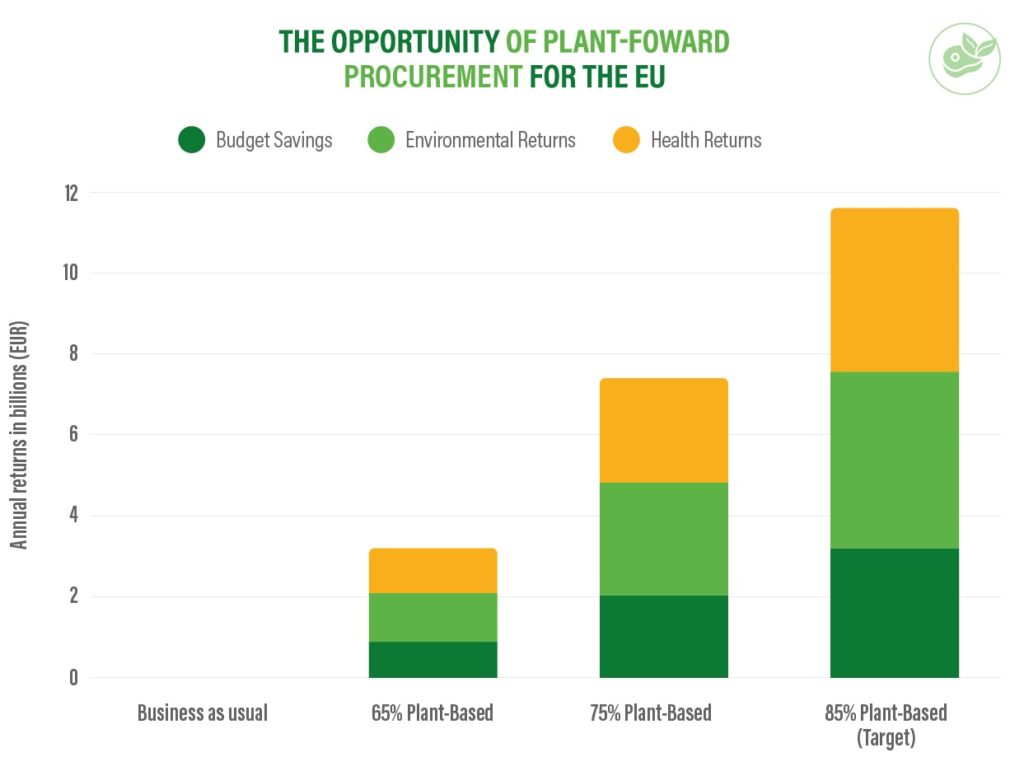
New modelling commissioned by ProVeg International finds that shifting EU public food procurement to 85% plant-based menus could generate €11.61 billion in annual savings and avoided costs when environmental and health impacts are factored in.
The research, conducted by Bryant Research and published as The €11 Billion Opportunity: Unlocking the Economic Potential of Plant-Forward Public Procurement in the EU, covers food served across schools, hospitals, universities, military institutions, and other public bodies throughout the EU-27.
“Public procurement is one of Europe’s most overlooked climate and health tools.”
Europe currently spends more than €45 billion annually on public food. According to the analysis, existing procurement patterns generate an estimated €8.43 billion in environmental externalities each year, costs absorbed by taxpayers through healthcare spending, climate damage, and environmental degradation.
“This is not a lifestyle debate, it is a fiscal and strategic one. Public procurement is one of Europe’s most overlooked climate and health tools. By shifting spending to 85% plant-based, the EU could save €3.16 billion directly from food budgets, and over €11 billion annually when environmental and health impacts are included,” said Jasmijn de Boo, Global CEO at ProVeg International.
Schools as a policy lever
The report identifies schools as a particularly significant intervention point, noting they account for 39% of institutional animal-based food consumption across the EU. Reforming school meals alone, according to the modelling, could function as a structural preventative health measure, reducing future adult obesity rates at population scale.
Timing and policy context
The findings arrive as the European Commission prepares to revise the EU Public Procurement Directive, with a proposal expected later in 2026. The reform process, which has been subject to public consultation since late 2025, is focused on mainstreaming sustainability criteria in public spending. ProVeg’s report argues that existing procurement mechanisms already allow for meaningful progress, but that targeted legislative amendments are needed to unlock the full projected impact.
The research also positions plant-forward procurement as a supply chain resilience tool, arguing that reduced dependence on animal-based food inputs lowers exposure to volatile agricultural costs and supply disruption, and aligns with proposals under the Common Agricultural Policy (CAP) 2028-2034.
“Public food purchasing is preventative fiscal policy hiding in plain sight. Adjusting menu composition is one of the fastest ways governments can influence emissions, healthcare costs, and public spending at scale,” de Boo added.