
A team at Appalachian State University has received a $1.82M grant to develop plant-based milk and dairy products from surplus sweet potatoes grown in North Carolina.
Potato milk has come and gone – is it time for the sweet potato now?
Researchers at Appalachian State University are betting on it with a new project to create plant-based milk from surplus sweet potatoes.
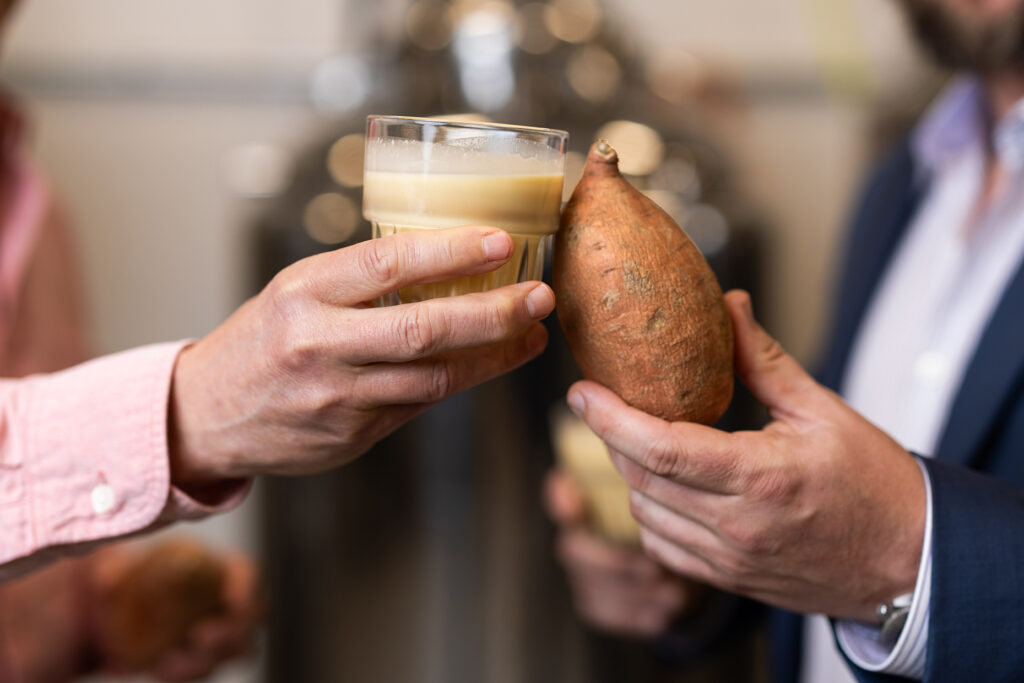
The team, led by Prof Brett Taubman, has secured a $1.82M grant from state-backed non-profit NCInnovation to take sweet potatoes from the US’s top-producing state and turn them into products like dairy-free milk, ice cream, creamers, and yoghurts, as well as fermented foods such as miso and hot sauce.
“The Rootsii project brings home the value of public impact research at App State,” said Christine Ogilvie Hendren, vice chancellor of research and innovation at the university.
“NCInnovation’s funding lends critical support to this novel approach of converting the unused material of a key North Carolina crop into a viable and nutritious product line,” she added.
Clean-label sweet potato milk redirects vast amounts of waste

North Carolina is home to 60% of the sweet potatoes grown in the US. However, 40% of the raw product can be lost between the field and the store shelf. In fact, 63 million lbs of these are left to rot in fields each year, costing farmers around $13.2M.
To make plant-based milk from sweet potatoes, the Rootsii team has created a patent-pending process that uses enzymes to break down the roots’ long-chain starches.
It’s described as having a smooth, rich taste and texture compared to other non-dairy milks, and a natural, mild sweetness without any added sugar. It’s also rich in micronutrients like vitamins A and C, potassium, and magnesium.
“This product is made out of only sweet potatoes, chia seeds as the emulsifier, a yeast-derived protein, and coconut oil,” said Appalachian State University professor Brett Taubman, who founded the Rootsi project with fermentation sciences lab manager Daniel Parker. “That’s cheap and easy to source as well.”
The coconut oil will eventually be replaced with muscadine grape seed oil, a waste product of the North Carolina wine industry. There are further environmental benefits: being locally sourced, sweet potato milk requires only a fraction of the water almond milk does.
The work to develop the non-dairy products has involved four undergraduate student researchers, who helped test production processes and formulations for yield, nutritional content, flavour, texture and other factors.
The non-dairy milk has already been developed, and refinement of the related products is set to follow. Rootsii will now begin consumer testing, shelf-life validation, production scale-up, and commercialisation.
Rootsii aims to reach supermarket shelves in two years
Launched in 2014, Rootsii is currently in the proof-of-concept stage and aims to be market-ready within two years. Taubman believes the company could create hundreds of jobs at scale, and seize a portion of the expanding plant-based milk market.
“The larger plant-based milk industry is already a multibillion-dollar industry, and in the next 10 years, it is expected to almost double. So it’s a huge growth industry,” he said.
The biregional production model involves a bulk-processing facility in eastern North Carolina, where the majority of sweet potatoes are grown, and a production site in Boone.
A number of partners are assisting this effort. The North Carolina Sweetpotato Commission will help secure the sweet potatoes, the Caldwell Community College and Technical Institute will support recipe development and product testing, and the High Country Workforce Development Board will aid in workforce development.
Meanwhile, the Boone Area Chamber of Commerce and Watauga Economic Development Commission will help develop economic opportunities and a workforce pipeline, and the High Country Impact Fund will provide mentorship to move the project into full commercial capacity.
Rootsii is also in talks with merchant distributors and beverage companies. “Rootsii offers a new pathway to revitalise demand for sweet potatoes and stabilise the regional agricultural economy,” Taubman said.
He pointed out that the sweet potato industry has been declining due to pandemic-era disruptions in distribution and shifting consumer habits. But they’re an ingredient prime for a reinvention through health-conscious, allergen-free products.
“We have our sweet potato casserole, our sweet potato pies, but we don’t necessarily eat sweet potatoes on a regular basis, even though they are nutritious and delicious,” he noted. “So that industry is desperately in need of innovation, and we have an innovation that should seriously help to promote it.”