
A new report shows that three in five homes in the US bought plant-based food in 2025, with the South spending the most money and the West leading in household penetration.
Most Americans who buy plant-based products in the supermarket come back for more, according to new research charting the regional performance of this category in the US.
The report, published by the Plant Based Foods Association (PBFA) and Plant Based Foods Institute (PBFI), found that retail sales of vegan food remained steady at $7.9B last year (compared to $8B in 2024). This figure is still more than twice as high as the 2019 total of $3.3B, reflecting the long-term growth of this category.
Notably, 60% of households bought a plant-based product in 2025, and 78% repeated their purchases. Meanwhile, high-growth categories signal evolving consumer demand: sales of ready-to-drink beverages were up by 12.1%, baked goods by 8.6%, and dairy-free creamers by 2.1%.
“Consumers across every region of the US are already voting for plant-based foods with their grocery dollars. American farmers, processors, and manufacturers can, and should, be the ones that supply them,” said PBFI executive director Sanah Baig.
“A thriving domestic plant-based sector means better foods for consumers, new markets for farmers, and a more resilient food system for everyone,” she added.
PBFA and PBFI analysed data across census regions to find that at least 95% of plant-based meat shoppers also put conventional meat in their grocery carts. This flexitarian segment represents roughly 14 million households, and is the core target audience for the sector’s expansion.
The West is the ‘benchmark market’ for plant-based
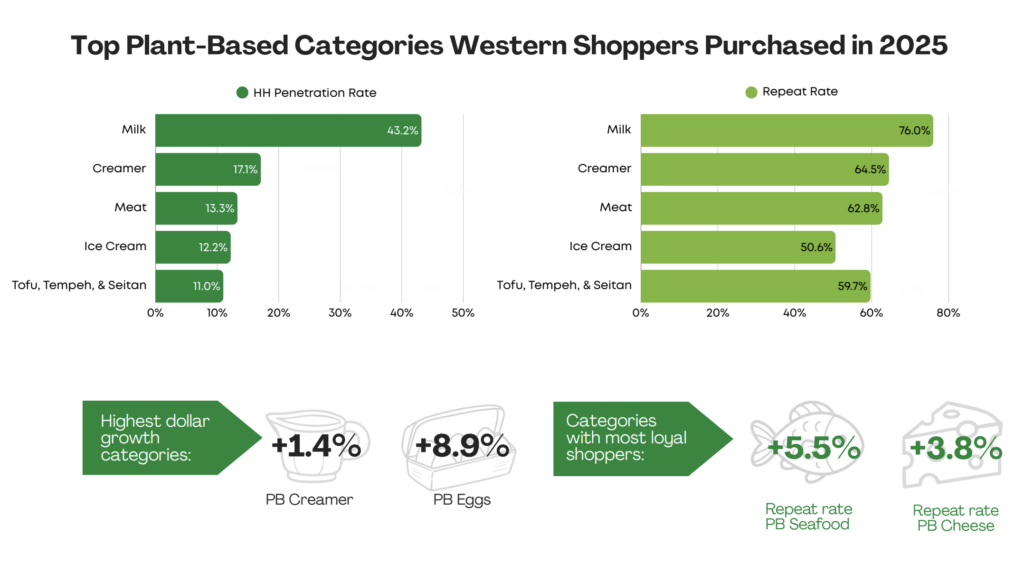
The Western region had the highest household penetration (67%) and repeat rates (81%) across the US, making it the “benchmark market” for the vegan food industry. That said, overall sales dropped by 2.3% to reach $1.9B.
Plant-based milk was the top segment, purchased by 43% of homes (with 76% returning for more). Meat alternatives were bought by 13%, but had a high repeat rate of 63%.
The products witnessing the biggest hikes in repeat rates were vegan seafood (+5.5%) and cheese (4%). And in terms of dollar sales, plant-based eggs experienced a 9% growth.
Traditional plant proteins like tofu, tempeh and seitan only made it into 11% of households, but once they did, 60% bought them again. And this region also spent more dollars on these proteins than the rest, accounting for 31% of the total.
California was by far the biggest market, with sales of meat and dairy alternatives four times higher than the next best (Washington). In Oregon and Colorado, over half of households bought non-dairy products, rising to nearly 62% in Wyoming. And in Montana, this share rose by 4.4% from 2024.
The South is the largest plant-based market
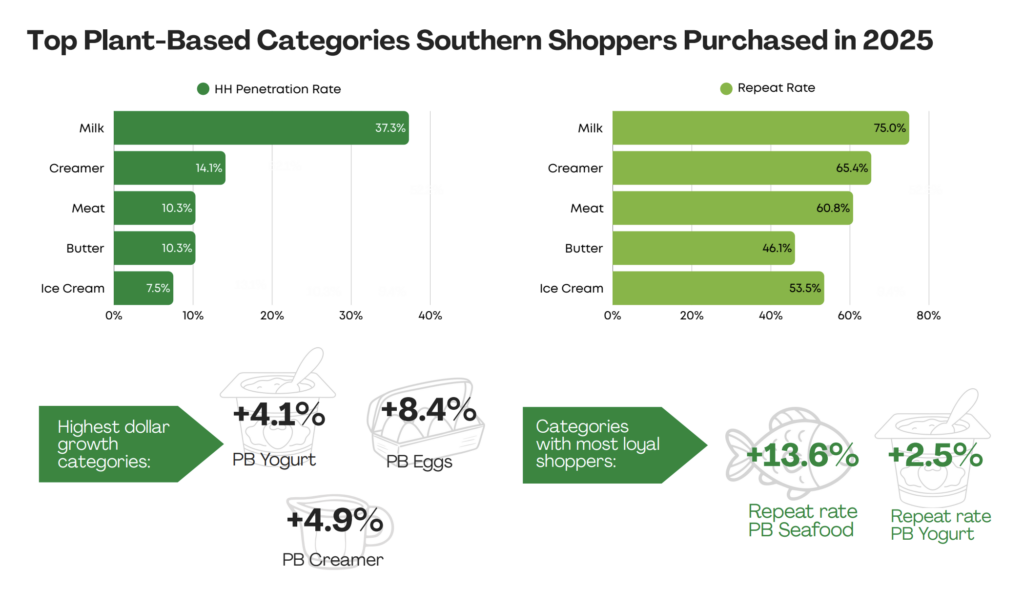
Southern states collectively represent the biggest market in terms of sales volume, contributing to 36% of total spend on plant-based food nationwide in 2025. Retail sales were largely stable, dipping slightly by 0.8% to reach $2.6B.
Plant-based products reached 58% of homes in the South, with repeat rates high at 77%. Non-dairy milk was purchased by 37% of them (and 75% came back for more). Only a tenth of them put meat analogues in their baskets, but after trying them, 60% bought them again.
Just like the West, fish-free seafood had the most loyal consumer base in the South, with penetration up by 14%, and sales of vegan eggs rose higher than any other segment (8%).
Texas and Florida were the two largest markets within the region, with the latter topping the charts when it came to plant-based dairy. Meanwhile, people in Delaware and Arkansas were more likely to buy meat alternatives than the average, with these products reaching 20% and 12% of households, respectively.
The number of households that bought plant-based dairy grew by 7% in Mississippi, 4% in Alabama, and 3% in North Carolina. Overall, Southern states accounted for 37 cents for every dollar spent on non-dairy alternatives across the US.
The Northeast is loyal, especially with vegan cheese
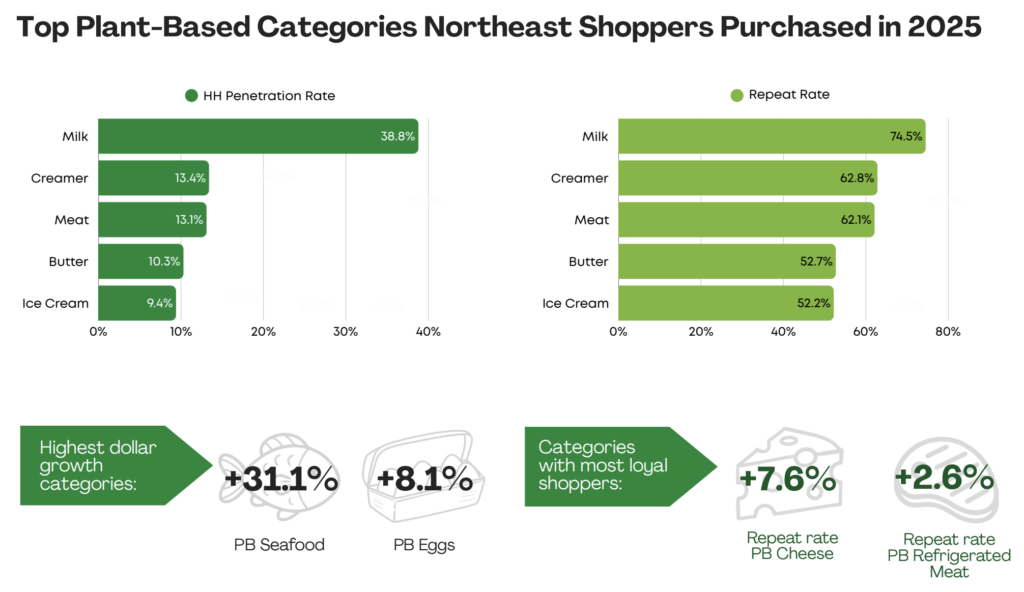
Sales of plant-based food fell by 1.4% in the Northeast, but this region was second only to the West in terms of household reach (61%) and repeat rates (79%).
Nearly 39% of homes picked up plant-based milk on their grocery runs, and 75% liked it enough to buy it again. For plant-based meat, penetration reached 13%, while 62% of households made repeat purchases – in fact, refrigerated meat alternatives experienced a 2.6% uptick in penetration.
Home to pizza-famous cities like New York City, Chicago and New Haven, the Northeast has a particular love for non-dairy cheese, which reached 7.6% more households in 2025.
When it came to dollar sales, seafood alternatives enjoyed a 31% rise, while vegan eggs saw an 8% increase. New York is the largest market for both meat and dairy analogues in terms of the number of shoppers, followed by Pennsylvania.
More than 50% of homes in New Hampshire, Rhode Island and Connecticut purchased a plant-based dairy product in 2025, while vegan meat and seafood reached 16% of households in Massachusetts.
The Midwest is the fastest-growing plant-based region
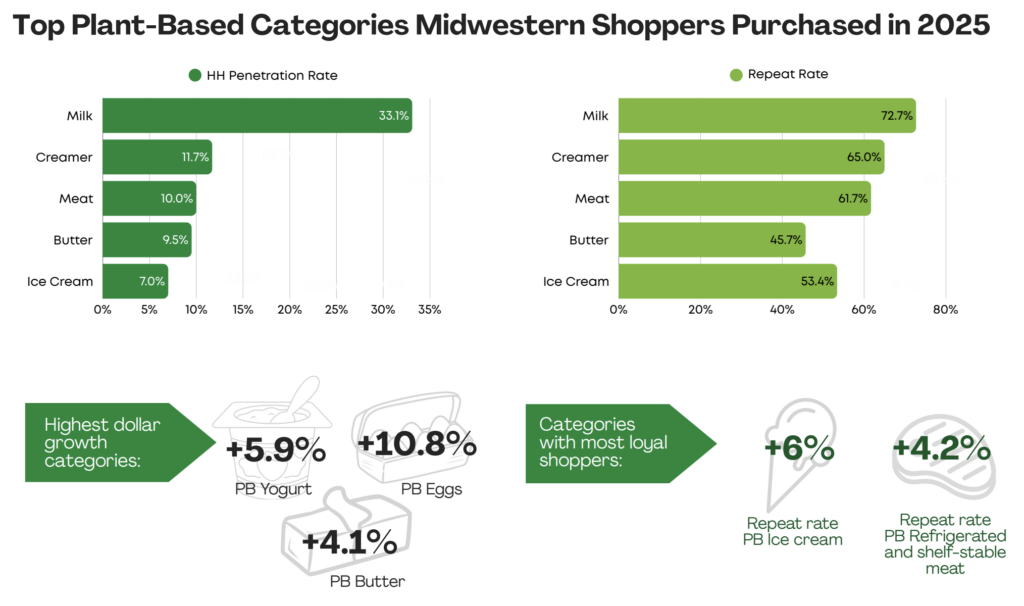
The only region where plant-based sales bettered their 2024 total was in the Midwest, whose staple crops include soybeans, oats, dried peas, chickpeas, and wheat. These states spent $1.2B on these vegan products last year (up by 2.4%).
And while this region has the lowest household penetration (55%) across the country, it’s also the fastest-growing on this metric (+2.7%). Repeat purchase rates remain high at 76%.
A third of Midwestern households drank plant-based milk in 2025, and 72% bought it again. Meat alternatives made it into 10% of homes (a 4.2% increase from the previous year), and 62% of them returned to the supermarket for more.
Repeat rates for ice cream were even higher (6%), while dollar sales rose for a number of plant-based segments, including eggs (11%), yoghurt (6%), and butter (4%).
Ohio had the highest number of plant-based meat shoppers in the Midwest, while Illinois topped the non-dairy list (both states had similar totals across each category).
The share of households that purchased dairy-free products climbed by 12% in Nebraska, 10% in North Dakota, 5% in Wisconsin, 4% in Indiana, and 2% in Illinois.
“Plant-based foods have become a routine part of grocery shopping for millions of Americans, and this report shows that demand is both widespread and durable. The regional data highlights where consumers are embracing plant-based foods most strongly today, while also pointing to significant opportunities for continued growth across the country,” said PBFA executive director Marjorie Mulhall.
“For manufacturers, retailers, and industry partners, these insights provide a roadmap for meeting consumers where they are and expanding access to the products they increasingly want.”