
Cultivated meat startup SuperMeat has raised $6M in fresh financing, as part of a targeted $10M Series A4 round, and filed for regulatory approval in Switzerland.
Six months after securing $3.5M in funding, Israeli food tech startup SuperMeat has received yet another boost from investors.
The firm has attracted $6M in the first close of its Series A4 round, led by existing investors Agronomics (which pumped in $5M through the issue of new ordinary shares) and New Agrarian Company (which invested $1M).
Milk & Honey Ventures and other existing backers have also subscribed as part of a targeted $10M fundraise. The initial closing takes SuperMeat’s total funding to $24.5M to date, and will support its licensing-based commercialisation model.
The startup is targeting Switzerland as its launch market, having filed for regulatory approval to sell its cultivated chicken in the European country.
SuperMeat hits several milestones ahead of reorganising under UK company
The funding will help SuperMeat advance its path to market, for which the company has notched several partnerships over the years.
Since 2022, it has been engaged in an R&D and technology development framework agreement with Japanese conglomerate Ajinomoto, an investor in the startup that has been expanding its horizons in the future food sector lately. Last month, Ajinomoto developed a plant-derived transferrin protein alternative to significantly lower culture media costs for cultivated meat.
It has also extended its ongoing collaboration with meat processor Micarna Group, a subsidiary of leading Swiss retailer Migros Group, through which it aims to produce and distribute cultivated chicken in Switzerland.
Last year, SuperMeat joined forces with Argentinian biotech company Stämm to enhance yields and lower costs through process optimisation, with a view to bringing cultivated chicken to market by 2026.
And in 2024, a life-cycle analysis conducted by CE Delft concluded that SuperMeat’s cultivated meat could generate roughly 50% fewer carbon emissions than conventional chicken.
According to Agronomics, near-term milestones for the startup have since included joint product development with Ajinomoto, a Swiss consumer validation study led by Migros, process verification at commercial scale, and a Swiss regulatory submission.
Fellow Israeli startup Aleph Farms and Dutch firm Mosa Meat are also awaiting the regulatory green light for their cultivated meat innovations in Switzerland. The two are among several startups to have submitted an application in the UK, too – and now, SuperMeat is progressing a reorganisation under a UK holding company.
Cost reduction and scalability key to funding success for cultivated meat

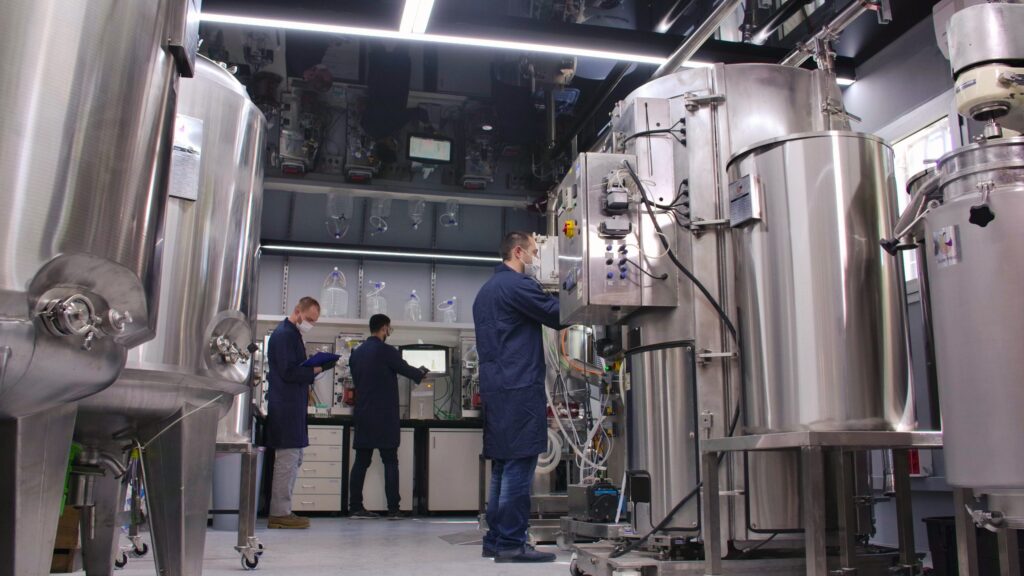
SuperMeat uses a continuous process to produce muscle and fat from chicken cells. These are grown in a seeding bioreactor, where they’re provided warmth, oxygen and nutrients. This helps them mature into meat tissues just like they would in an animal’s body. Once the cells reach the desired density, they’re harvested by removing the remaining liquid feed.
The meat mass is harvested daily in the form of ground chicken that’s ready to be cooked. The process requires minimal space and resources and produces three lbs of meat (the same as the yield from one chicken) in just two days, compared to the 42 days it takes to raise and process a chicken.
The startup’s robust, self-renewing cell line allows it to reach densities of 80 million cells per ml in just nine days. It has developed a high-throughput system that replaces expensive animal-derived ingredients like serum and albumin with more affordable alternatives, resulting in media costs of under 50 cents per litre.
Speaking of which, in 2024, SuperMeat made several breakthroughs to make its cultivated chicken more affordable. The combination of a highly stable cell line, a fully controlled animal-free media formulation, and rapid differentiation protocols helped it achieve production costs of $11.8 per lb at a 25,000-litre scale, in line with the price of premium chicken in the US.
And importantly, these cost advancements are based on a 100% cultivated chicken product (with 85% muscle and 15% fat), not a hybrid version with minimal cell-cultured ingredients and a larger share of plant-based inputs.
As part of its Series A4 round, SuperMeat’s SAFE investment from November has now converted into equity, with the shares now forming part of Agronomics’s holding in the startup. The British investor has now invested £15.2M ($20.5M) in the cultivated meat maker and holds 27.8% of the business.
The funding is a vote of confidence for the wider cultivated meat sector, which has struggled to attract investors. Last year, startups in this segment raised only $74M, nearly half of the funding total from the previous year, and 20 times less than the peak investment levels seen in 2021.
But startups with cost-efficient, scalable pathways to market are bucking the trend – last week, London-based Meatly secured £10M ($14.1M) to establish Europe’s largest cultivated meat facility, with pet food product launches slated for 2027.