
US startup Brami has raised $33M in Series B funding to expand its plant-based protein pasta portfolio and bring the range to more stores nationwide.
Two ingredients, high in protein and fibre, and centred around beans – those are the characteristics that have made Brami the fastest-growing pasta brand in the US.
The lupini bean pasta maker has now brought in $33M in a Series B investment round led by VMG Partners, which it will use to introduce new shapes, enter more retail doors, and bolster its Italy-based supply chain, founder and CEO Aaron Gatti told Forbes.
“This is a huge step towards bringing the Brami vision to life via sharing uncomplicated food inspired by my childhood with more Americans. I’m so grateful for the journey ahead, and all the special meals we will share together,” Gatti said in a LinkedIn post.
Brami bets on ‘old-world’ ingredients to create plant protein pasta
Founded in 2014 when Gatti was an entrepreneur-in-residence at VC firm Lerer Hippeau, Brami launched into the US market in 2016 with a range of pickled lupini bean snack pouches.
“Lupini beans have the highest density of protein and fibre per calorie of any crop grown on the planet,” Gatti told Forbes. “They’re naturally low in trypsin inhibitors, lectins and phytates that make other beans hard to digest, and they’re naturally umami in flavour.”
Moreover, lupini beans – aside from being rotation crops that fertilise the soil – have strong root structures that can replenish nitrogen and phosphate into the ground. They’re also naturally pest-resistant and require low amounts of water.
After gaining traction through listings in national retailers like Whole Foods Market and Wegmans, Brami began working on its protein pasta lineup, eschewing protein isolates for whole lupini beans. It introduced the plant-based range in 2021.
“Our intention was to craft a nutritious pasta that doesn’t compromise on great taste, texture, and pure joyful eating,” Gatti wrote on LinkedIn. “Instead of cutting corners, we invested in timeless production methods and just two old-world ingredients to create authentic bronze-cut pasta from premium durum wheat semolina and lupini bean flour.”
Brami’s pasta uses a different variety of lupini beans than the pouched snacks – they’re a naturally selected, sweeter version that don’t need curing, and so can be milled into a flour.
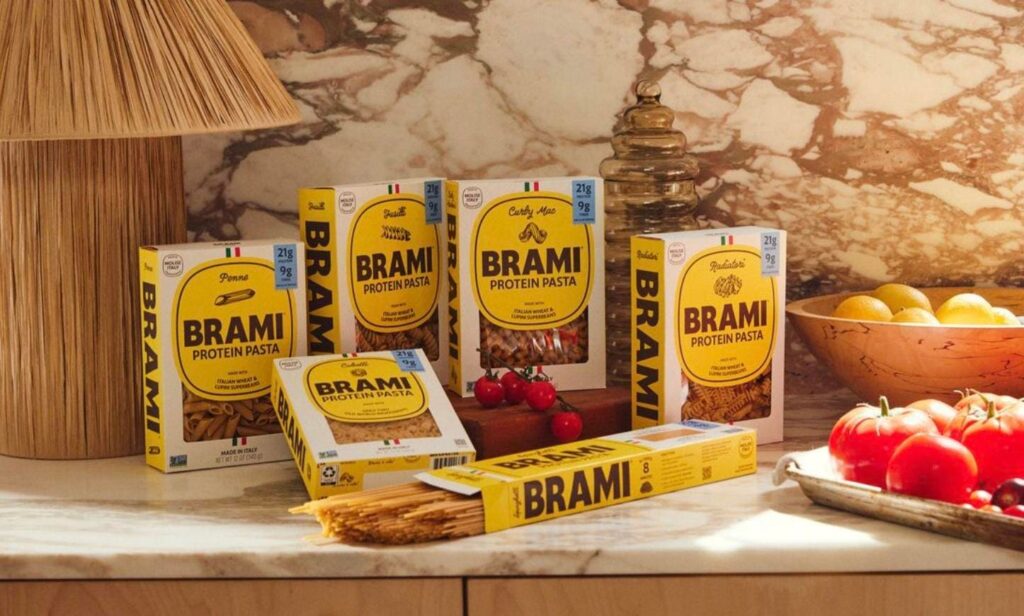
The brand sells the pasta in five shapes – spaghetti, curly macaroni, fusilli, penne, and radiatori – with each 100g serving containing 21g of protein and 9g of fibre. That’s three times higher on both counts than the conventional pasta sold by Barilla, the world’s largest pasta brand.
Meeting the anti-UPF, GLP-1-fuelled proteinmaxxing era
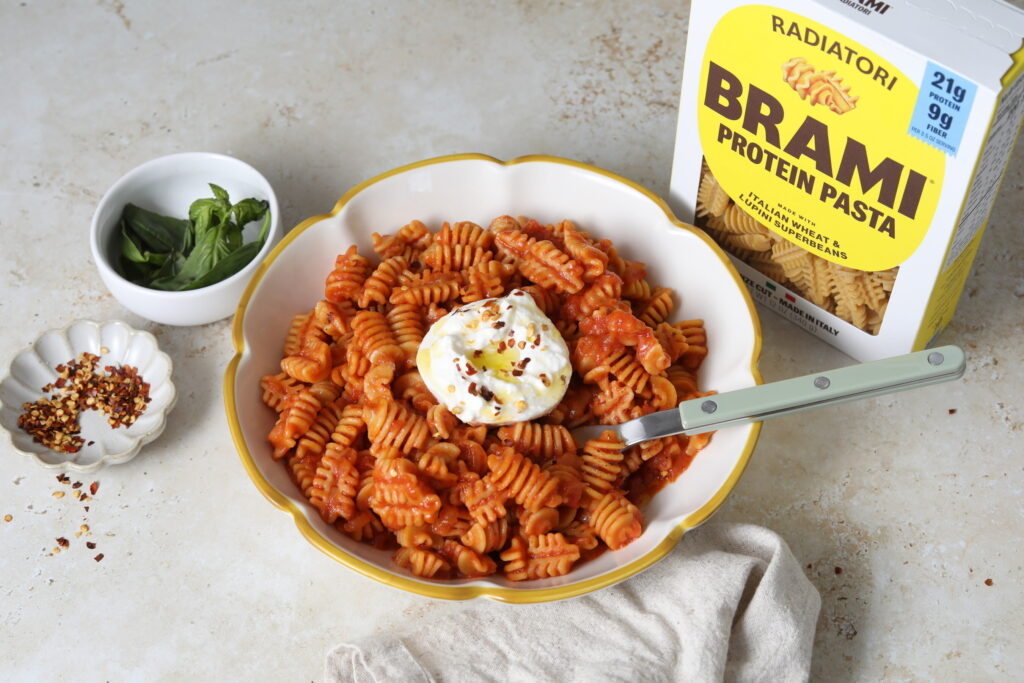
Brami’s popularity among consumers and investors can be explained by the fact that it hits on several key health trends in the US. The protein pastas only contain two ingredients, fitting into the clamour for non-ultra-processed foods.
Americans now get 55% of their calories from UPFs, and while some health experts have linked these to a multitude of health ailments (and even premature death), others have argued that processing levels shouldn’t be conflated with nutritional value, since many UPFs can actually be good for you.
Nevertheless, these products now top Americans’ list of health concerns. Now, 72% of them are trying to avoid these UPFs in their diets, and 79% feel they’re a “significant threat” to public health. This has also led to a shunning of foods with long ingredient lists and an embrace of formats that champion whole foods.
Meanwhile, 57% of Americans are making protein a priority this year, a trend fuelled by factors such as the new national dietary guidelines and the rise of GLP-1 drugs.
People who use drugs like Ozempic experience a 25-40% decrease in muscle mass over 8-16 months (much more than with non-medicated weight-loss approaches and age-related muscle loss). According to Innova Market Insights, the share of Americans on GLP-1 medications rose from 10% in 2024 to 18% in 2025, and 40% of those on GLP-1 medications are consuming more protein.
All that has doubtless contributed to Brami’s growth. In 2025, the company’s sales skyrocketed by nearly 440% to reach $14.7M, while unit sales were up by 284%. This year, the profitable business is expected to expand by a further 400%, according to Forbes.
Brami, which has partnered with the New York Yankees for the 2026 season, is now entering all Walmart stores nationwide, alongside Kroger, Costco, Whole Foods Market and Target locations, surpassing 4,000 distribution points. It will also launch exclusive pasta shapes at the latter two retailers, including cubetti.
Speaking to Forbes, VMG Partners principal Wayne Wu said: “Brami has all the makings of becoming a transformational brand in a longstanding category that has the opportunity to seed its next chapter.”