
New retail price data covering Germany, Spain, and the UK show a sustained widening of the price gap between conventional meat and plant-based proteins, with beef recording the steepest increases since 2019.
“The relentless rise of meat prices across Europe is not good news for people struggling to feed their families”
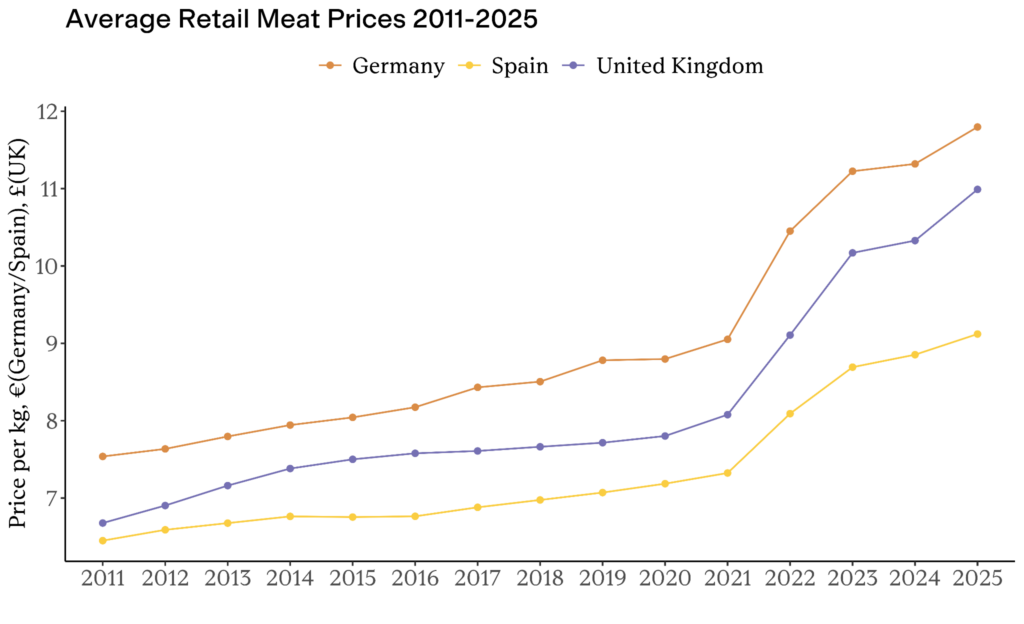
The analysis, conducted by climate and food advocacy group Madre Brava using data from market intelligence agency Euromonitor International, found that average meat prices have risen by between 29% and 42% across the three markets since 2019, with beef recording the steepest increases of up to 56% in the UK.
A shifting price equation
The more consequential shift may be in how plant-based meat alternatives (PBMAs) now compare to processed meat. In Germany and the UK, PBMAs have moved from being more expensive than processed meat in 2019 to cheaper by 2025. Spain, where the PBMA market remains less developed, has seen the gap narrow substantially over the same period.
Madre Brava’s Chief Programme Officer, Nico Muzi, attributed the trend to forces unlikely to reverse. “The relentless rise of meat prices across Europe is not good news for people struggling to feed their families. And this is just the beginning of a new normal where prices will continue to rise because climate change, wars and the decline in livestock numbers are long-term trends.”
Calls for supermarkets to act
Madre Brava is using the findings to press European retailers to accelerate the shift toward plant-rich ranges. The group is calling on supermarkets to set concrete targets to ensure at least 60% of all foods sold are plant-based by 2035, with protein-source food sales reaching at least 33% plant-based. A recent Madre Brava benchmark of 27 supermarkets across eight European countries found only seven had developed detailed roadmaps to reduce near-term supply chain emissions.
The opportunity, Muzi argues, is one retailers can act on now. “The good news for consumers is that the price of healthy, sustainable proteins such as beans, lentils and tofu has not increased as much, so they’ve stayed relatively cheap.
“This provides supermarkets with an opportunity: they can make money and help their customers weather the cost of living crisis, while also getting more fibre, by committing to increasing the proportion of beans, lentils, tofu and plant-based meat alternatives they sell.”