The German government has released a biotechnology roadmap that includes creating an innovation hub for cultivated meat and precision-fermented foods, and advancing novel food regulation.
Last year, Germany’s Scientific Advisory Board on Agricultural Policy, Nutrition and Consumer Health advised the government to step up its support for plant-based, cultivated, and fermentation-derived foods.
Its report, presented to agrifood minister Alois Rainer, highlighted the climate, health, economic, and animal welfare benefits of alternative proteins and called for policies that put them on the “common table” alongside animal proteins and conventional plant-based foods.
Already the leading plant-based market in Europe, Germany is now heeding those calls with a new biotechnology roadmap that spotlights cultivated meat and precision-fermented foods as part of the country’s High-Tech Agenda.
The roadmap was presented by the Federal Ministry of Research, Technology and Space, which aims to make Germany a top location for health research and biotechnology, advance innovative medical technology, and develop a crisis-proof agrifood system.
Among the targets under the latter goal are the establishment of a national innovation hub for alternative proteins, and achieving technological milestones to put locally developed cultivated meat and precision-fermented proteins on the market.
Germany charts path to price parity with innovation hub
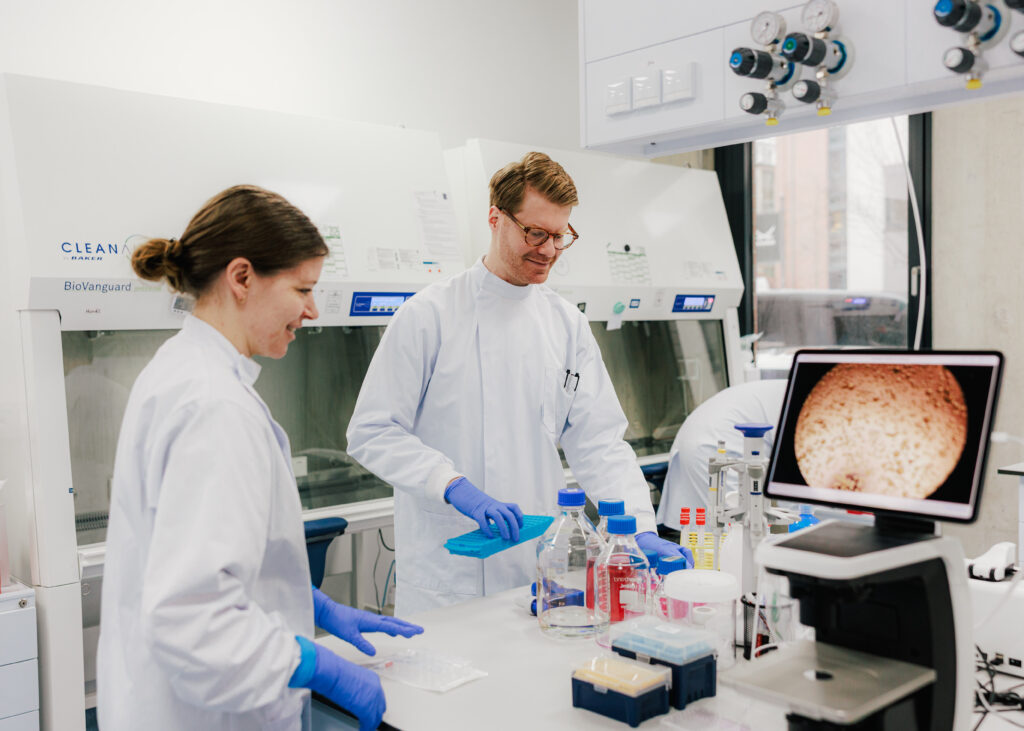
The innovation hub, set to open in 2027, will help consolidate previously scattered research activities, minimise duplication, and accelerate the commercialisation of research results, according to the Good Food Institute Europe.
It cited the example of similar centres in the UK and Sweden, where industry, academia and policymakers are working together on open-access research to advance the protein transition.
The think tank’s research shows that Germany has published more scientific research on alternative proteins than any other European country in recent years, while ranking fourth in patents. “Getting the policy and infrastructure to match that research strength has taken time,” GFI Europe managing director Alex Mayers said in a LinkedIn post.
There’s a notable public funding gap here. Between 2020 and 2025, Germany invested €79M in this space, equating to less than €1 per capita. That puts it behind the UK, the Netherlands and several Scandinavian countries. Plus, the majority of investment has been focused on plant-based proteins – only around a fifth of the funding went to cell cultivation or fermentation.
In its biotech roadmap, Germany’s government said it would utilise the “specifically leverage existing innovation potential” by pooling publicly funded research activities, networking firms, and research institutions.
It will also strive to achieve competitive production costs for these novel foods by 2028, which would be underpinned by milestones like cell densities of over 100 million cells per ml in stable cultures, slashing bioreactor costs in half, and reducing nutrient media prices by 90%.
German government bats for novel food regulatory sandboxes

Cultivated meat and precision-fermented foods are subject to novel food regulation in the EU, a complex, lengthy and expensive process that has hindered their progress in the region and forced many players to look elsewhere to commercialise.
One way to fast-track this process is to create regulatory sandboxes, controlled environments that allow businesses and researchers to work with regulators to design standards and guidance for new products. But novel foods are the only category left out of the new food and feed sandboxes in the EU’s first Biotech Act, a decision that has faced pushback from some of the world’s largest food companies.
Germany’s biotech roadmap identifies the need to implement the novel food regulation efficiently and transparently, and calls on the EU to include novel foods in the regulatory sandboxes being created under the Biotech Act.
“It is encouraging that the roadmap highlights the role of efficient and transparent approval processes and calls for the EU Biotech Act to include the possibility of establishing regulatory sandboxes for novel foods,” said Ivo Rzegotta, GFI Europe’s lead for Germany, Austria and Switzerland.
Research shows that Germany’s alternative protein sector could generate €20-65B in annual value by 2045 and create between 115,000 and 250,000 jobs. GFI Europe said the roadmap puts the country on a promising path to making this a reality.
“The inclusion of cultivated meat and precision fermentation in the high-tech agenda is a first crucial step towards implementing the coalition agreement’s plan to advance sustainable alternative proteins,” said Rzegotta.
“To support the impact of this plan on Germany’s innovation power and technological sovereignty, it is now crucial that the announced innovation hub is secured with sufficient funding and that it is designed in an interdisciplinary manner with industry participation,” he added.