Nearly half of the EU’s member states levy higher VAT rates on plant-based meat or dairy, and no country taxes these alternatives less than animal proteins, finds new research.
Taxes still play a key role in the price gap between plant-based products like oat milk and animal proteins like dairy in the EU, according to a new report by the European Vegetarian Union (EVU).
The analysis found that 12 of the 27 EU member states apply higher VAT rates to at least one vegan food product than its animal equivalent. Plant-based milks face higher levies in eight countries; margarine, yoghurt, meat and mince in five; and cheese, cream, fish, tofu, tempeh and seitan in four.
The EVU’s research covers 33 product categories organised into 15 direct pairs and six traditional plant proteins. No member state applies lower rates to the plant-based items in any of the 15 pairs.
In fact, the only instance where a vegan product is taxed below an animal protein comes from Spain, which applies a 4% (super-reduced) rate to dry pulses, compared to the 10% rate on fresh meat.
VAT gap translates into price premiums for plant-based products
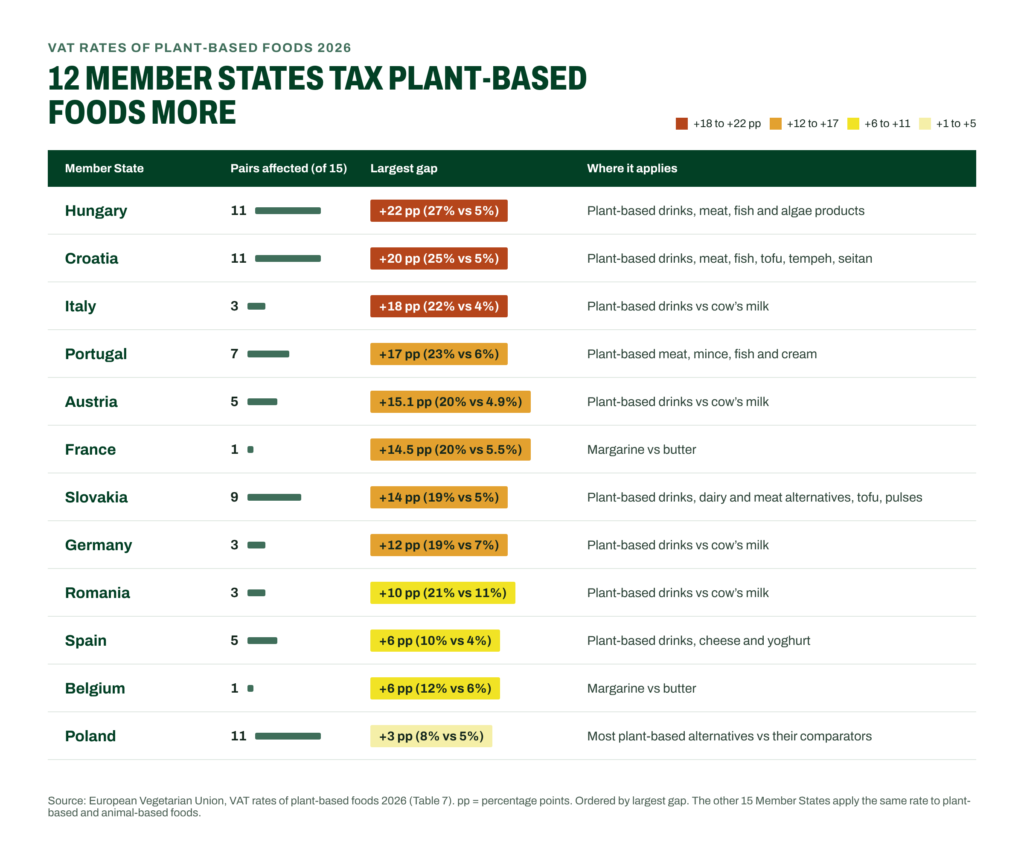
The largest absolute differences in VAT rates are in Hungary, where dairy-free milks and meat and fish alternatives are levied a 27% standard rate; their conventional counterparts are taxed at 5%, a 22-point gap (or a 440% increase for plant-based products).
Italy is home to the largest relative differential, with non-dairy milks taxed at 22% against 4% for cow’s milk (a 450% hike). In Portugal, meat and seafood analogues carry a 23% VAT (versus 6% for animal proteins), while plant-based milk, meat, fish, tofu, tempeh and seitan are subject to a 25% levy in Croatia (compared to 5% for their conventional equivalents).
Plant-based milk is the most affected category, with higher VAT rates in more countries than any other category, and differentials of six to 22 percentage points.
Of the 15 member states that apply a uniform tax across every surveyed food category, so that no product is assigned to a less favourable bracket, four have the lowest VAT rates in the EU: Ireland, Malta (both 0%), Luxembourg (3%), and Cyprus (5%).
The EVU singled out Latvia as a unique case. This country has a level playing field with a 21% VAT rate on most products. But to mitigate food price hikes, it has temporarily reduced the rate on milk, fresh poultry, bread and eggs to 12% until the end of June 2027. That exception, however, was not extended to plant-based alternatives.
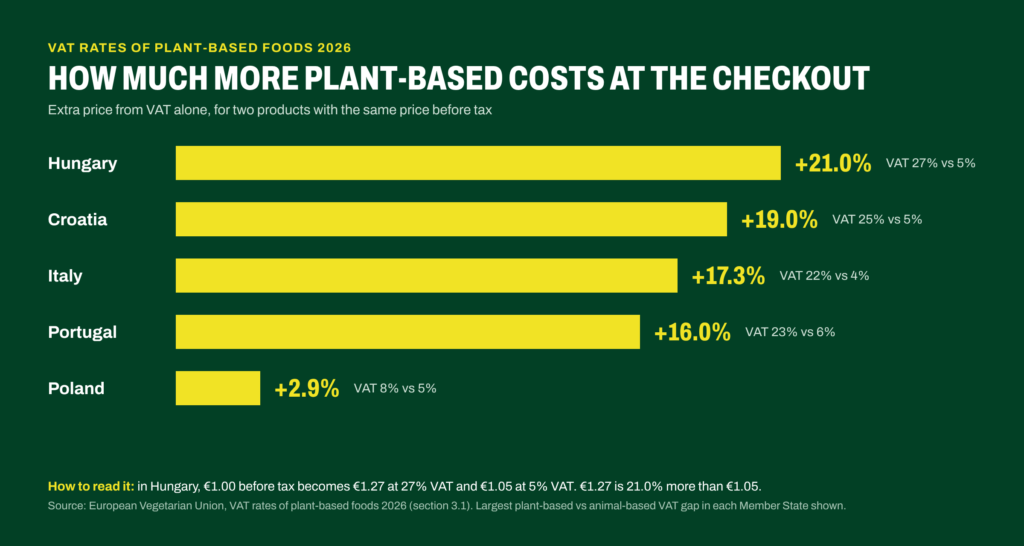
For consumers in the EU, the VAT differentials translate into price premiums for animal-free products. If two items have the same pre-tax price, VAT alone makes the shelf price of plant-based options 21% higher than meat or dairy in Hungary. For example, an oat milk and cow’s milk that both cost €1 before tax translate to €1.27 and €1.05 after, respectively.
Likewise, taxes widen the price gap between animal and plant proteins by 19% in Croatia, 17.3% in Italy, and 16% in Portugal. In contrast, the VAT gap is smallest in Poland, which is why the cost difference is only 2.9%.
“Modelling by the Joint Research Centre (JRC) finds that differentiated VAT rates shift EU consumption between substitute foods, most strongly when lower rates on healthier foods are combined with higher rates on less healthy ones, and retail data show plant-based sales volumes rising where prices fall, with increases of 30% or more reported by retailers that introduced price parity,” the report states.
Consumers, businesses and politicians alike support equal VAT rates
The report identified three mechanisms driving the VAT gap. The first has to do with classification: product lists and customs categories drawn up before plant-based alternatives reached the market leave them outside the reduced band by default.
Secondly, in some countries, reduced rates for meat and fish are confined to unprocessed products, as part of an origin-neutral rule that produces an origin-based outcome, so this can treat comparable products unequally because plant-based items are generally classed as processed.
Finally, certain legacy rates predate the plant-based category altogether, the difference between butter and margarine being a key example. Moreover, a related mechanism amplifies these effects: when a country lowers the VAT on essential foods defined by reference to animal proteins, the relief widens the gap with their plant-based equivalents.
The report notes that equal VAT can widen access to affordable protein at a time when food prices are top of mind for consumers, while also protecting the freedom of choice. The EVU calls it a matter of tax fairness, as a higher tax rate puts the burden on households that rely on such products and the farmers and businesses that produce them.
Plant-based sales rise when prices fall, with an analysis of Circana data finding that cost was a key driver of the increase in purchases last year. In France, meat alternatives became cheaper and their retail sales volume rose by 16.8%. In Italy, plant-based meat and milk posted sales hikes as average prices declined.

In Germany, Europe’s largest market for plant-based food, Lidl recorded 30% sales growth of these products in six months after pricing them on parity with or below animal proteins, and placing them side by side. And in Austria, Billa reported a 47% increase in sales of discounted private-label plant-based lines after introducing cost parity.
Both businesses and consumers have been calling on EU policymakers to level the playing field with respect to VAT, and 51.5% of parties polled by the EVU support the measure (only 16.7% oppose it).
“The EU legal framework already allows equal treatment. Since the 2022 reform of the VAT Directive, member states may apply reduced, super-reduced or zero rates to foodstuffs,” the report states.
“The differentials identified in this report therefore stem from national classification choices rather than from constraints in EU law. The differences, however, are broad and significant enough to justify common EU guidance on the classification of plant-based foods, especially given the targets of the EU Protein Plan.”