
9
The funding gap between fintech and agritech goes well beyond Africa. Historically, financial technology has attracted a large share of the world’s venture capital, and for much of the past decade it has been one of the most heavily funded startup sectors.
However, the reign has been shaken by the advent of AI, which has drawn an increasing share of venture capital since 2023.
What is seen in Africa is a reflection of the same global pattern, where fintech has consistently topped startup funding and attracted more investor attention and capital than most other sectors such as agritech.
Maybe the problem has not been the sector itself but rather a funding culture that favours quick returns.
What Makes Fintech So Attractive?
Returns! That’s the word every investor chases, and fintech promises it faster than most sectors in Africa.
Fintech appeals to investors because it serves an existing need at an enormous scale. Around 40% of adults own a mobile money account and one in five has no other financial account. Startups building on these networks can reach millions who already use their phones to pay, send and save money.

We are excited to share with you
This FREE E-Book of 50 Agritech Pioneers & Their Game Changing Innovations.
Download the Ebook now
That demand generates revenue quickly. Payments, transfers and loans bring fees or interest, so a fintech company can show traction within months. An agribusiness may wait for a planting or harvest cycle. Fintech is also less asset-heavy since software and licences can replace the farmland, cold rooms and trucks that agricultural businesses require.
Investors can measure fintech through transaction volumes, loan book size and default rates. These figures are easier to model than businesses exposed to harvest cycles and complex logistics. There are success stories, too. Paystack acquired by Stripe, Flutterwave, Interswitch and Moniepoint have reached billion-dollar valuations. These milestones show investors how a fintech investment can grow and deliver an exit.
In funding figures, fintech was Africa’s leading startup sector in 2025 with 37% of funding and energy followed at 27%. Familiarity also works in fintech’s favour. Investors in the US, UK and India have already watched similar models grow, so they know what a successful one looks like and can judge African companies against it. Farmers, traders and retailers all need to move money, which means a fintech company can grow with every industry around it without operating in any of them.
What the Funding History Tells
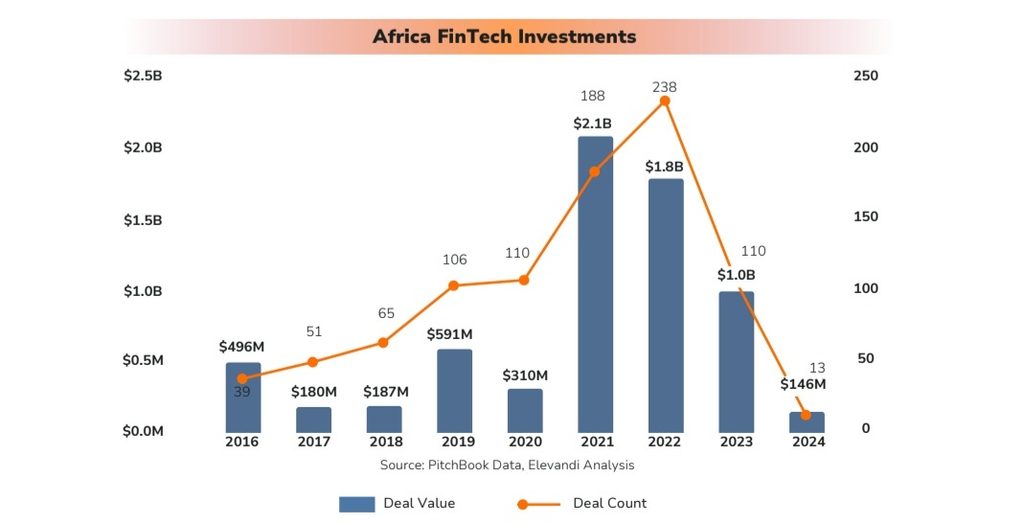
The funding history shows that African fintech has attracted billions of dollars in venture capital over the years although investment has fluctuated with global market conditions. According to Elevandi the sector raised $2.1 billion in 2021 before falling to $1.8 billion in 2022 and $1 billion in 2023.
Agrifoodtech on the other hand followed a different path. AgFunder estimates that African agrifoodtech ventures attracted $732 million in 2022 but funding fell by 62% to $275 million in 2023. The sector raised another $145 million in the first half of 2024. Over the preceding decade global investors had contributed a cumulative $2.4 billion to African agrifoodtech ventures.
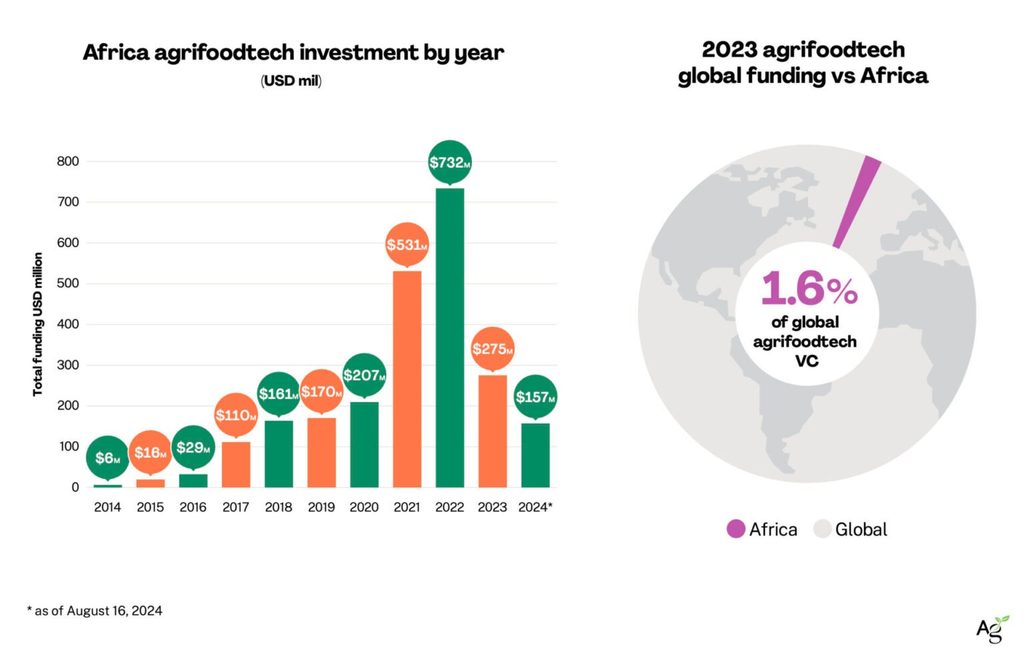
Now, let’s look at how funding has changed over the years. African fintech raised $496 million in 2016 and reached a high of $2.1 billion in 2021. Funding then fell to $1 billion in 2023. Agrifoodtech followed a different path. It attracted $732 million in 2022, but this fell to $275 million in 2023. The sector raised another $145 million in the first half of 2024.
That is a wide difference in the amount of capital flowing into both sectors. In 2023 fintech attracted roughly 3.6 times the funding recorded for agrifoodtech.
So for every $1 that went into African agrifoodtech in 2023, fintech attracted about $3.60. The gap points to a difference in investor appetite, but it also raises a bigger question about the types of businesses and returns that venture capital is willing to back.
The Realities of an Agritech Business.
An agritech business is tied to the farm calendar and that shapes how it earns. Most of those customers are smallholders spread across wide areas with modest incomes, which raises the cost of reaching each one and limits what each can pay.
Infrastructure and agriculture are not strangers. Every harvest depends on power, roads, storage and water long before it depends on a screen, and when these are missing, the cost lands on the farmer. In Africa, the lack of infrastructure works as a “heavy tax on production” that prices African goods out of global markets.
On the farm, that gap takes the form of missing power, roads and ports. Nearly 600 million Africans lack grid electricity, according to data tracked by the International Energy Agency. Even when produce reaches the coast, it can spend weeks waiting at some ports.
And although investors are beginning to turn bullish on infrastructure-focused agritech, the amounts are nowhere near what fintech attracts.
What Would Make Agritech More Investable?
Agritech becomes more investable when investors can see the risks reduced and the returns made clearer. Ways to consider:
- Match the funding to the business. Software and customer growth suit equity while processing plants and storage need long-term debt and blended finance.
- Reduce the risks investors cannot control. Weather-indexed insurance and guaranteed offtake agreements make revenue more predictable and let lenders price risk with more confidence.
- Show the numbers. Tracking yields, repayment rates and retention across seasons makes companies easier to assess. Building payments and credit into the offering also adds transaction data and a second revenue line.
- Create ways out for investors. According to Briter’s 2025 Report, fewer than 10% of more than 490 funded agtech startups tracked between 2016 and 2025 have raised over $10 million, and limited exit opportunities remain one of the factors that dampen investor confidence.
- Improve the operating conditions. Stable currencies, predictable regulation and public spending on roads, power and storage lower costs for every agritech company at once.
Investors fund what they can measure and exit, and agritech needs to offer both.
Can Agritech Ever Outraise Fintech?
Money follows opportunity, but it also follows the returns investors believe they can make. Fintech offers scale, frequent transactions and visible growth. Agritech often needs more time, infrastructure and patient capital.
Can agritech surpass fintech? It is possible, but that should not be the only measure of its progress. What the sector needs is more businesses that can turn agricultural challenges into commercially viable opportunities in the African Food systems.