
A government-funded university project in South Korea has developed a whole-muscle cultivated meat cut combined with plant proteins that can reduce production costs by up to 80%.
Scientists at a South Korean university have devised a way to give cultivated meat the texture omnivores desire while dramatically lowering costs for producers.
At the Gyeongsang National University, researchers have developed a 3D whole-cut cultivated meat product combining cultured animal cells with plant-based proteins. The protein has a chewy, fibrous texture and visible marbling, and takes 70-80% less capital to produce.
The project was funded by the Korean food and agriculture ministry and the Korea Institute of Planning and Evaluation for Technology in Food, Agriculture and Forestry (IPET) through a high-value-added food tech development programme.
“Domestic university researchers have secured world-class cultured meat technology necessary to solve future food issues,” an IPET official said. “We will provide full support to ensure this technology does not remain in the laboratory but reaches actual dining tables.”
Gyeongsang National University spins cells and plant proteins into fibres
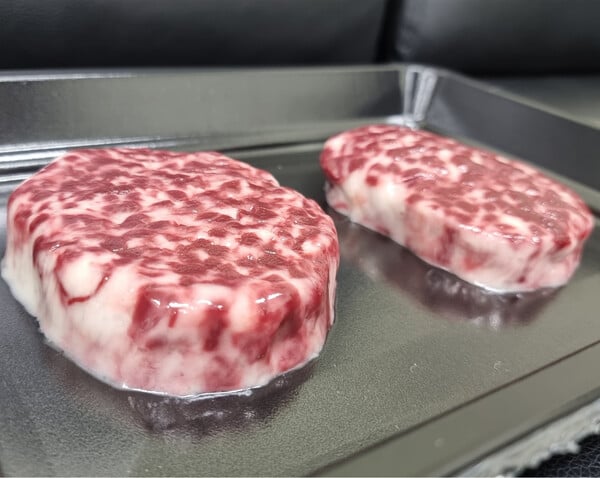
While earlier prototypes of cultivated meat emerged mostly from ground formats, such as burgers or nuggets, these often failed to live up to consumer expectations around taste and texture.
The team at Gyeongsang National University sought to change that with the hybrid approach, a strategy that has been adopted by nearly every cultivated meat startup that has managed to enter the market.
The researchers combined cultured animal muscle cells with pea, soy and wheat proteins, before spinning the mixture into thread-like artificial muscle fibres and bundling them together to create a 3D mass structure with a texture reminiscent of conventional beef.
They then coated the product with a blend of vegetable oils and beef tallow to reproduce the fat distribution, marbling and chewiness of steak cuts like sirloin and tenderloin,
They also developed factory-scale production equipment. This system extrudes and bundles fine muscle fibres in large volumes, in a process similar to pulling noodles, and creates a foundation for mass production of cultivated meat.
Moreover, the researchers lowered costs by reusing scaffolds used in cell culture and employing economical culture methods, marking a departure from expensive culture media and disposable scaffolds.
If their hybrid tech is commercialised, the product can be sold in the market for around ₩40,000 ($30) per kg, which is around half the price of grade 1 Hanwoo sirloin steak.
South Korea’s cultivated meat sector heats up
To commercialise their efforts, the research team had set up a startup, Orange Cow, from their lab in 2024. It is now proceeding with full-scale product development based on the completed prototype as it pursues commercialisation.
“This research is highly significant in that it represents a practical technology capable of reaching actual consumers’ tables, rather than remaining merely a laboratory achievement,” an IPET spokesperson was cited as saying by Korean publication The Buyer. “We will spare no continuous support until the product launch, including technology verification, licensing, and securing distribution networks,” they added.
Aside from the production and marketing aspects, regulatory approval looms as a major challenge. In South Korea, novel foods like cultivated meat are regulated by the Ministry of Food and Drug Safety, and to the government’s credit, it has supported the industry’s commercialisation efforts by creating a regulation-free special zone in Gyeongbuk.
This zone is home to the Cell Culture Industry Support Center, as well as Uiseong County’s upcoming 2,660 sq m Food Tech Research Support Center, and exempts companies from certain red-tape regulatory hurdles to fast-track the commercialisation of these proteins by scaling up production and achieving price parity with conventional meat.
Several startups are vying for the regulatory green light in South Korea, including CellMeat, Simple Planet and SeaWith, with the Good Food Institute APAC (which is working to advance the domestic future food industry) pinpointing the country as one to watch for upcoming regulatory approvals.
Polling shows that 90% of Koreans are willing to try cultivated meat, and two in five are in favour of it being sold at supermarkets and restaurants. Pricing is the most important purchase driver, cited by 65% of respondents, followed by taste and texture (62%). And 57% and 25% say they’d eat cultivated pork and beef, respectively, if they’re cheaper than their conventional counterparts.