US startup Pythag Tech has closed a $4.25M funding round for its AI-led platform to lower the cost and production timelines for cultivated meat on a commercial scale.
The cultivated meat sector is encountering a dearth of funding, which makes the already-difficult task of scaling up production and lowering costs even more formidable.
To help these companies optimise their R&D processes and get to market in a faster, more economical manner, New York-based Pythag Tech has created an artificial intelligence (AI) platform that drives large-scale lab experiments centred on the industry’s three main cost drivers – growth media, cell line development, and bioprocessing – to identify parameters that can bring down costs.
The tech startup has raised $4.25M in seed funding led by Azolla Ventures, which will help expand its biological dataset and scale its machine learning (ML) tech to create optimised processes that can be licensed to cultivated meat startups.
“We’re buying automation equipment, opening a second lab in Thailand alongside our lab in Melbourne, and growing the wet lab team that generates our data. We’re also expanding our AI team to do more dry lab discovery, so more of the hypotheses we test come from computational work before they reach the bench,” Pythag co-founder and CEO Sami Nabulsi tells Green Queen.
“With that in place, we’ll be building far more datasets across cells, media and bioprocess, expanding on what we already collect in each. The point of all of it is to strengthen the platform so food companies can partner with us on joint R&D and get to real products faster.”
How Pythag Tech’s machine learning tech streamlines cultivated meat R&D

Nabulsi, who founded Pythag with chief R&D officer Anne-Sophie Mertgen in 2023, describes the business as “an R&D company for cultivated meat”.
“We’re building a platform, made up of our own data and the ML models trained on it, and we use that platform to build production processes: the cells, the media that feeds them and the bioreactor conditions they grow in. Those processes are what we license to food companies, who then make the meat,” he explains.
“The work starts in the dry lab. We use computational tools on existing public data to generate hypotheses: which molecules might activate a growth pathway in the cell, which nutrients a cell might not need, which conditions are worth testing. That gives us a shortlist before we touch the lab.
“Then we go to the wet lab and run as many experiments as we can, as cheaply as we can, with the goal of generating as much diverse data as possible. That data is the core of the platform. We built our own software to collect it in a uniform way, from flasks right up to bioreactors, so every experiment lands in one database in a form a model can learn from.
“The ML sits on top of that data. It looks across all of it at once, picks out the relationships between cells, nutrients and process conditions, and tells us which experiments to run next. We run them, feed the results back in, and the loop repeats. Every experiment makes the platform better, and that’s what lets us move rapidly on a small budget.”
Pythag’s tech builds the intelligence layer that cultivated meat companies need to scale production, and each of its AI-assisted experiments adds to its proprietary dataset. The new capital will enable it to continue developing this tech and deliver actionable insights to cultivated meat producers seeking profitable commercial-scale manufacturing.
AI helps achieve high densities and low media costs
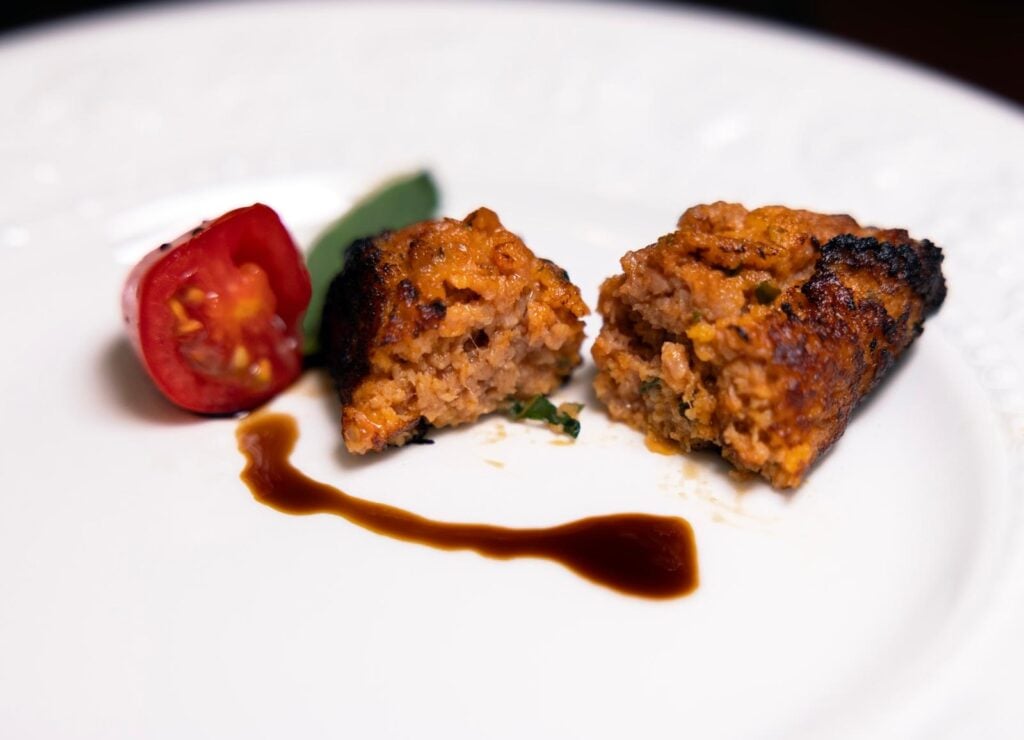
So how does Pythag’s AI technology lower costs for cultivated meat? “We’ve generated a lot of results with very high cell densities and very low media costs, and we’ve seen the same across cells and bioprocess,” says Nabulsi.
The company isn’t disclosing headline figures publicly, with the CEO calling them a “bit of a gimmick in this industry” and arguing that a number on its own “says little about whether a process works at scale”.
“Any single result is one point in a very large space. What matters is a platform that can produce the strongest process for a given product, at large scale, and keep improving it with every experiment,” he suggests. “Hitting one cost number is a short-term win. Building the thing that keeps producing them is what gets cultivated meat to market.”
Pythag is exploring partnerships at the moment, though details remain under wraps. That said, Nabulsi does confirm that, as a tech provider, the startup doesn’t have to go through any regulatory approval processes – the onus for that lies on the companies looking to bring cultivated meat to market.
“But we plan on doing this work jointly with our customers, which means going through approval with them. We think it’s on us to get them through the regulatory process, and that starts with building processes and products that a regulator will approve in the first place,” he says. “We also think approval is far easier with a food company behind it than as a small startup on its own.”
The seed financing round can help advance what is now a financially stressed sector. Funding for cultivated meat startups fell by 49% in 2025, totalling just $74M. In contrast, this industry attracted $1.5B in funding at its peak just four years prior.
“Cultivated meat can provide a solution, but only if it provides functional equivalence at lower cost,” said Matthew Nordan, co-founder and general partner at Azolla Ventures. “Pythag is using AI to make cultivated meat production more efficient and scalable, helping deliver the future of food.”