
Danish startup Cellugy has scaled production of its fermentation-derived skincare ingredients 10-fold, bringing bio-based skincare to industrial manufacturing levels.
In a major milestone for the fossil-free cosmetics space, Cellugy has proven its proprietary fermentation technology to produce fossil-free skincare on an industrial scale.
The Danish firm completed the first demonstration of its platform at this scale in partnership with the Bio Base Europe Pilot Plant (BBEPP) in Ghent, Belgium, consistently reproducing product quality and performance.
The development comes over a year after Cellugy secured an €8.1M grant from the EU’s Life Programme to scale up its eco-friendly materials technology.
This latest demonstration shows that the startup’s process can deliver the same material characteristics at large scale, a critical requirement for future commercial production and customer supply. It said this achievement has significantly reduced scale-up risk and provided a stronger foundation for commercial partnerships and market adoption.
“Scaling production to 15,000 litres is more than an operational achievement. It is a commercial validation that enables deeper engagement with strategic customers and manufacturing partners,” said Koen Paesmans, chief commercial officer of Cellugy.
Industrial run bolsters Cellugy’s commercialisation efforts

Founded at Aarhus University in 2018 by Isabel Alvarez-Martos, Deby Fapyane and Parun Sihombing, Cellugy makes high-performance functional ingredients via a microbial fermentation platform that produces tailored exopolysaccharides. These bio-based materials deliver rheology, stabilisation, sensory and bioactive functionalities, while replacing petrochemical and microplastic-based incumbents.
The firm’s first product, EcoFlexy Rheo, is a biofabricated rheology modifier that swaps fossil fuels for cellulose in personal care applications, offering excellent suspension, stability and sensory performance.
Rheology modifiers are a core part of the personal care industry, appearing in everything from skin and oral care to deodorants and colour cosmetics. They’re used for thickening and viscosity, and make cosmetics easy to pour and flow when force is applied.
But nearly 70% of rheology modifiers on the market are derived from petrochemicals. This means these substances are classed under the EU’s REACH regulation, which seeks to protect human and planetary health from chemical risks.
ExoFlexy Rheo, however, is made from high-purity, crystalline cellulose, produced by a specific strain of bacteria that bioconverts sugar via fermentation. The ingredient is said to provide functionalities that weren’t achievable with existing bio-based ingredients like xanthan or cellulose gum, and it eschews the handling challenges associated with plant-nanocellulose alternatives.
“As brands accelerate their transition to more sustainable formulations, this milestone strengthens our position to bring EcoFlexy to market as the next-generation multifunctional performance technology enabling superior suspension, enhanced sensory properties, and formulation innovation beyond traditional fossil-based rheology modifiers,” said Paesmans.
Apart from EcoFlexy Rheo, which was debuted as part of a skincare cream in collaboration with fellow Danish firm Bioli, Cellugy’s fermentation platform also enables the development of new polymers for surfactant-rich and industrial applications, as well as bioactive variants for higher-value markets.
From four to 15,000 litres in 16 months
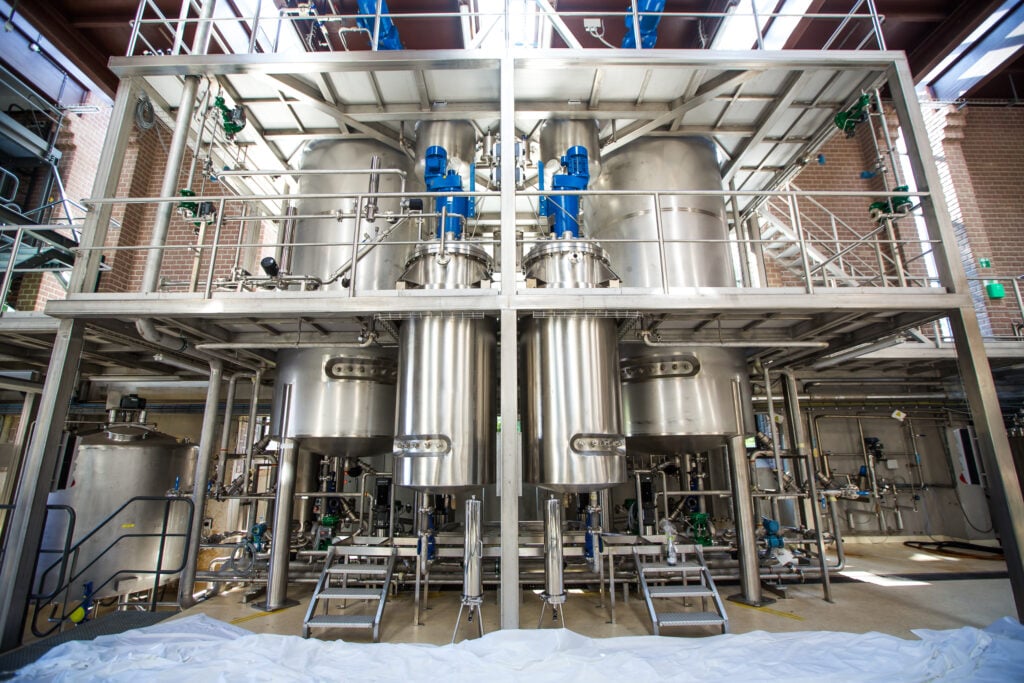
Cellugy’s technology is built on a common fermentation backbone, enabling it to rapidly expand its product portfolio while leveraging the same scalable, capital-efficient manufacturing infrastructure. The company said its expansion to 15,000 litres showcases its potential to support commercial production and develop additional product families.
Alex Patist, biotech scale-up and commercialisation expert at Cellugy, called it a “great example of what a disciplined, stepwise approach to scaling up a bioprocess looks like”.
“Cellugy’s collaboration with BBEPP to successfully bring the EcoFlexy process to 15,000-litre scale is a significant achievement, and a very different challenge from demonstrating the process at pilot scale. At this volume, consistency, reproducibility, and equipment transfer are truly put to the test,” he said.
The large-scale demonstration was carried out at BBEPP’s facility using industrially relevant fermentation infrastructure and expertise to validate the robustness, reproducibility and industrial scalability of the Danish firm’s platform.
“Scaling a fermentation process from four litres to 15,000 litres in just 16 months is a significant achievement. Across multiple scale-up stages, the BBEPP and Cellugy teams continuously adapted process parameters and implemented necessary scale-specific adjustments,” said Hendrik Waegemani, head of business operations at BBEPP.
“This approach resulted in a robust and straightforward scale-up protocol, overcoming the challenges of working with a non-conventional product that yields a unique broth texture. Cellugy and BBEPP shared the common goal of bringing this technology closer to market. This scale-up story is proof that, with a well-thought-out scale-up plan, even the most unique fermentation processes can be run successfully at 15,000-litre scale.”
Cellugy said it has reached an “important inflexion point” in its development, and will now build on the knowledge gained through the industrial-scale run to advance EcoFlexy towards commercial production and broaden its platform’s application across cosmetics, personal care, and other high-value markets.