
Finnish food tech company Solar Foods, known for its gas-derived Solein protein, has joined the Deep Space Food Consortium as a foundational member, two years after winning the Nasa-backed challenge that spawned the alliance.
In 2024, Solar Foods became the international category winner of the Deep Space Food Challenge run by Nasa and the Canadian Space Agency, recognised for its development of a “food production system through gas fermentation that relies on single-cell protein production”.
The Finnish company, whose Solein gas protein has been commercialised in Singapore and the US, has now joined the Deep Space Food Consortium as a foundational member.
It’s run by the administrators and partners of the aforementioned food challenge, who established the alliance to continue expanding the definition and deployment of future foods by uniting the global community and connecting opportunities across disciplines.
“We are proud to join the Deep Space Food Consortium and to contribute to scientific advances that aim to help humanity produce food wherever people live, whether in the most challenging environments on Earth or, one day, beyond it,” said Arttu Luukanen, senior VP of space and defence at Solar Foods.
“The fundamental question remains the same: how do we produce nutritious food when conventional agriculture is not an option? Space is the most demanding test environment, and the technologies operating there may also help build more resilient food systems here on Earth.”
Solar Foods explores gas protein production in space
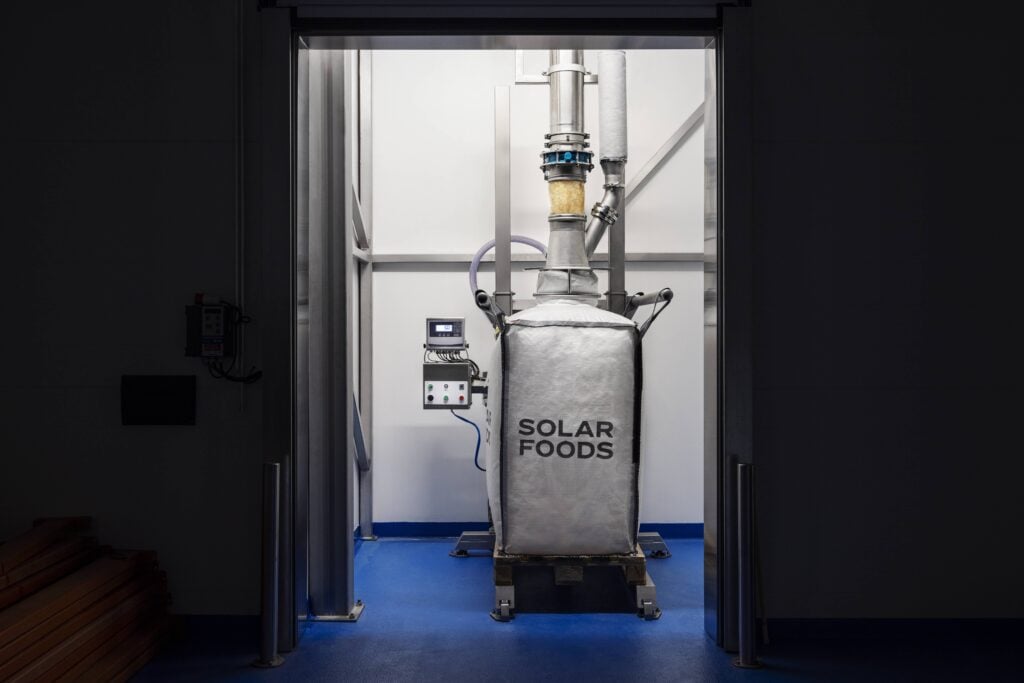
Having spun out from the VTT Technical Research Centre of Finland and LUT University in 2017, Solar Foods produces Solein, a deep-yellow complete protein ingredient, by feeding microbes on carbon dioxide, hydrogen and oxygen instead of sugar.
The microbes are grown in a liquid form, in a process that eliminates the need for farmland, water for irrigation, and fertilisers and pesticides. They’re then dried into a flavourless powder that has 78% protein, 6% fat, and 10% dietary fibre, and a macronutrient profile akin to dried soy or algae.
Solein has a mild flavour, making it an ideal base for a variety of products, and has been described as the “most sustainable protein” on Earth. Since the main raw materials here are CO2 and renewable energy, it generates just 1% of the greenhouse gases emitted by meat and 20% that of plant proteins.
Solar Foods currently produces Solein at its demo plant, Factory 01, in Vantaa, which is set to reach a capacity of 230 tonnes this year. Factory 02, expected to begin operations in 2028, will produce 12,800 tonnes of Solein annually. The protein can be scaled up to these industrial levels without relying on farming cycles, ensuring a year-round supply and production in climates like the desert, the Arctic, and yes, even outer space.
The tech offers an “attractive value-add” to space habitat operators by significantly reducing the need for resupply of food and water, offering a fresh source of nutritious protein onboard. Solar Foods aims to incorporate the process with the onboard life support systems of future commercial space stations, as well as surface habitats on the Moon, and eventually Mars.
The company, which secured $89M in June to build its industrial facility, is working with space tech major OHB System on the development of a small-scale gas fermentation pilot, with the goal of testing the tech onboard the International Space Station. This project is funded by the European Space Agency and aims to develop a prototype of Solein production tech suitable for zero-gravity operations.
“Solein is produced through gas fermentation, using carbon dioxide and hydrogen as its main feedstock. In space habitats, oxygen is generated by splitting water molecules,” explained Luukanen.
“While the oxygen is used by the crew, the hydrogen – and the CO2 exhaled by the crew – is typically vented into space, wasting valuable water. By feeding this hydrogen and the CO2 exhaled by astronauts on the spacecraft into Solar Foods’ process, the water can be recovered while producing Solein at the same time.”
Space industry embraces future foods
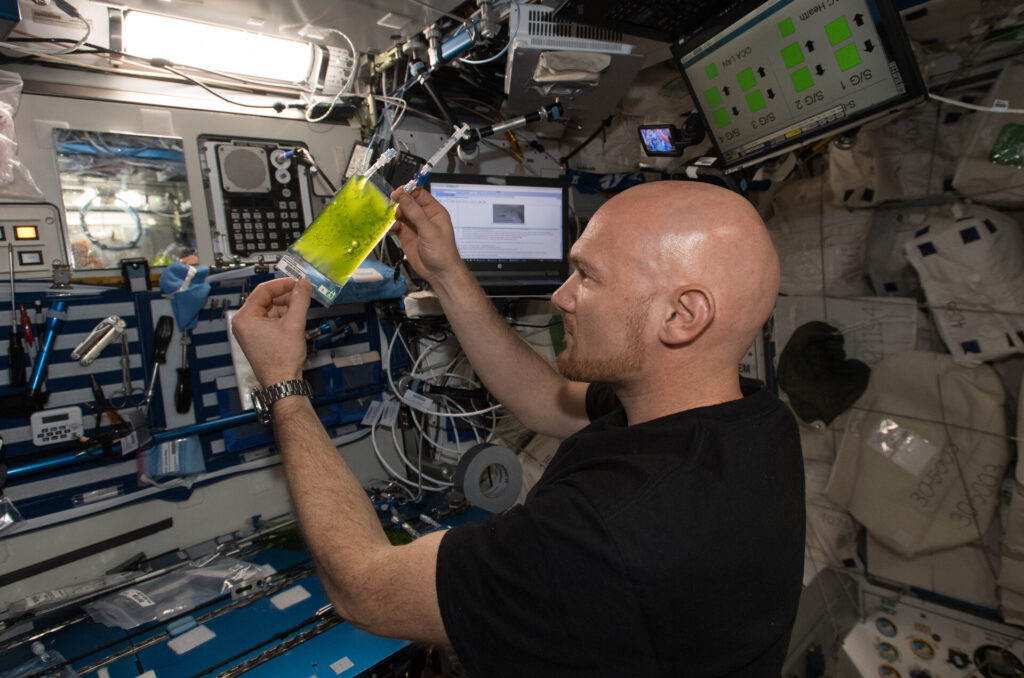
The Deep Space Food Consortium aims for the development and deployment of sustainable, evolvable space food systems that enable human exploration and habitation beyond Earth, advancing resilient, efficient and equitable systems for life on the planet.
It is an independent, tech-agnostic organisation that brings together researchers, space agencies, food companies, technology developers, private space station companies, funders, and public sector partners to define shared priorities, identify implementation gaps, prioritise research, and support the validation of food technologies for both future low Earth orbit and long-duration exploration missions.
“From early expeditions across the oceans, to the exploration of the polar regions, history has demonstrated time and again that food is often the critical factor between any mission’s success and failure -– and space is no different,” said Angela Herblet, co-founder and lead of operations and initiatives at the Deep Space Food Consortium.
“The future of food in space will define the future of humanity in space. We are pleased to welcome Solar Foods to the Consortium and look forward to exploring how their expertise and innovative approaches can contribute to the broader development of sustainable, resilient food systems.”
Solar Foods’s move to become a foundational member of the alliance comes months after the World Economic Forum pushed for the incorporation of alternative proteins like plant-based and cultivated meat into long space missions.
It’s not necessarily a new idea – Nasa has been conducting experiments on cultivated meat since 2000 – but it’s one that has gained considerable traction in recent years. In 2023, the US agency partnered with fungal protein startup Nature’s Fynd to develop a microgravity biofilm-biomass reactor to produce nutrient-dense vegan protein for astronauts.
The European Space Agency has also previously funded two projects to explore the viability of producing cultivated meat beyond the exosphere, and was part of a consortium that launched a fully automated miniature laboratory off a SpaceX base to explore microbial protein production in space last year.
SpaceX itself has conducted experiments on the effects of microgravity on muscle tissue growth, using beef cells harvested by Israeli startup Aleph Farms, which has also grown cell-cultured beef on the International Space Station, nearly 400km away from any natural resources.