Mercy for Animals has ranked the US’s 25 largest burger chains on their plant-based options, with McDonald’s among the lowest-scoring businesses and facing calls to expand its meat-free offerings.
McDonald’s, the world’s largest fast-food chain, sells plant-based burgers in the UK, the Netherlands, Slovenia, Switzerland, and Malta, among other markets – why does it not do so in the US?
In fact, the behemoth tried once. The company piloted the Beyond Beef-featuring McPlant burger in San Francisco and Dallas, but it never made it onto the permanent menu, with the chain suggesting Americans were simply not interested in plant-based proteins. At the time, critics contended that it was a “marketing malpractice issue” rather than a lack of demand.
Now, calls for McDonald’s to expand its plant-based offerings have renewed after a new report ranked it near the bottom of the list of the most plant-forward burger chains in the country.
The analysis, carried out by animal rights charity Mercy for Animals, looked at the 25 largest companies in this sector, and scored them for their plant-based offer, menu presentation, pricing, and marketing.
McDonald’s received just one point out of 30, landing in the lowest Bottom Buns tier, suggesting it has one of the industry’s greatest opportunities to expand consumer choice thanks to its size, influence and experience offering plant-based options in international markets.
“McDonald’s has helped shape the way generations of people eat. Today, it has another opportunity to lead by expanding plant-based menu options for American consumers,” said Arash Yomtobian, president and CEO of Mercy for Animals.
The winners and losers
The non-profit chose to focus on chains selling burgers because Americans consume 50 billion of these a year – that’s roughly three per person per week. The influence of the largest companies in this space extends far beyond their eateries, with the report arguing that they create consumer trends and can use strategic marketing to make sustainable options the default for millions of diners.
Since they purchase ingredients at a colossal scale, they wield enormous power over global supply chains, and a single decision by a top-five burger chain to prioritise plant proteins can help lower the cost of sustainable ingredients, slash carbon footprints, and reduce animal suffering.
Menus featuring vegetarian or blended meat burgers accrued one point, and those with two or more plant-based burgers or where all patties are at least 50% plant-based received five points. Menus with one or two sides were awarded one point, rising to three points for three or more, and this was the case for desserts, too. Plant-based burger components – like bacon, eggs or buns – scored a point for the chain too.
It’s not just what’s on the menu, but how it’s presented. Restaurants that list meat-free options on a separate menu got one point, and those that integrate them into the main menu and describe them with appealing language got two.
For every menu where at least one meat-free or blended burger is priced the same as or cheaper than a 100% animal protein option, a chain received three points. Sales and discounts incentivising plant-based and alternative patties, as well as attractive advertising online, scored them another two points.
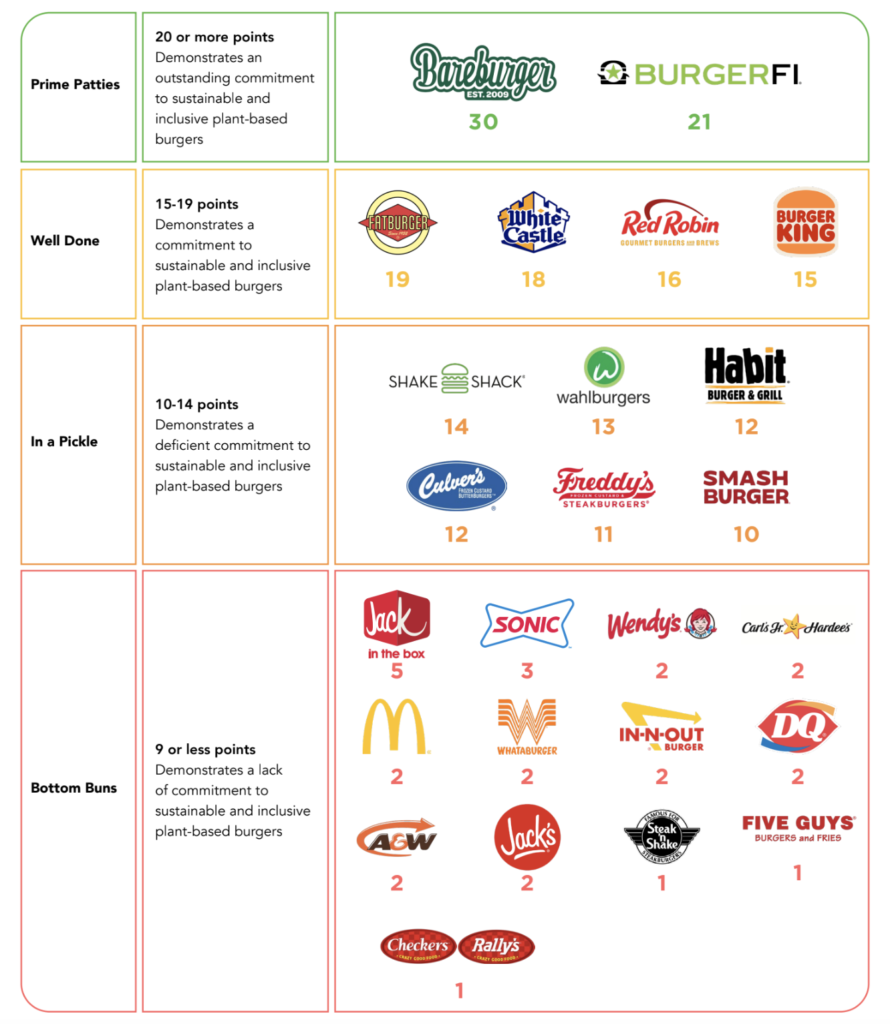
The report found that only six of the top 25 chains currently offer a dedicated plant-based patty on their US menu, and the same share scored high enough to demonstrate a genuine commitment to inclusive plant-based options.
Bareburger topped the list with a maximum of 30 points, followed by BurgerFi (21), Fatburger (19), White Castle (18), Red Robin (16), and Burger King (15). Chains like Shake Shack (14) and Smashburger (11) fell into the category demonstrating “deficient commitment” to sustainable and inclusive options.
More than half of the chains joined McDonald’s at the bottom of the list, showcasing a lack of such commitments, including the likes of Jack in the Box (5), Wendy’s (2), In-N-Out (2), and Five Guys (1).
Will McDonald’s take a page out of its European playbook?
For McDonald’s, the shift away from meat analogues followed market trends. Sales of plant-based meat have consistently been sliding since the highs of 2021-22. Last year, foodservice sales of plant-based proteins (including meat alternatives, tofu, tempeh, and whole-food formats like veggie burgers) were down by 7% in the US.
In contrast, consumption of plant-based alternatives rose by 20% in the foodservice channel across Europe in 2025, which would explain the McPlant’s continued presence on McDonald’s menu in a host of markets there.
However, low sales did force the chain to pull its vegan burger from Germany and Austria last year, where it now only sells plant-based nuggets via its partnership with Beyond Meat.
Back in its home market, McDonald’s serves around 26 million Americans every day, making it one of the most influential restaurant brands in the country. Now, with 71% of consumers open to eating plant-based foods, Mercy for Animals is calling on the Golden Arches to replicate its European embrace of plant-based proteins in the US.
“The company has already demonstrated that this kind of innovation is possible in other parts of the world, such as the UK and Ireland, and American consumers deserve that same opportunity,” said Yomtobian.
He added that the wider report, titled Patty Battles, isn’t meant to criticise companies: “It’s about recognising progress, encouraging innovation and inviting industry leaders to offer more choice while helping build a more sustainable and compassionate food system.”