15
That Africa needs better ways to preserve what it grows is hardly a new conversation.
It has featured in commitments by African heads of state, echoed through FAO reports and taken centre stage at food systems summits.
Investment has followed too, with new cold-chain infrastructure and technologies taking shape from farms to major food markets.
More cold-chain infrastructure will help. But who pays to keep it running?
How Cold Is Africa’s Food Chain?
Africa has a lot of catching up to do.
How much depends on where you look. South Africa has a relatively developed cold-chain market, while capacity in several other countries is still limited or concentrated around a few industries. The cold-chain gap, therefore, is not only between Africa and the rest of the world. It also exists within the continent itself.

We are excited to share with you
This FREE E-Book of 50 Agritech Pioneers & Their Game Changing Innovations.
Download the Ebook now
Kenya offers a glimpse of what that difference looks like. An assessment supported by UK aid and the IKEA Foundation found its cold-chain market still in its early stages but expanding. Both off-grid and on-grid technologies are in use. However, complete farm-to-fork cold chains are still largely limited to a small number of high-value export crops. For much of the food sold locally, that level of cooling is yet to follow.
Nigeria has seen more cold-chain infrastructure. Cold rooms, ice plants and refrigerated vehicles now thrive alongside the refrigerators and deep freezers found at retail points. The market is described as nascent but growing.
Lagos gives some sense of that growth. The Global Alliance for Improved Nutrition mapped around 200,000 cubic metres of cold-chain infrastructure in the state in 2018.
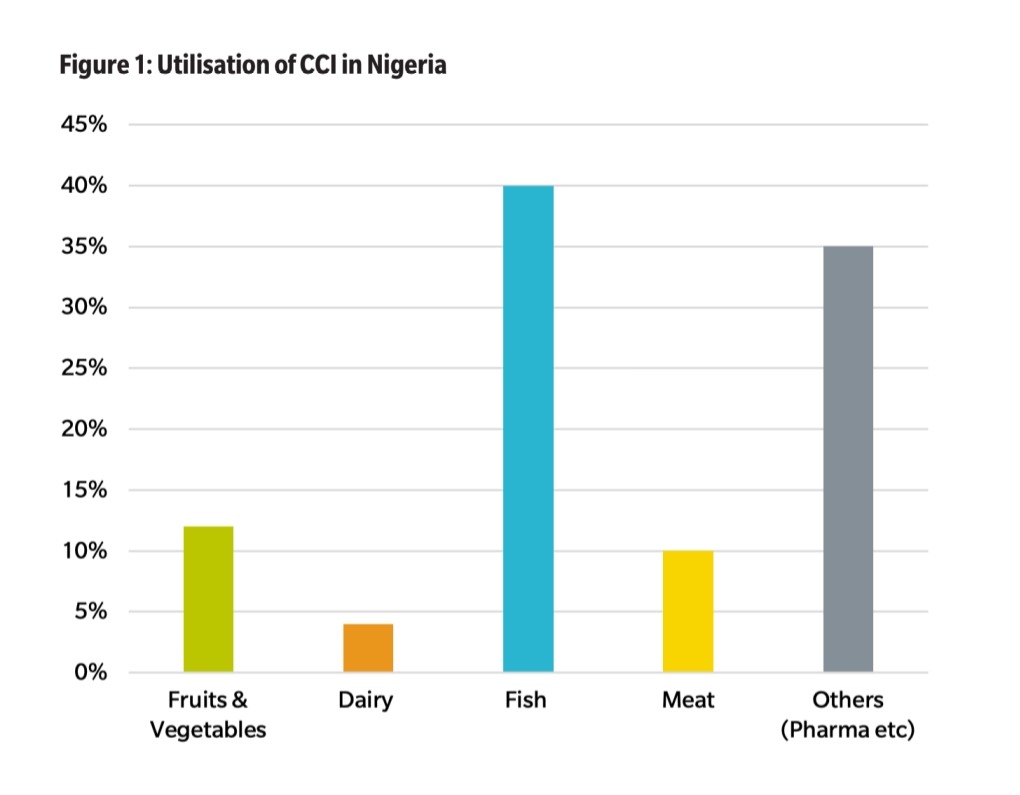
*CCI: Cold Chain Infrastructure
Image Source: IKEA Foundation & UK Aid Report
Fish has had much to do with that growth.
At the time of the assessment, imported fish accounted for about 39% of Nigeria’s cold-chain infrastructure. Fruits and vegetables accounted for 12%, meat 10% and dairy 4%. Pharmaceuticals took much of the rest.
Kenya and Nigeria are only two markets, but Africa’s cold chain is growing. The next task is ensuring there is enough of it in the right places, for the right foods, and to the right market.
Keeping the Chain Cold
The journey to the market can undo the benefits of cooling if the temperature cannot be maintained along the way.
If we keep produce fresh from farm to market, the cold has to travel with it.
An ideal chain would be:
Farm → Aggregation → Cooling & Storage → Refrigerated Transport → Wholesale → RetailUnfortunately, keeping that sequence cold is the difficult part.
Produce from small farms often travels a long way before hitting a hub or cold storage. From there, it heads out again. Without refrigerated transports, food that starts out chilled can spend hours on the road in the heat.
The weak points can appear at several stages:
- First mile — farm to aggregation or cooling
- Transport — movement between cold points
- Power — keeping storage operational
- Wholesale — holding produce before redistribution
- Last mile — market to retailer
What do you notice? Power runs through much of this.
It is said that “ necessity is the mother of invention” and in Nigeria, solar-powered refrigeration is beginning to offer another route. A cold-chain market assessment in the country found growing interest in solar cooling where reliable grid electricity is difficult to access.
Some models now go beyond the cold room. In a pilot supported by the International Finance Corporation (IFC), Nigerian company Eja-Ice tested a solar-powered system that combined cold storage with refrigerated transport, from aggregation through distribution to the last mile.
Where that infrastructure sits can make just as much difference. Everything from location and power to transport and market demand has to be taken into account.
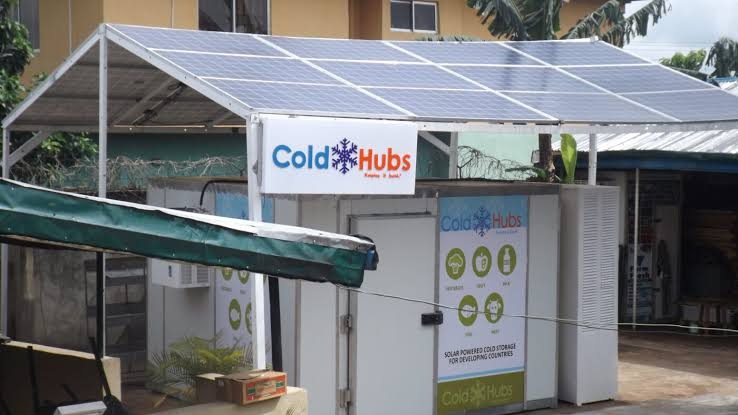
Image Source: ColdHubs
More cold rooms will expand Africa’s capacity. But connecting them to farms, transport and markets is what turns that capacity into a cold chain.
The Price of Cold Chain
Progress, they say, comes at a price. So does keeping food cold.
There is the initial cost of the facility, then electricity, maintenance and labour. If the cold has to travel with the food, refrigerated transport adds another expense.
In Nigeria, a study of ColdHubs’ solar-powered cold rooms estimated that one facility cost about $40,000 to build, with monthly operating costs of roughly $142 to $162 at the time of the research. Farmers and traders did not have to own the infrastructure themselves. They paid ₦100 per 20kg crate per day to store their produce.
The breakdown:
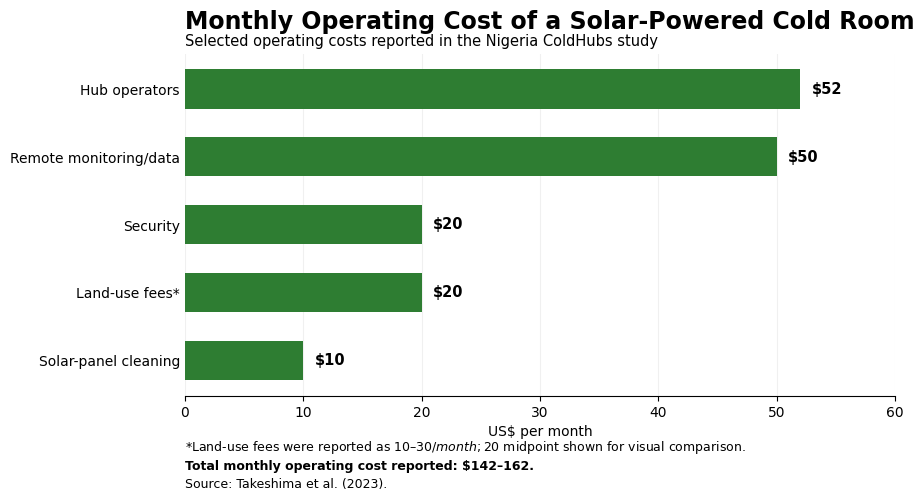
That model makes cold storage more accessible to farmers and traders who could hardly justify owning their own cooling equipment. The concern is that even a small daily fee has to make sense against the value of what is being stored.
A crate of tomatoes kept fresh long enough to fetch a better price may justify the cost. If the extra shelf life adds little value, paying for cooling will be hard to justify.
That is why cold chains have developed faster for high-value produce, fish, and export crops in some African markets.
So, Who Pays?
The question, then, is not only who pays, but who pays for what.
A farmer who needs a few crates of tomatoes cooled for two days should not need to own a cold room. Private operators can take on that role. ColdHubs in Nigeria, SokoFresh in Kenya and InspiraFarms Cooling in several African markets offer different versions of it, from pay-as-you-store services to cooling infrastructure and financing.
Farmers and businesses get access to the cold storage without necessarily carrying the full cost of owning it.

Image Source: Roam
The larger bill, however, is elsewhere. Cold rooms have to be financed and installed. Refrigerated transport has to be acquired. Power systems need investment. Some locations may not attract private capital quickly enough on their own.
So, it leaves room for a division of the cost.
BUILD
Government, development finance and private investment
OPERATE
Cold-chain companies and other private operatorsUSE
Farmers, traders, processors and retailersSUSTAIN
Revenue generated from the value the cold chain preservesThat last part? Highly important.
Public money can help build the market. Development finance can make investment less risky. Private companies can operate the infrastructure. Farmers and traders can pay for a service rather than an asset.
Everyone Pays, Including the Consumer
The value saved through longer shelf life, lower losses, better quality and access to better markets has to be large enough to cover the cost of keeping food cold. If it cannot, the cold chain will struggle once grants and subsidies disappear.
So, who pays to keep Africa’s food cold? Everyone who captures value from keeping it cold, but not in equal measure and not at the same stage.
And for the chain to last, some of that cost will eventually have to travel with the food. In the end, buyers and consumers ultimately sustain it through the value attached to better-preserved food.