5
For all its potential, Africa still faces a curious contradiction. It has the fertile land, the young workforce and the growing appetite that a food powerhouse needs. But much of the food on African tables is grown, packed or processed somewhere else.
While individual countries have made progress in their own right, the continent as a whole has struggled to turn what it grows into what it eats.
Somewhere between what Africa grows and what Africa eats, value is slipping away.
Let’s Follow the Leak
Africa imported nearly $114 billion worth of food in food in 2022, according to the UN Economic Commission for Africa.
That figure fell to about $104 billion in 2023. Even that does not tell the whole story. Around a fifth of those imports came from within Africa itself.
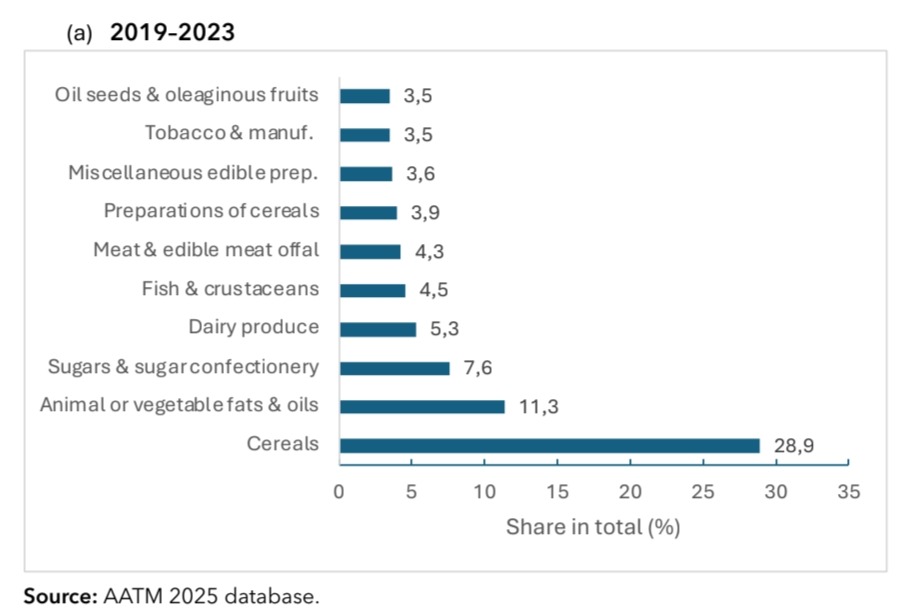
Image credit: CGSpace
A look at what makes up the bill reveals something else. Almost three in every ten dollars spent on agricultural imports went to cereals between 2019 and 2023. Oils and fats took another sizeable share, while sugar and dairy also featured high on the list. Much of the bill, therefore, goes towards food staples that millions of Africans consume every day.
We are excited to share with you
This FREE E-Book of 50 Agritech Pioneers & Their Game Changing Innovations.
Download the Ebook now
But there’s a catch: that $100 billion figure still needs some context. Africa’s population has grown rapidly, and so has demand for food. International food prices have also risen considerably over the past two decades. A bigger import bill does not necessarily mean that Africa is producing less food.
The picture also changes depending on where one looks. Eastern Africa, for instance, has maintained an approximately balanced food-trade position since 2020. Within the East African Community, food exports have consistently exceeded imports. The surplus reached $2.8 billion in 2023.
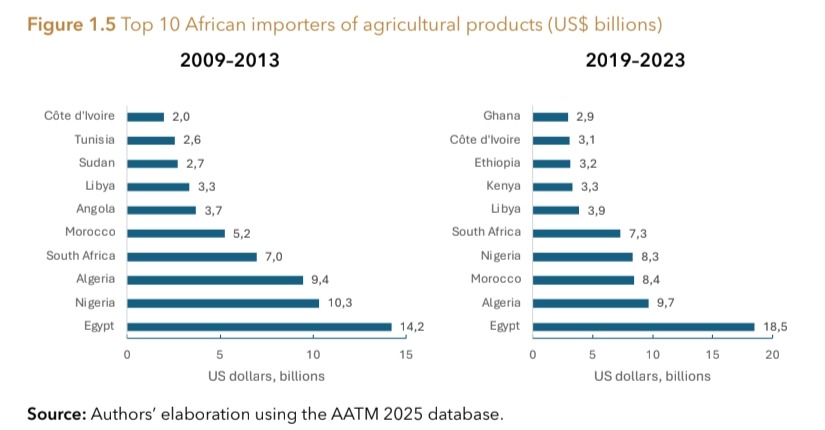
Move west, and there is a twist to it. West Africa exports large amounts of agricultural commodities, but the region imports more agricultural products than it exports overall. Cocoa is its biggest agricultural export, driven largely by Côte d’Ivoire and Ghana. On the other hand, cereals, fish and oils feature prominently among what the region imports.
Overall, Africa as a whole is still a net food importer. In 2023, it bought more food from outside the continent than it sold there.
The opportunity, therefore, lies not only in producing more, but in retaining more value from what Africa already produces.
And much of that value comes after the harvest.
The Money Is After the Harvest
Africa has long known how to grow for the world. However, capturing what comes after the harvest has proved harder.
Part of that story goes back decades. The 2025 Africa Agriculture Trade Monitor traces today’s trade patterns to the colonial era, when agricultural systems in several parts of the continent were built around a handful of export commodities. Independence changed much, but the commodity pattern did not simply disappear.
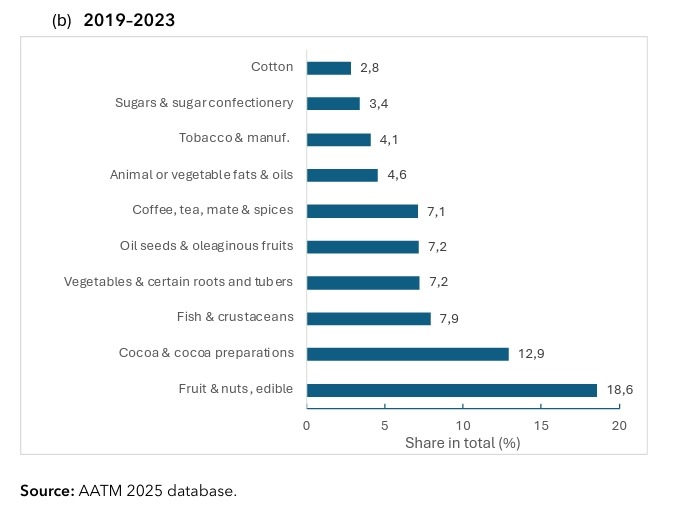
Image credit: CGSpace
Look at what Africa sells today. Between 2019 and 2023, fruits and nuts, cocoa, fish, vegetables, oilseeds, coffee and tea featured prominently among its agricultural exports. West Africa offers perhaps the best example. Côte d’Ivoire and Ghana are among the world’s leading cocoa exporters, much of it leaving as unprocessed or semi-processed cocoa.
Actually, there is nothing wrong with selling what the continent grows well. The bigger concern is what happens before it leaves. More value can be made from cocoa when it is processed before export.
Then there is the market at home.
African diets are changing. Urbanisation and rising incomes are driving demand for dairy, meat and processed foods. The irony is that Africa exports agricultural commodities while its own consumers are demanding the value-added foods it lacks the capacity to produce at scale.
Growing more will help. But the money does not end at the farm gate. There is more value in what comes after, from processing to packaging and distribution. Capturing it, however, takes more than just producing.
The Cost of Adding Value
Adding value comes at a cost. There is machinery to buy, power to keep running and produce to source. Perishables bring another cost, with cold storage and transport needed before value becomes waste.
For many businesses, that is where the promise of value addition meets its first wall. The African Development Bank estimates that Africa’s agri-food SMEs face an annual financing gap of about $180 billion, despite supplying much of the food consumed on the continent.
More investment is now going into fixing some of these gaps. The African Development Bank and its partners have committed billions to Special Agro-Industrial Processing Zones, which connect farming areas with processing, storage and markets. Similar efforts are taking shape outside the big programmes too.
More players plugging the leaks
| Supply Chain | Selected Players & Initiatives |
| Aggregation & market access | WARC Africa (GH/SL), Complete Farmer (GH), AFEX (NG) |
| Cold storage & logistics | ColdHubs (NG), InspiraFarms Cooling (EA), Koolboks (NG) |
| Processing & value addition | Frostan (TZ), ZEAN (RW), Africa Improved Foods (RW) |
| Finance & investment | Aceli Africa, Root Capital, AgDevCo |
| Infrastructure & value chains | AfDB SAPZs, IFAD, GIZ, AGRA |
Codes: NG (Nigeria) · GH (Ghana) · SL (Sierra Leone) · TZ (Tanzania) · RW (Rwanda) · EA (East Africa)
These are only a snapshot of a much larger ecosystem. The challenge is less about the absence of solutions and more about making each part of the value chain work together at scale.
Africa Cannot Trade With Itself on Paper
Producing and processing more food is only useful if there are markets to absorb it. For Africa, some of the biggest opportunities may be closer than they seem.
The African Union has made that bet. Under the Kampala CAADP Strategy for 2026–2035, the continent wants to triple intra-African trade in agrifood products and inputs, while raising locally processed food to 35% of agrifood GDP. The strategy also places agro-industrialisation and AfCFTA at the centre of that push.
The next step is making trade work beyond declarations. Farmers and processors still need markets, finance, infrastructure and easier links across borders.
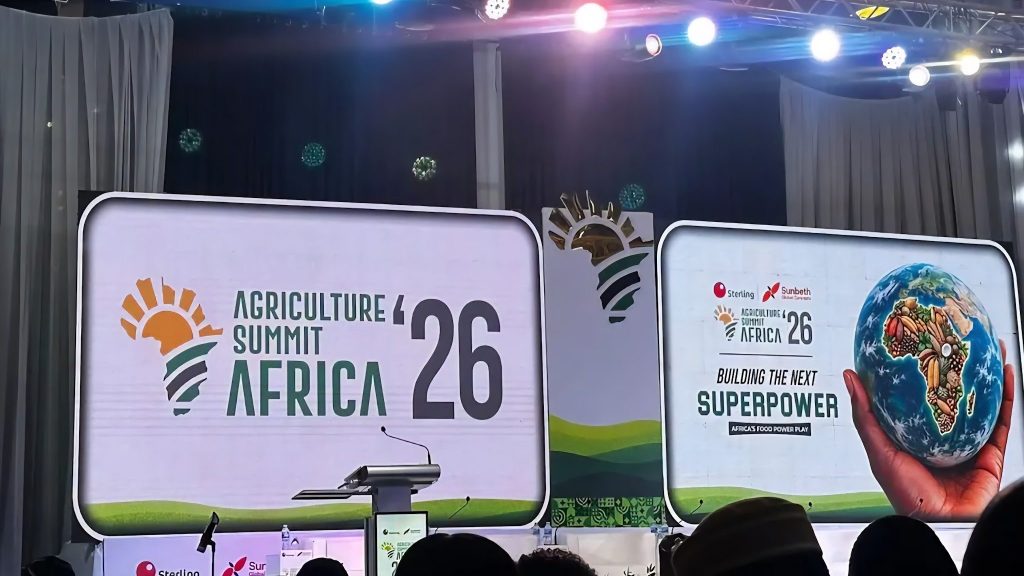
Image credit: SARO Agrosiences
That same concern surfaced at the ninth Agriculture Summit Africa in Abuja. The conversation moved beyond producing more towards building the systems around production. More than 40 agribusinesses met investors and financial institutions through the summit’s Deal Room as reported by the Guardian Ng. The summit also saw the launch of AgricHub, Nigeria’s first digital information and social networking platform built specifically for the agricultural community.
Can Africa Keep More of the $100 Billion?
It can, if the conditions are met. Not by shutting out imports, but by keeping more value from what it already grows.
Grow it. Process it close to the farm. Then sell it to the world, and to markets closer to home in Africa.
That is where the leak begins to close.