Scientists have developed a way to grow self-organising bovine tissues from cultured embryonic stem cells to recreate the texture of animal muscle fibres in cultivated meat.
Cultivated meat companies are currently focused on scaling up and reducing costs, but they must also keep in mind the top factors that will make or break these proteins’ fate: taste and texture.
Researchers at the European Molecular Biology Laboratory (EMBL) Barcelona suggest that current production techniques still face challenges in recreating the complex structure of a steak, since they often require separate preparation of multiple cell types and their intricate assembly.
They’re not proposing a different tactic that relies on co-inducing these different cell types and the formation of tissue-like structures in 2D and 3D cultures. The serum-free process provides an early proof of concept for producing whole-cut cultivated steaks, and could help advance future technologies to produce these proteins.
“One of the biggest challenges in cultivated meat is reproducing the complexity of real tissue,” said Marina Sanaki-Matsumiya, former postdoctoral fellow at the Ebisuya Group, which developed the protocol.
“Instead of growing each cell type separately and assembling them afterwards, we showed that embryonic stem cells can develop together and self-organise, mimicking real tissue development,” she explained.
How embryonic stem cells can transform current approaches
The researchers noted how current approaches to cultivated beef rely on stem cells taken from adult cows. While these can produce muscle, they have limited capacity to divide and are already committed to becoming only certain types of tissue, making it difficult to recreate the diversity of cell types found in meat.
With existing manufacturing methods, the assembly of separately prepared cell types requires advanced engineering techniques, such as “bioprinting purified cells with a bioink, co-culturing cells on edible porous scaffolds, and stacking myocyte-laden hydrogel modules”.
Electrical or mechanical stimuli are often applied to facilitate muscle maturation and boost the texture. “While these engineering approaches are promising and evolving rapidly, they add extra manufacturing steps to cultured steak production,” the study, published in Nature Communications, outlined.
So the researchers developed a way to grow self-organising bovine tissues containing muscle, nerve, and blood vessel cells from a line of embryonic stem cells that can be grown and multiplied over long periods (unlike adult cells).
Given that they are pluripotent stem cells, embryonic cells retain the ability to develop into many different cell types and proliferate indefinitely, offering a more stable cell base for cultivated meat.
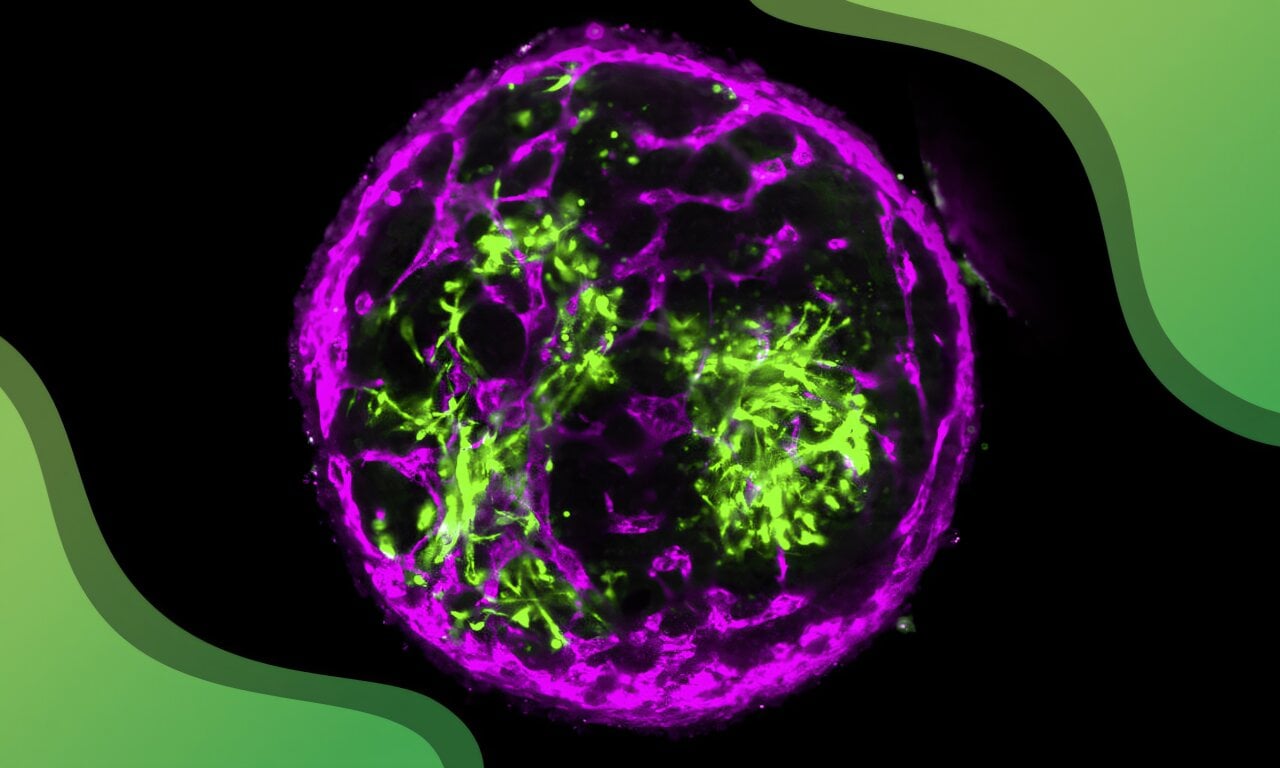
The team at EMBL Barcelona guided their development to generate three components of muscle tissue simultaneously: skeletal muscle cells, neurons, and endothelial cells, which can create blood vessels. The cells organised themselves into 3D tissue-like aggregates of 0.6 mm in diameter in 15 days, without requiring complex assembly techniques.
Cost reduction crucial for commercialisation
The researchers noted that the ability to develop endothelial cells was particularly important, since blood vessels deliver oxygen and nutrients in living tissues to enable them to grow larger and remain healthy. Although the vessel-like networks in the study were still primitive, they represent a critical step towards creating larger, more complex cultured tissues.
Likewise, the tissues developed in the study were tiny; however, they exhibited a high level of cellular complexity. In each of the 3D aggregates, muscle fibres formed alongside networks of endothelial cells and spinal neurons that interacted with the muscle. This demonstrated that multiple interacting tissue types can be generated together by the same developmental process, rather than assembled from separate adult cell types.
“The tissue we generated is still very small,” said Miki Ebisuya, former leader of her namesake Ebisuya Group at EMBL Barcelona. “To produce something resembling a steak, we will need much larger tissues with more mature blood vessel networks that can support continued growth.”
The other major challenge is cost. Growing embryonic stem cells and directing their development calls for expensive cell culture media and reagents. That makes large-scale food production economically unfeasible.
“Substantial cost reductions through the mass production of these materials or the development of plant-based alternatives will be essential for potential commercialisation,” read the study.
Further, the scientists pointed out the relevance of their work beyond food production, arguing that it provides a powerful model for understanding how muscle tissues develop. Since the system contains multiple cell types, it could help researchers investigate muscle development and tissue engineering in ways that would otherwise be difficult to achieve with simpler cell cultures.
“Our approach will also be complementary to engineering approaches: co-induced cells can be mixed with a bioink and readily used for bioprinting, while muscle aggregates featuring endothelial networks can serve as building blocks for complex tissue assembly,” they wrote. “Diverse types of cultured beef will offer novel food options.”