US-based Association for Meat, Poultry and Seafood Innovation and UK company Cultigen Group have teamed up to accelerate progress for the cultivated meat sector.
A new cross-Atlantic collaboration aims to help companies boost their R&D and commercialisation efforts for cultivated meat.
The Association for Meat, Poultry and Seafood Innovation (AMPS), based in Washington, DC, has partnered with Cultigen Group, a UK company building commercial infrastructure for the cultivated meat industry.
The latter’s platforms include Cellbase, an online B2B marketplace for equipment and inputs needed to produce these proteins, as well as Cellag Bio, a structured intelligence platform to streamline R&D efforts. It plans to roll out a suite of new tools over the coming months.
AMPS, meanwhile, is a trade body with members including Upside Foods, Eat Just, BlueNalu, and more. Cultigen Group founder David Bell called it the “first partnership of its kind” in the sector.
“AMPS is an industry body in the most literal sense: its members are the companies actually making and selling cultivated meat. Cultigen Group works at that same commercial end – we build the platforms those companies buy through, research with, and sell into,” he told Green Queen.
“Partnering with AMPS means the things we build get shaped by producers rather than guessed at, which is the only way infrastructure ever gets built properly.”
Procurement and R&D platforms can significantly speed up commercialisation
Cultigen Group unveiled its first platform in mid-2025, a consumer-facing e-store for cell-cultured proteins called Cultivated Meat Shop. The move was anticipatory, since regulatory hurdles have meant that only a handful of companies are able to sell these foods right now (and none for human food in Europe), and the industry hasn’t yet reached a scale large enough to market them in online retail.
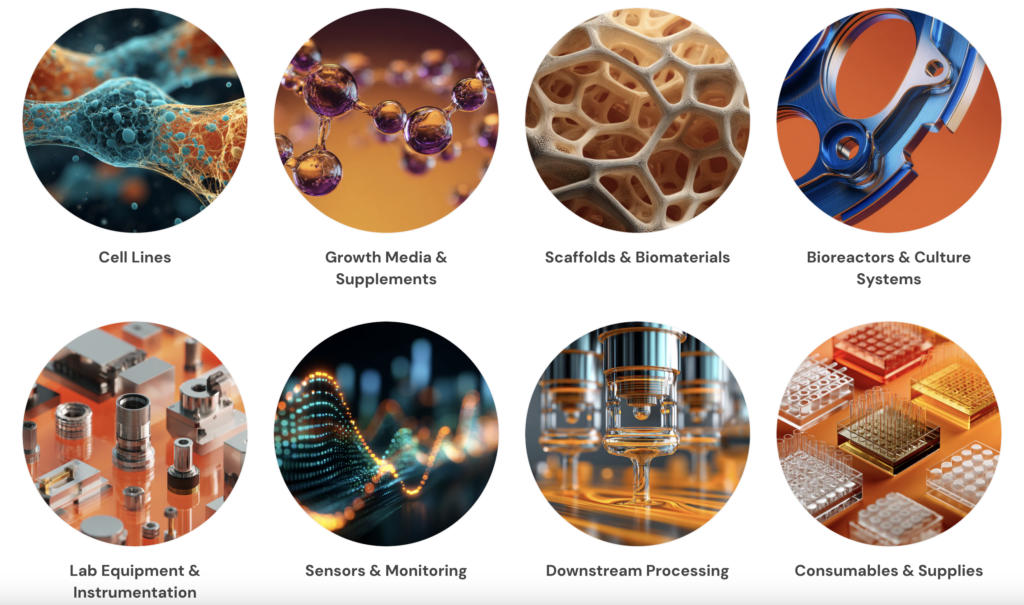
Months later, the company launched Cellbase, which connects suppliers of bioreactors, growth media, scaffolds, cell lines, sensors, and processing equipment with cultivated meat startups and researchers. Its first cohort of partners included Multus, Sallea, Quest Meat, and Cellcraft, among others.
Cellbase includes multiple product categories with deep taxonomies; advanced filtering, search, and comparison via structured metadata parsing, full e-commerce functionality (online ordering, cart and checkout); comprehensive marketplace infrastructure (order management, automated payouts, account dashboards, etc.), and multiple suppliers across categories.
This was followed by the rollout of Cellag Bio, which uses artificial intelligence (AI) to pull structured data from scattered scientific research, passes it through editorial review, and publishes “decision-ready” experiment records that enable companies to move faster and avoid burning capital on known pitfalls.
“Companies can monetise inputs, cell lines, cleared products, and scientists can share insights and orphaned findings (including null results) across the various platforms that enable significant acceleration of knowledge translation and commercialisation,” Suzannah Gerber, executive director of AMPS, said in a LinkedIn post.
Cultigen Group can ‘help bring the industry to the next stage’

In a press release, AMPS described its new collaborator as a “founder-led group with a strong background in digital commerce, consumer experience and ethical entrepreneurship”.
The partnership is aimed at creating a fleet of platforms to provide cultivated meat producers, vendors, scientists and researchers with tools to connect and scale their businesses.
Additionally, AMPS noted that the link-up with Cultigen Group is a “vital way” to accelerate progress in this industry and can help foster new revenue and communication channels and transform how cultivated meat enters the global market.
“Cultigen Group is offering a suite of supportive platforms that can help bring the industry to the next stage, worldwide,” said Gerber, echoing the AMPS’s call for companies, researchers and enabling technologies to seek out Cultigen’s platforms to amplify their business.
“I started Cultigen to build the commercial infrastructure this industry needs as it moves from science to sale – the marketplaces, data and tools that every maturing sector ends up relying on,” Bell said in a LinkedIn post. “Having AMPS behind that is a meaningful step, and there’s more to come on what it looks like in practice.”
He added: “It means the platforms – Cellbase for procurement, Cellag Bio for R&D intelligence – sit alongside the organisation that convenes the producers, scientists and regulators actually building this industry.”