
Gene Therapy Extends Lifespan and Reduces Symptoms in Sandhoff Disease Cat Model
Sandhoff disease, like Tay-Sachs disease, is a fatal neurodegenerative lysosomal storage disease caused by the absence of ß-hexosaminidase (Hex) which leads to the accumulation of GM2 ganglioside in lysosomes. The disease, for which there are no available therapies, results in the death of children at a young age (around four years old).
Now, in a new study, gene therapy delivered intravenously extended the lifespan and reduced symptoms in a cat model of Sandhoff disease. The findings could extend the potential of gene therapy to treat Sandhoff and Tay-Sachs disease, both of which are marked by toxic accumulations of fat in nerve cells of the brain and spinal cord.
This work is published in Science Translational Medicine in the paper, “Intravenous gene therapy improves lifespan and clinical outcomes in a feline model of Sandhoff disease.”
Previous clinical trials showed that adeno-associated virus (AAV) gene therapy for Sandhoff disease could be delivered by injection into the brain or cerebrospinal fluid. More specifically, previous studies “have led to the development of an adeno-associated virus (AAV) vector–delivered gene therapy for children with GM2 gangliosidosis in both expanded access and Phase I/II clinical trials through intrathalamic and cerebrospinal fluid–based delivery.” But intravenous AAV gene therapy has not been evaluated until now.
The AAV gene therapy tested in this study expressed the two Hex enzymes that have been implicated in Sandhoff disease. (Hex consists of two subunits, α and β, encoded by the HEXA and HEXB genes, respectively.) Deficiencies in these enzymes prevent the breakdown of waste in nerve cells’ lysosomes, leading to the toxic fat buildup.
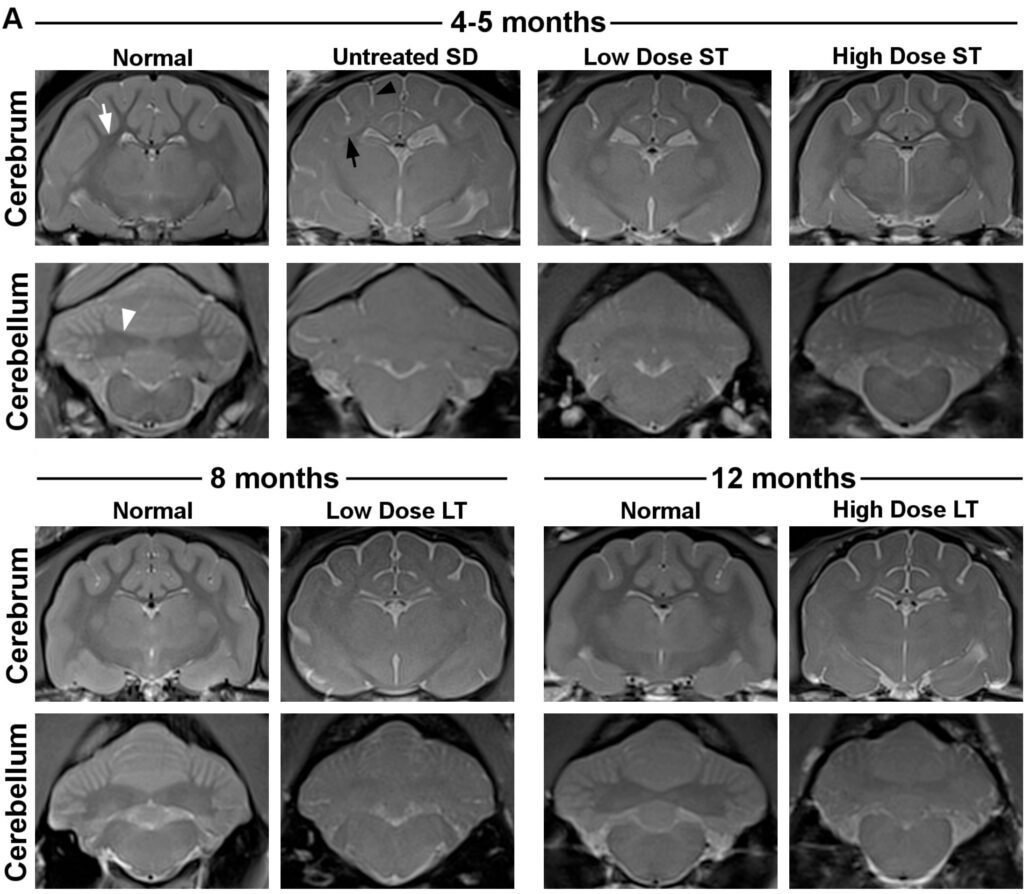
The study investigated intravenous delivery of a bicistronic AAV vector–based gene therapy that has not yet been tested in clinical trials to a feline model of Sandhoff disease, treated presymptomatically at one month of age.
In the feline Sandhoff models, intravenous delivery of the AAV gene therapy was safe and efficacious, and cats treated with a low dose lived two times longer than untreated cats; cats treated with a high dose lived three times longer. The authors write, “whereas untreated SD cats lived to 4.3±0.2 months, SD cats treated with low or high doses of the gene therapy lived to 8.3±1.2 or 12.4±2.7 months, respectively.”
The treatment also led to marked improvement in body tremors, reduced markers of central nervous system damage, and improved liver damage in the high-dose treatment group. “These data support the dose-dependent efficacy of IV-delivered gene therapy for restoration of Hex activity and preservation of clinical metrics, supporting potential for translation to patients with SD,” the authors note.