Record-breaking heatwaves have been seen across the world this summer, causing a rise in consumer demand for cooling sunscreens. In response, Kolmar Korea is expanding its sun care range with proprietary technologies designed to overcome the limitations of conventional cooling cosmetics.
The company has developed a novel non-menthol cooling ingredient derived from a blend of multiple botanical extracts that delivers an immediate, long-lasting cooling sensation. It can also minimize skin irritation and enhance performance synergistically with other cooling agents.
“Demand is surging for products that offer dual benefits of UV protection and cooling as extreme heat becomes the global norm,” says a Kolmar Korea representative.
In tandem, personal care ingredient supplier Provital has also seen a growing demand for cooling skin care as global temperatures climb.
Spotlight on cooling cosmetics
Traditional cooling cosmetics often use volatile ingredients that lower skin temperature through evaporation. Others rely on menthol-based ingredients that stimulate the skin’s cold-sensing receptor, TRPM8 (transient receptor potential melastatin 8), to create a cooling sensation.
B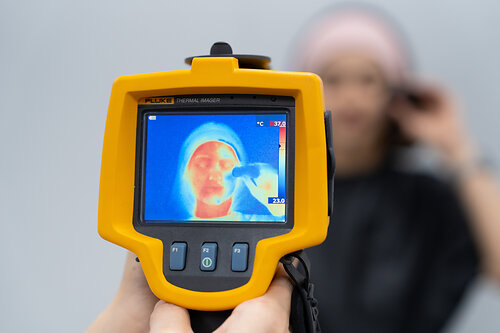 A researcher applies a cooling sun stick to one side of the face to observe differences in skin temperature.eyond its cooling properties, Kolmar Korea’s ingredient is said to offer soothing and elasticity-enhancing benefits while supporting the recovery of UV-damaged skin, making it highly versatile for a wide range of skin care and sun care applications.
Utilizing this technology, Kolmar Korea has developed a “Cooling Sun Essence” engineered to combat both heat-induced aging and photoaging.
Kolmar Korea is also pioneering cooling technologies driven by internal water particles rather than chemical cooling agents. An example is its proprietary “water-drop” technology. The particle structure breaks down upon contact with the skin, releasing moisture in the form of microdroplets.
Most conventional water-drop formulations have faced structural stability challenges in sunscreens. Over time, ingredients can separate, and microscopic cracks can form in the UV-protective film, significantly degrading sunscreen efficacy.
To address this issue, Kolmar Korea has developed a formulation utilizing a clay-based material composed of thin, interlocking layers. The particles are designed to collapse and release moisture only when friction is applied, allowing the UV-protective film to spread evenly across the skin.
Upon application, this formulation reduces skin temperature by approximately 4°C and suppresses approximately 90% of subsequent heat-induced temperature increases.
Sun care stick formats
Kolmar Korea has similarly overcome the traditional limitations of sun care stick formats by significantly increasing water content to maximize the cooling effect.
One standout innovation from the company is its Jelly Sun Stick, developed using a naturally derived seaweed ingredient. Unlike conventional stick cosmetics, the Jelly Sun Stick features a water-based surface layer that immediately refreshes and cools the skin upon contact. By minimizing oil content, the formulation achieves a resilient, jelly-like elasticity while maintaining the structural stability required for a solid stick format.
Products incorporating a water technology layer deliver powerful UV protection while lowering skin temperature by approximately 6°C instantly upon application.
“Building on the competitiveness of K-sun care, we will continue to pioneer diverse functionalities and expand the boundaries of the sun care category,” says the company representative.
Demand for cooling skin care evolves
Provital also noticed the need for cooling skin care solutions as global temperatures continue to rise. This need for well-being and hydration is growing, and the company’s gels, mists, and masks provide intense hydration.
Provital says skin care routines are evolving “to provide comfort and a feeling of freshness to the skin while preserving its radiance.”
Mindful product layering can help address the skin’s changing needs throughout the day. For example, in the morning, thermal water and a hydrating serum can provide moisture and help prepare the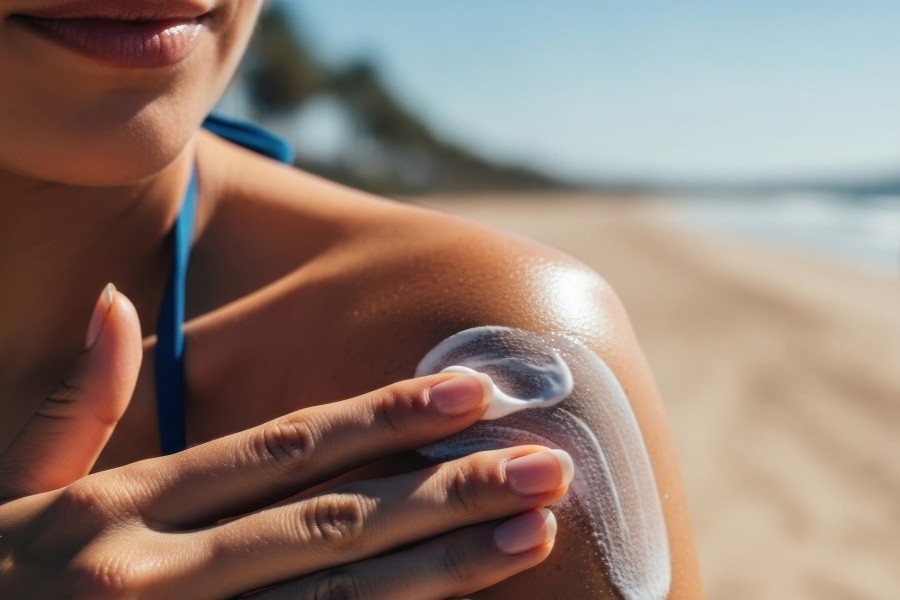 Provital has also seen a growing demand for cooling skin care as global temperatures climb. skin for exposure to environmental stressors. In the evening, a soothing, hydrating mask followed by a night balm or gel may support recovery after prolonged sun and heat exposure, says Provital.
Sun care shifts
As temperatures rise and sun exposure may increase, the sun care industry is undergoing a profound shift. In recent years, it has been signified by the switch of sunscreen from a beach day grab to a daily essential.
Personal Care Insights recently sat down with the founders of Green People and Seprify, who said that the daily sun care use shift is partly driven by increasing consumer awareness of the need for SPF protection.
Spate’s US sun care report has also shown that brands that treat SPF like sunscreen are losing competitiveness against brands that treat it like skin care. Instead, the data-driven beauty platform recommends marketing SPF as a daily cosmetic, rather than a seasonal one.
Earlier this year, a necklace that can track personal sun exposure hit the wearable beauty market. The90 has launched Gem, which tracks real-time UVA and UVB exposure and translates the data into personalized guidance.
A researcher applies a cooling sun stick to one side of the face to observe differences in skin temperature.A researcher applies a cooling sun stick to one side of the face to observe differences in skin temperature.A researcher applies a cooling sun stick to one side of the face to observe differences in skin temperature.Provital has also seen a growing demand for cooling skin care as global temperatures climb.Provital has also seen a growing demand for cooling skin care as global temperatures climb.Provital has also seen a growing demand for cooling skin care as global temperatures climb.