
Belgian bean-free coffee startup Koppie has launched OtherKinds, a direct-to-consumer brand of filter coffee and lattes, as a testbed for its climate-friendly alternatives.
Just over six months after securing fresh funding for its beanless coffee platform, Ghent-based Koppie has commercialised its first products through a new consumer brand.
The startup uses fermentation to turn legumes into coffee-like alternatives that can be used as standalone ingredients or combined with coffee beans to create hybrid formulations.
Koppie is now selling filter coffee grounds and ready-to-mix latte powders that are completely free from coffee beans under its direct-to-consumer brand, OtherKinds.
It follows a period of scaling up through new manufacturing partnerships, which have strengthened its supply chain. Now, it’s making a strategic bet on the D2C channel to bolster its positioning in the B2B market (where the focus is on hybrid coffee).
“The intent of the branded solution is indeed to help our B2B growth, and mainly on two fronts: collecting data and insight on consumer wants and needs, and building a showcase that consumers are open to new drinks in the coffee and tea space,” co-founder and CEO Daan Raemdonck tells Green Queen.
“What we’re seeing in B2B is that our current product solution satisfies the requirements of R&D, purchasing, and operations. It’s the marketing side of things where it gets more complex,” he explains. “That’s largely driven by a horrible perception of ‘coffee adulteration’, built during the war years, with ‘historical alternatives’ like chicory, chickpeas, grain-based alternatives, etc.
“We believe that’s the novelty of our product, though. The taste we deliver has evolved to such a point that it can make certain coffee simply taste the same or even better. Meanwhile, it significantly reduces the climate footprint, brings caffeine down to healthier levels, and is an economical and supply-assured option. It’s not about ‘faking’ coffee; it’s about making a new and better blend.”
Beanless coffee in an Aeropress?
Koppie, which was founded by Raemdonck and Pascal Mertens in 2022, has developed a flexible technology that can make use of a number of “locally abundant and culturally relevant” legumes, including chickpeas, fava beans, and yellow peas.
Its current focus is on the latter. “It all starts by selecting and cleaning the peas. We then go on to our patented flavour modulation, which we believe is akin to fixing a Rubik’s Cube,” says Raemdonck.
“Once everything is in the right order and setting, we move on to roasting, followed by grinding and packaging. For these last steps, we use the exact equipment and settings used in coffee processing.”
Coffee roasters can buy these pea-derived “Koppie beans” and use them the same way they would green coffee – they can co-roast with coffee on the same equipment, grind like coffee, and use the same packaging framework. “Since it’s in bean form, it can be used in bean-to-cup or fully automatic machines, which is a massive market in B2B hospitality,” he explains.
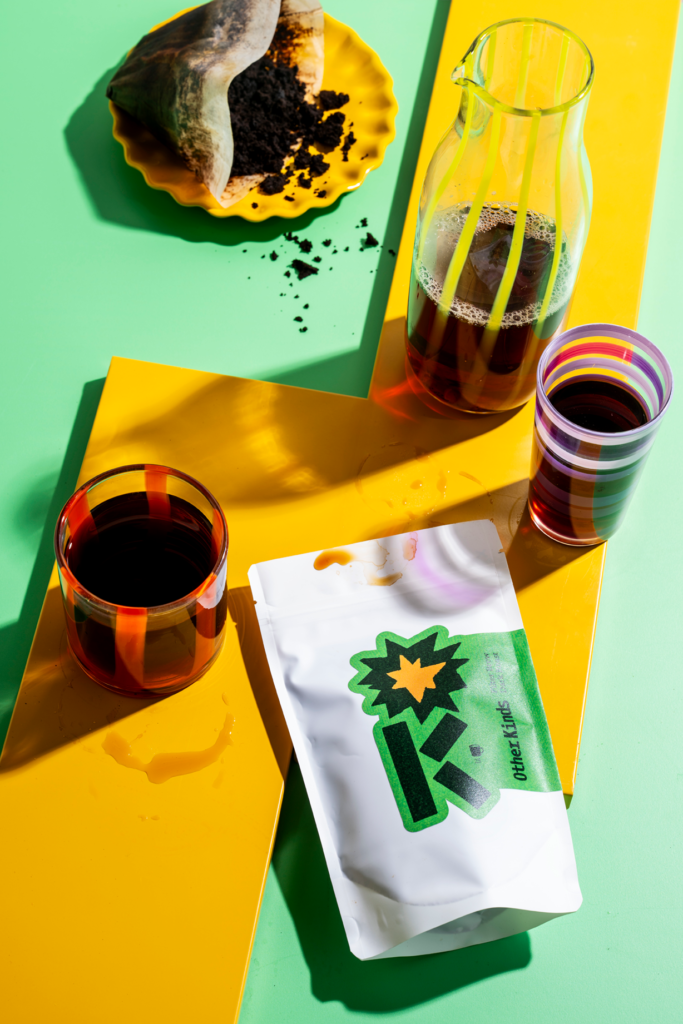
With OtherKinds, the company is selling single-ingredient filter coffee alternatives in medium and dark roast varieties, which can be brewed as a pourover, in an Aeropress, or in drip coffee machines (they are, however, too fine for French press brewing).
“Most people, when not aware of anything ‘out of the ordinary’, drink it and assume it’s coffee. When asked to dig deeper and reflect and truly ‘taste’ what they are having, they notice the differences with coffee/tea respectfully. It’s then often described as smooth, sweet and nutty, with a light bitter finish,” says Raemdonck.
“This is also exactly what we can bring to coffee in flavour experience: make it sweeter, slightly more nutty, and with a delicate, coffee-like bitterness.”
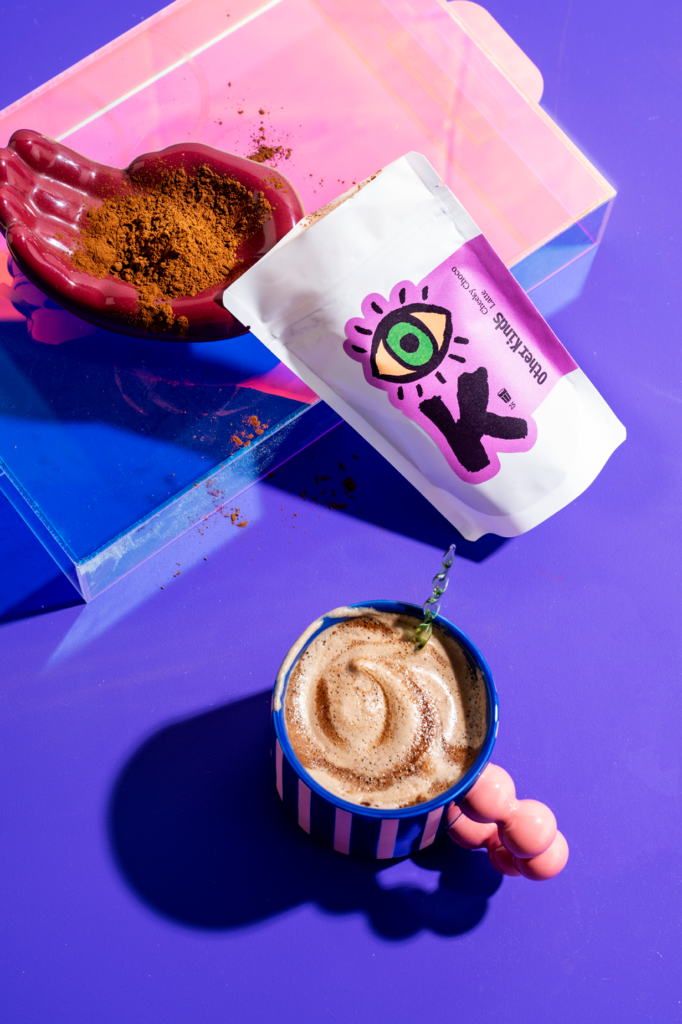
Koppie has rolled out A-OK lattes in nutty and chocolate flavours as well, which combine the fermented peas with roasted carob to “add a slight bit of natural sweetness to the drink”.
Consumers can mix these powders with any kind of milk – much like you’d prepare matcha – and drink them hot or cold. The CEO says the caffeine-free beverages have received great reviews at trade events such as the Amsterdam Coffee Festival and World of Coffee Brussels.
Reflecting on the name OtherKinds, he feels it “clearly signals” something new and different. “We don’t want to reference coffee, tea, chai, [or] matcha too much. OtherKinds allows us to claim a space for ourselves, while not having to invent a ‘new name’. The brand, hopefully, becomes the category,” he says.
The D2C rollout – which will serve as a channel to gather consumer feedback and test new recipes – is just the initial iteration of its broader launch of the branded side of the business. “We’re also intending to work with restaurants, coffee bars, [and] specialty stores in Belgium and the Netherlands,” Raemdonck outlines.
Koppie can produce 1,000 tonnes of bean-free coffee through co-manufacturers
Koppie’s technology aims to alleviate problems for a coffee industry pummelled by climate change. Between 2021 and 2025, Brazil, Vietnam, Colombia, Ethiopia, and Indonesia – which represent 75% of the global coffee supply – experienced 57 extra days of harmful heat (above 30°C). That causes heat stress and reduces yield, bean quality and disease resistance among coffee plants.
It’s partly why global coffee prices reached an all-time high in early 2025. And research shows that 60% of coffee species are already endangered, and the tropical area suitable for growing coffee is set to be halved by 2050.
Coffee production itself is partly to blame. A kg of beans, on average, generates more greenhouse gases than a kg of poultry and pig meat combined. The same amount of Koppie’s beanless coffee is associated with 1.19kg of emissions, according to a life-cycle assessment, which is up to 95% lower than conventional coffee.
But bean-free alternatives have a bad rap, with many viewing them as inferior (especially in the specialty coffee scene) and detrimental to coffee farmers. That’s why Koppie is looking to meet producers in the middle with hybrid solutions that combine conventional coffee with its fermented peas. (This blended approach has already taken the meat industry by storm.)
“As Belgians, we know the world of chocolate pretty well. When you add hazelnuts to chocolate, that’s just a better product for a specific group of consumers who prefer that taste. Why wouldn’t that be the way to tell the story of hybrid coffee blends?” says Raemdonck.
“We are very happy with the progress on the B2B side. We continue to work towards market launch with our first signed customer (a large coffee roaster) and have a few additional exciting leads in the pipeline or in the industrial testing phase,” he reveals.
Its manufacturing network involves “respected operators” in the European food industry. Koppie can tap into their expertise and scale up without high capital expenditure. “We hope to repay their trust through significant volumes in the coming year,” notes the CEO.
“Through these partners, we have an annual capacity of 1,000 tonnes of our fermented and roasted pea. We can deliver ‘green’ peas, roasted peas, roasted and ground peas, or a ready-made blend of peas and coffee to customer specifications. We continue working on concentrate and instant blends through partners.”
Koppie is among a number of startups making bean-free coffee alternatives across the world – these include Prefer, Voyage Foods, Compound Foods, Atomo, Northern Wonder, and Wake.