
Swedish oat milk giant Oatly has unveiled new packaging in response to the 89 Percent Project, a global journalistic effort highlighting how a majority of people want governments to take stronger action to fight climate change.
A year after being named the world’s first climate solutions company in the food and beverage category, Oatly is now illustrating the “ultimate climate solution” on its oat milk cartons.
The company’s packaging initiative, launched this month in Sweden before a planned international expansion, is a reference to the 89 Percent Project, a global journalistic coalition led by Covering Climate Now (CCNow) that entails reporting on studies that show 80-89% of people want to see more political action to fight the climate crisis.
Oatly’s cartons now carry a message to “engage politicians” and “create awareness among citizens” that they aren’t alone, according to the firm’s senior sustainability director, Caroline Reid.
“With a summer fuelled by wildfires and drought, continued climate migration, soaring food prices, food insecurity and linear, fossil-fuel-driven supply chains being disrupted, we need governments to look up, listen to science and act,” she said in a LinkedIn post. “In fact, 89% of us want that.”
Why the 89% message is the ‘ultimate climate solution’
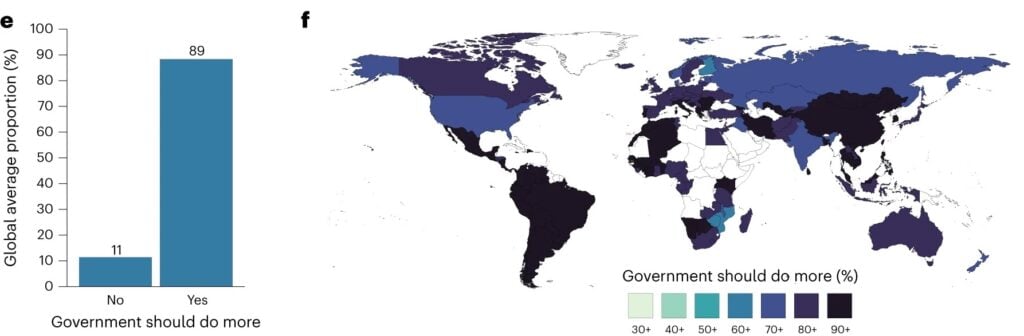
The 89% statistic comes from a 2024 poll covering 130,000 participants from 125 countries, which asked people if they’d contribute 1% of their personal income towards the climate fight, and if they want their governments to take stronger action.
While 89% was the global average of agreement for the latter, the number varies among different countries. In Germany, the largest national market for oat milk, 86% of citizens want to see their political leaders step up their climate action, falling to 86% in India and 74% in the US, but rising to 98% in Chile and Bolivia.
Here’s the problem: most people don’t realise they’re the overwhelming majority, so they tend to stay silent on environmental issues. This was illustrated in a 2025 survey of over 143,000 people from 140 countries and territories, which found that 40% of respondents feel personally “very threatened” by climate change, but only 31% think others feel the same.
That gap widens in high-income countries (a hotbed for oat milk), where nearly half (49%) of people identify the climate crisis as a serious threat, but just 20% believe their compatriots agree with them.
Among Oatly’s top markets, 51% of Americans call climate change a personal threat, but only 10% think others agree with them. And in the EU, 52% lie in the former camp and 24% in the latter.
Reid praised CCNow’s “mission to improve climate coverage in media worldwide and unlock the power of the 89% of people”, calling it “the ultimate climate solution”.
In response, CCNow said what gives the 89% message that designation is that it makes many other climate fixes, from rooftop solar panels to policies like ending fossil fuel subsidies, more achievable.
Oatly employs playful wording to drive its message home
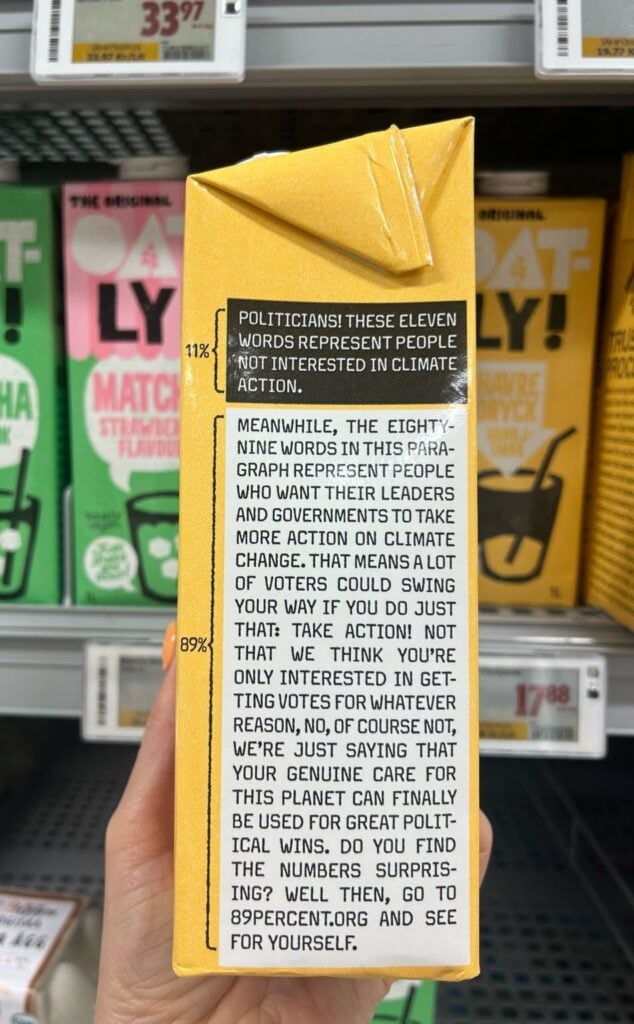
The 89% stat is illustrated on the side of Oatly’s cartons with clever formatting. The text is divided into two blocks. The first is 11 words long and reads: “Politicians, these eleven words represent people not interested in climate action.”
The second – you guessed it – has 89 words to reflect the share of the population clamouring for better climate policies. “A lot of voters could swing your way if you do just that: take action,” the message tells politicians.
That line is followed by the signature humour that underpins Oatly’s brand identity. “Not that we think you’re interested in getting votes for whatever reason, no, of course not,” the packaging states, adding: “We’re just saying that your genuine care for this planet can finally be used for great political wins.”
Reid argued that public demand for stronger climate action is “not polarised, nor partisan”. “As a citizen, you are not alone – you are the majority,” she urged readers. “So use your voice, use your vote. Solutions exist; governments can enable and support the transition.”
The move is the latest example of Oatly’s sustainability leadership. Its certification as a climate solutions company reflects the fact that 90% of its revenue comes from products that significantly lower emissions compared to market alternatives. A recent analysis shows that its barista oat milk is 58-71% more planet-friendly than chilled cow’s milk in several European countries.
The designation further denotes that Oatly has near-term emissions and net-zero targets covering scopes 1, 2 and 3 that are tracked annually. It followed the launch of its updated global sustainability strategy, which outlines measures to reduce its emissions by 89% by 2050 (from a 2020 baseline), and counterbalance its remaining emissions with permanent removals.
Oatly has also long been an advocate for on-pack carbon footprint labelling. “It’s not the whole answer, but climate labelling is about giving consumers the freedom to make informed choices about what they’re buying and how it impacts the planet – from grower to grocer,” Reid told Green Queen last year.
“We want to see more organisations from across the full spectrum of the food industry coming together to work out what an effective climate labelling system should look like,” she added. “The science is unequivocal – emissions from the food system must come down, and these reductions can’t happen without consumer behaviour change.”