
Plant-based proteins blow animal sources out of the water on sustainability and health metrics, with tofu leading the charts, according to a new analysis by the Better Protein Institute.
What’s the best source of protein?
That’s the question that forms the core of a new study by the Better Protein Institute (BPI), which analysed 20 high-protein foods based on a multidimensional rating system that accounts for both sustainability and health.
BPI founder Chris Macdonald argues that assessing protein sources solely on their nutritional or environmental credentials can “conceal critical tradeoffs” and mislead consumers by failing to provide a holistic outlook. By measuring foods against both metrics, you get a more complete picture.
The resulting metric, called the BPI Score, evaluates sources on two categories. The planet score looks at greenhouse gas emissions, water pollution and land use, whereas the people score considers health factors like sodium and saturated fat content, alongside accessibility metrics like cost and availability.
“A clear disparity emerged between plant-based and animal-based proteins. Tofu emerged as the highest-scoring product, while cheddar cheese ranked last,” Macdonald wrote in Frontiers in Sustainable Food Systems.
Tofu tops the protein charts
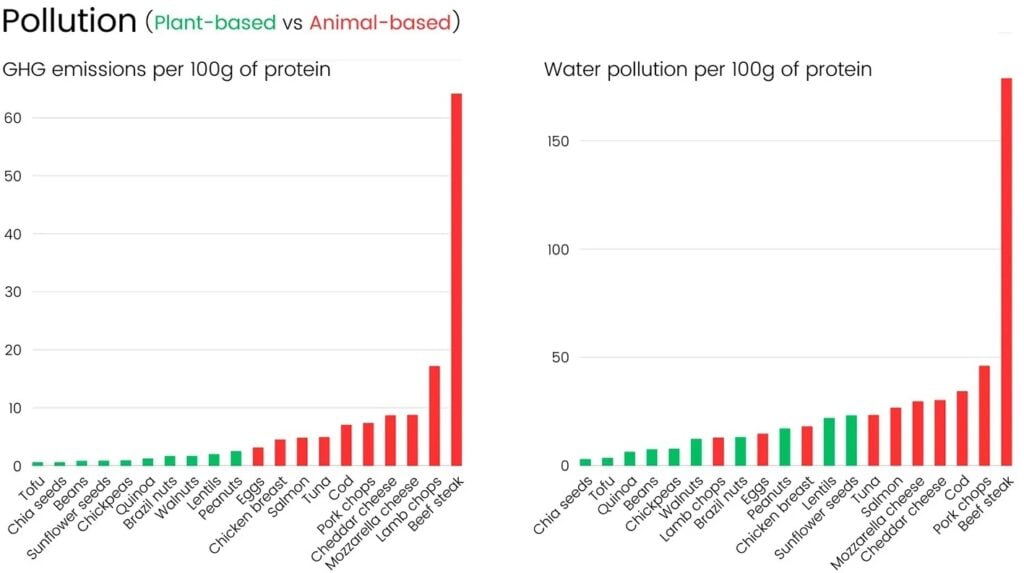
In terms of the climate score, tofu and chia seeds had the lowest GHG emissions and water-use impact, respectively, while beef steak was the most polluting and most water-intensive food by a country mile.
According to the data used by the study, tofu production generates 0.61kg of CO2e per 100g of protein, but this rises to 64.19 for beef – that’s two orders of magnitude higher. Likewise, the former needs just 2.16 sq m for this amount, nearly 100 times lower than beef (211.4 sq m).
Tofu reached the maximum planet score (16 points), and beef the lowest (one point). Plant-based proteins won in terms of product type, as every source in the top quintile of the combined scores – tofu, chia seeds, beans, and quinoa – came from plants. On the other end of the spectrum, the bottom-quintile products were mozzarella, pork, cheddar, and beef, all of which are animal-based.
Beans, walnuts, Brazil nuts, and lentils were found to contain the lowest levels of sodium, whereas eggs, tuna, cheddar, and mozzarella had the highest. In terms of saturated fat, cod had the least amount, but Cheddar had the most – both the top and bottom 20% contained plant-based proteins. All of the latter, though, had zero cholesterol.
The research also evaluated whether a food was a complete source of protein, i.e., it contains all nine essential amino acids. “While some plant-based sources such as tofu were considered complete, most plant-based sources were not. By contrast, all animal-based protein sources were flagged as complete sources,” the study stated.
When it came to accessibility, lentils were found to be the cheapest protein source at UK supermarkets, and quinoa the costliest. Overall, tofu came out on top again with 20 points on the people score (out of a maximum 24), lamb bottomed the list with 10, and plant proteins outperformed animal sources.
BPI Score aims to help policymakers and consumers make informed decisions

Macdonald combined the two rating systems to create the overall BPI Score, with tofu netting the highest share of points (36) and Cheddar the lowest (13).
“The product type winner was plant-based proteins, as every product in the top 20% of the combined scores was plant-based (tofu, chia seeds, beans, and quinoa). The product type loser was animal-based proteins, as every product in the bottom 20% of the combined scores was animal-based (mozzarella, lamb, beef, and cheddar),” he wrote.
He noted that this is just a first version of the BPI Score, which doesn’t include all protein sources, such as mycoprotein or Rubisco protein, which would likely score highly across both metrics. And if ethical concerns were incorporated into this version, then cheese would likely receive an even lower score.
“There is a lose-lose trade-off with regard to the ethical considerations of animal agriculture: increasing space can improve welfare standards for farmed animals, but increasing space for an already resource-intensive industry further decreases the space for wildlife and biodiversity,” he said.
“Against deliberate corporate obfuscation and marketing myths, the goal of a holistic score is not to create a new label, but to foster a new literacy,” he added, outlining his goal to empower consumers, policymakers, and organisations to make more informed decisions.
“Ultimately, beyond the spreadsheets and scores, lies a fundamental reckoning: our protein choice is a referendum on the compassion we are willing to show to animals, to the planet, and to future generations.”