
Monde Nissin-owned Quorn Foods, which houses the eponymous mycoprotein brand and Cauldron, witnessed a 2.2% hike in revenue in the first half of 2026, a welcome change from several years of decline.
Quorn Foods’s bet on convenience protein and blended meat is starting to pay off, as can be seen from its parent company’s latest earnings report.
The Monde Nissin-owned alternative protein company reported ₱7.38B ($120M) in revenue in the first half of 2026, a 2.2% year-on-year increase on a constant-currency basis. In terms of quarterly performance, it saw a 2.7% jump in the April-to-June period compared with the previous year.
This includes sales from Quorn’s mycoprotein meat alternatives and Cauldron’s range of tofu and plant proteins. The growth was driven by a double-digit hike in the snacking segment, which was bolstered by the UK launch of Protein Bites.
Monde Nissin’s protein business comprised 70% of its topline revenue for Q2 2025, and its snacking arm alone accounts for around 15% of that protein share. “The launch of Protein Bites, which offer healthy protein and fibres, follows a new trend [among] consumers who combine their snacks and meals to reduce overall food consumption,” the Filipino company’s CEO, Henry Soesanto, told investors in an earnings call.
“We are seeing these new products building good potential, playing into new convenient retail formats for single consumption, catering to a much wider audience even beyond the UK and Europe,” he added.
“We also believe that this is a scalable new part of the portfolio, where taste, convenience and health are rewarded with a higher price point, which will be accretive to the gross margin of the protein portfolio as a whole.”
Quorn’s Protein Bites raise brand awareness and purchase intent
The earnings results follow a years-long slump for Quorn. Its parent company, Marlow Foods (which was acquired by Monde Nissin in 2015), saw sales shrink by 9% in 2024. And last year, it registered a 1.2% drop in annual sales
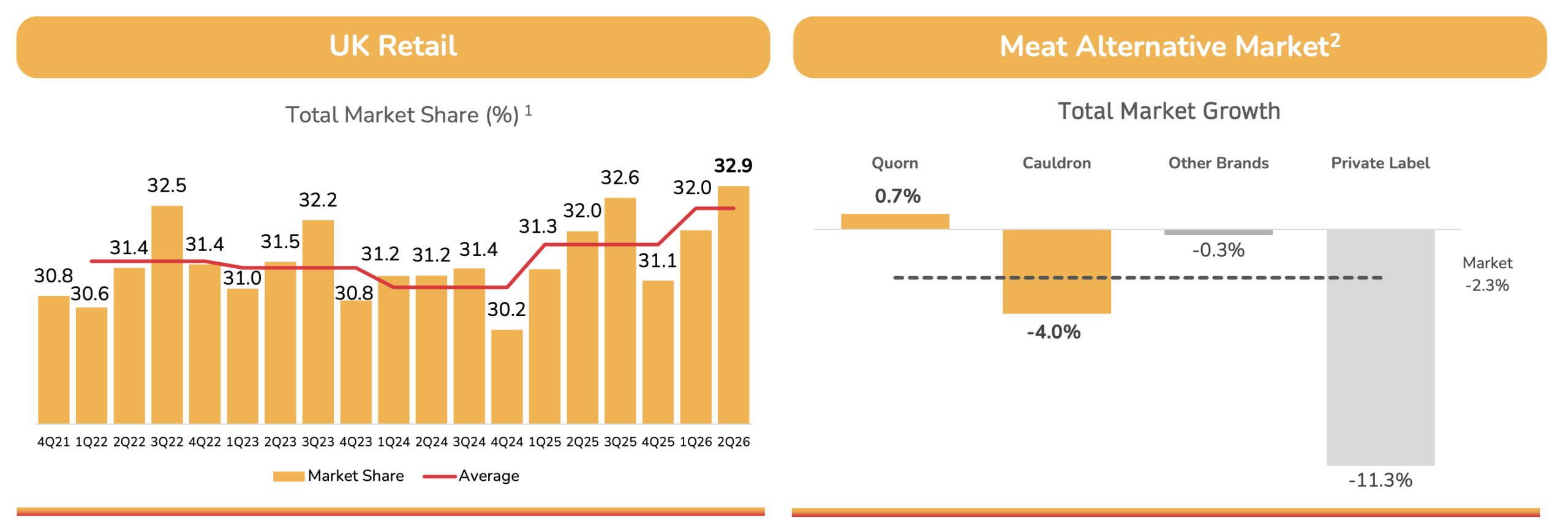
The Q2 2026 improvement was driven by a 0.7% growth from Quorn’s portfolio – 0.5% from chilled and 0.9% from its frozen products – offset by a 4% decline for Cauldron.
This is against the backdrop of a 2.3% decline in the market for meat alternatives in the US, according to Nielsen-NIQ data cited by the firm. Quorn’s market share ticked up from 32% in Q2 2025 to 32.9% in the corresponding period this year.
Quorn CEO David Flochel said launching the Protein Bites in both the meat-free and food-to-go sections of UK retail has enabled it to stretch the core business “beyond meat-free and into new consumer occasions”. This gives it a “real positive protein brand proposition”.
“It’s early days, but the rate of sales is very good and very promising, to a point that has been helping us to unlock even further distribution for the second half of the year. This is a key driver of the continuous double-digit growth in snacking that we’ve been enjoying in Q2,” he said.
He added that the snacking products helped Quorn reach “the highest awareness for the brand, but also the highest purchase intent for the future”, giving the executives confidence that the platform is a solid foundation for future growth.
“Protein Bites plays a key role for us to reach new consumers, to double our implementation in retail stores, meat-free and food-to-go,” Flochel said. “It is also an opportunity […] to expand distribution into convenience, into out-of-home in the UK, but also in future international markets with one new platform, which will help us again in terms of velocity and productivity in supply.
“It is margin-accretive and sales-accretive – and both are very important because it’s positioning us again as [a] category leader to be able to shift from meat-free into positive protein with that healthy, tasty, convenient proposition.”
Foodservice will ‘get worse before it gets better’
The Quorn division’s core net income reached ₱106M ($1.7M) in the first half of this year, versus a ₱215M ($2.5M) core net loss in the same period in 2025. Gross profit, meanwhile, increased by 44% to ₱2.3B ($37.2M).
However, Quorn CFO Nick Cooper said the Q2 growth was helped by a relatively weak year-on-year comparison, noting that most of the high input costs from the Iran war are “in inventory at the end of Q2 and will be a stronger drag on the gross margin in Q3 and Q4”.
The one area where Quorn continues to lag is foodservice, which accounts for 18% of its protein business but witnessed a 5% decline in Q2 sales. Flochel labelled the result “disappointing”, maintaining that stabilising the topline gradually is a “clear priority” here.
“What we are seeing are more structural challenges than expected,” he said. “The first one: significant cost pressure from operators and distributors in this market. Second one: QSR. There’s lower demand in the QSR we’re working with in Europe.
“Third point: in schools [and] in education in the UK, there are new regulations coming in, which have also been challenging the menu cycles. And historically, we’ve been relying too much on the education sector and a few limited numbers of QSRs.”
In response, Quorn is implementing a “back to basics” strategy focused on execution, a strategy it has previously deployed successfully in retail. “As much as we are protecting the core business, we are also planting the seeds for future growth with the launch of blended meat with [the] UltiMeat B2B solution for foodservice,” said Flochel.
The firm’s foray into the thriving blended meat category, which began with an NHS partnership in 2024, will enable it to expand the foodservice business beyond education and healthcare into business and industry as well. Additionally, it will now launch Protein Bites in QSRs.
“It’s probably going to get worse before it gets better,” Flochel said in reference to the foodservice market. “I remain convinced and confident that we can drive positive contribution and growth for that channel. However, short term, there’s still a lot to be fixed with clear focus, and the plans are now in place. It’s about execution.”