
Pangenome-Guided Breeding Boosts Yield and High-Altitude Adaptation in Buckwheat
Agricultural genomics is beginning to move beyond the limits of a single “reference” crop genome. In a proof-of-concept study, researchers used pangenome-guided breeding to recover useful DNA variation left behind during domestication and combine two traits that often work against each other in the field: high-altitude adaptation and yield.
The study, “Pangenome-guided breeding restores high-altitude adaptation and improves yield in Tartary buckwheat,” was published in Cell. The international team was led by the Chinese Academy of Agricultural Sciences and included researchers from 22 institutions across 10 countries, including scientists at Murdoch University’s Centre for Crop and Food Innovation (CCFI). Tartary buckwheat (Fagopyrum tataricum), a nutrient-dense grain grown in the Himalayan highlands, was selected as a model because its wild relatives tolerate harsh conditions such as cold and intense UV-B radiation.
Most genomics-assisted breeding compares crop lines with a single reference genome and focuses heavily on single-nucleotide polymorphisms. But that approach can miss larger structural variants, including gene copy-number changes, that influence agriculturally important traits. To capture that hidden variation, the team generated a telomere-to-telomere reference genome and assembled a graph-based pangenome from 16 accessions spanning Himalayan wild populations and globally distributed landraces. They also integrated genomic data from 994 accessions across 15 countries and cataloged 123,131 nonredundant structural variants.
“Most modern breeding compares a crop’s genome against a single reference, which is like judging a language by a single dictionary,” said Rajeev Varshney, FRS, FAA, CCFI director, and co-corresponding author of the study. “A pangenome captures the whole vocabulary, including the words a crop lost along the way. And that’s where a lot of the useful genetics for resilience is hiding.”
The analysis identified FtRNH, a wild-specific gene present in high-altitude wild plants but missing from cultivated varieties. The gene is associated with the repair of UV-B–induced DNA damage and enhanced high-altitude adaptability. The researchers also identified structural variation at the FtPLATZ locus, including copy-number variation and a 28-bp promoter insertion linked to seed-size variation.
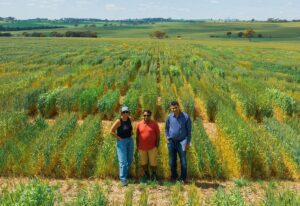
Using marker-assisted selection, the team crossed these superior FtRNH and FtPLATZ alleles into candidate breeding lines, effectively stacking high-altitude adaptation with larger seed size. In high-altitude field trials, the resulting lines showed improved growth, larger seeds, and significantly higher yields compared with the standard variety.
“Resilience and yield are usually a trade-off, meaning that when you increase one, you lose the other,” Varshney said. “What the pangenome lets us do is identify the specific DNA segments underlying each trait and deliberately stack them. That’s a template other breeding programs can follow.”
Whether the approach will translate broadly remains to be tested, but the study provides a framework for looking beyond elite crop genomes. By capturing variation in wild relatives and landraces, pangenomes may give breeders a clearer view of alleles that could be combined to improve adaptation without sacrificing yield.