
A new report from the International Panel of Experts on Sustainable Food Systems (iPES Food) argues that cascading geopolitical disruptions are exposing deep structural weaknesses in the global food system, and that governments must act now to reduce dependence on volatile international markets.
Published in May 2026, The New Geopolitics of Food: Navigating Policies for Resilient Self-Reliance draws on case studies from India, West Africa, Canada, and Norway to examine how market management tools, including public food reserves, supply management systems, and production quotas, can help stabilize domestic food markets during periods of external disruption.
A record import bill and rising debt
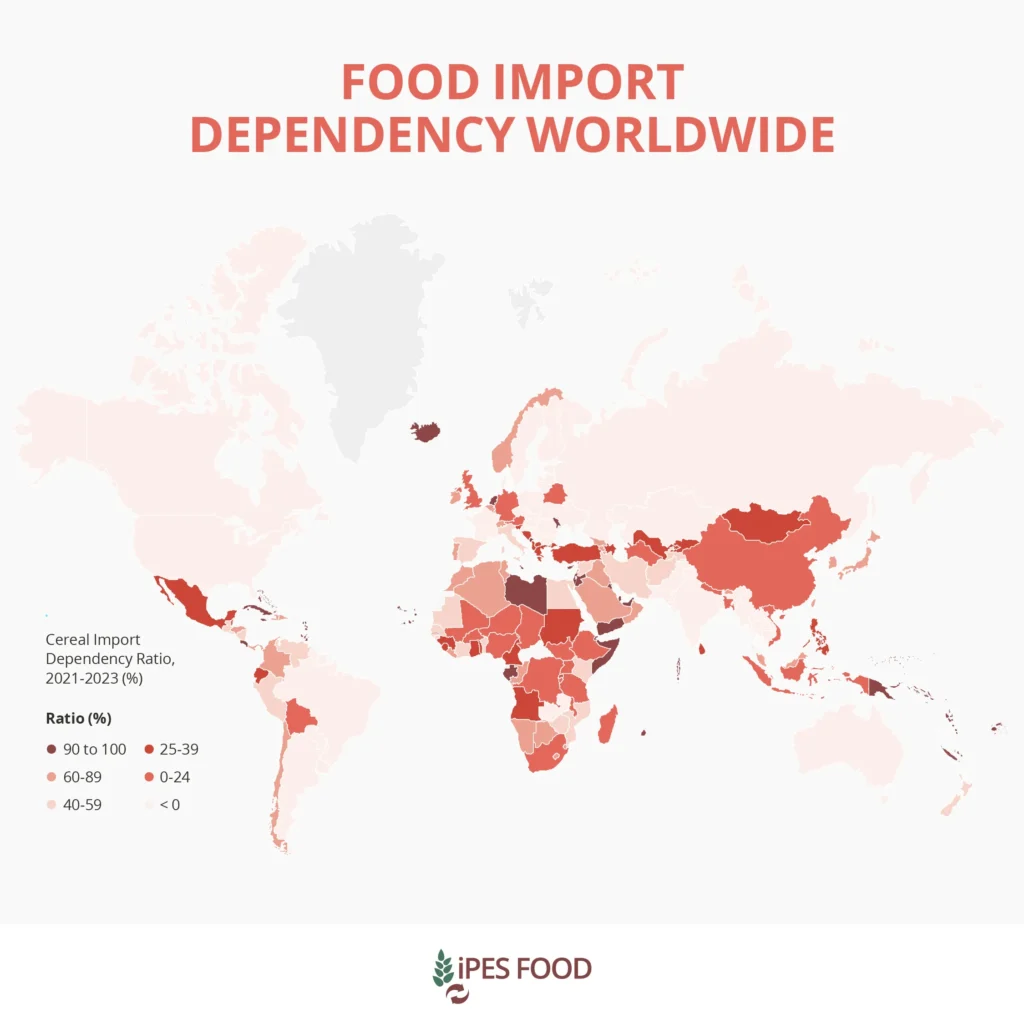
The report documents a significant deterioration in food affordability since 2020. Global food prices have averaged more than 35% higher than in 2019, and the global food import bill reached a record $2.2 trillion in 2025. The impact has fallen hardest on lower-income countries: the Least Developed Countries saw their food import bill rise from $41 billion in 2020 to $59.4 billion in 2024, while Net Food Importing Developing Countries went from $108 billion to $155.9 billion over the same period.
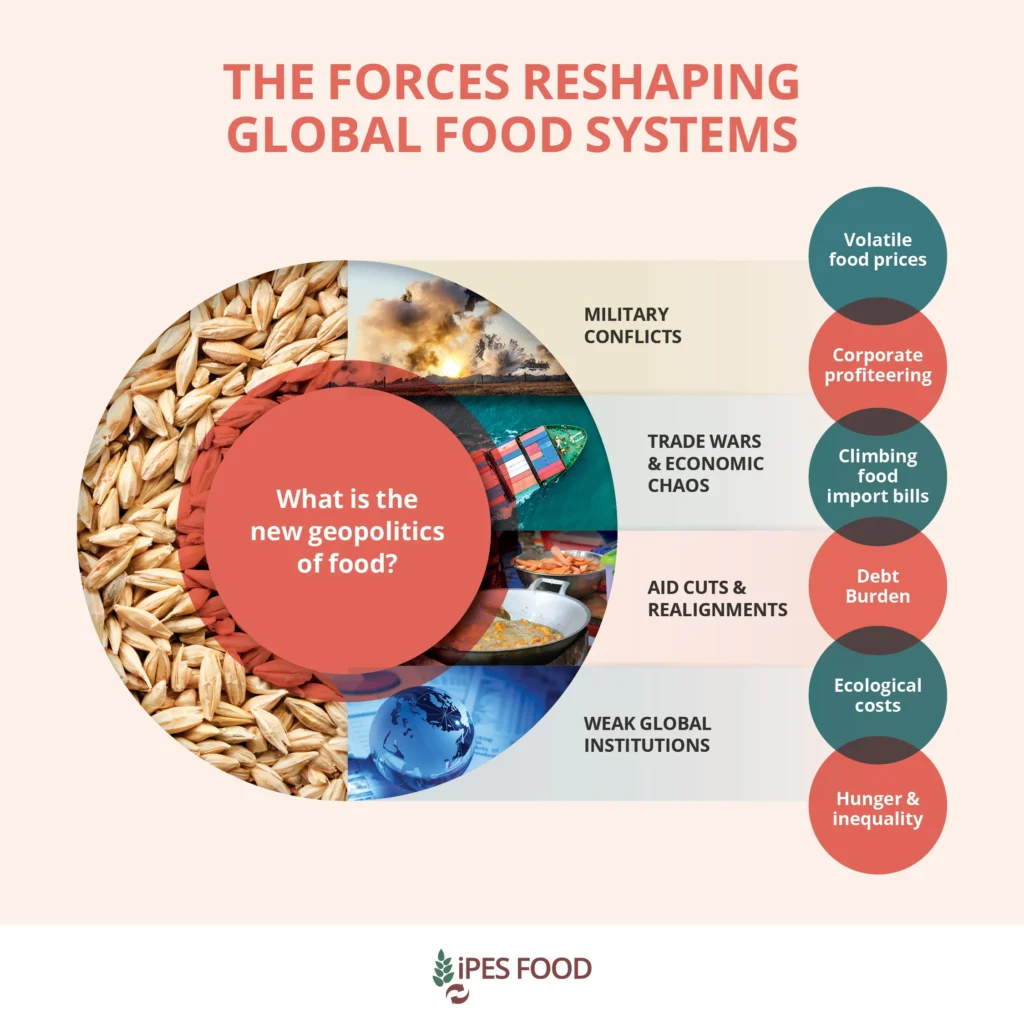
Rising import costs are compounding debt burdens in many low- and middle-income countries, leaving governments with less fiscal room to respond. According to World Bank data cited in the report, food price inflation exceeded 5% in roughly half of all low-income countries between May and August 2025, compared to one in five high-income countries.
IPES-Food expert Jennifer Clapp said: “We’re entering a new geopolitics of food, where food prices are shaped by conflict, trade disruption, and power play. Crisis after crisis exposes the risks of outsourcing food security to distant markets and fragile supply chains controlled by a handful of countries and companies. The way forward is resilient self-reliance, local food systems backed by fair trade. The tools to stabilise prices already exist, from food reserves to supply management, but governments are not using them at scale.”
Corporate concentration as a compounding factor
The report also examines how market instability has benefited large agrifood corporations. Since 2008, a wave of mergers has reduced the number of leading seed and agrochemical companies from six to four, and concentration has risen across virtually every other segment of the food supply chain. During recent periods of food price inflation, some dominant firms appear to have raised consumer prices beyond their own cost increases, a dynamic the report describes as corporate profiteering enabled by thin competition.
As one data point, US grocery retailer Kroger acknowledged in its failed attempt to acquire rival Albertsons that it had inflated the consumer price of certain products beyond its own cost increases.
Lessons from existing models
The report points to several existing examples of market management working in practice. During the 2007-2008 food price crisis, global rice prices rose by around 75% in a six-month period; in India, which operates a large public food stockholding system, wholesale rice prices increased by only 14% over the same period.
Canada’s dairy supply management system, in place since the 1970s, produced notably less price volatility than the US market during both the 2007-2008 crisis and the COVID-19 pandemic. In Norway, farmer-owned cooperatives in the dairy and meat sectors effectively function as marketing boards, purchasing commodities at negotiated prices and providing income stability for producers, including those in remote areas.
At the regional level, the Economic Community of West African States launched a collaborative food reserve in 2012 that has delivered over 55,000 metric tonnes of cereals to six member countries through 19 separate interventions.
IPES-Food expert Mamadou Goïta stated, “We already have solutions. The West African regional food security reserve shows that cooperation and public tools can stabilize markets. What is needed now is the political will to scale these efforts, cut reliance on volatile global markets, and build lasting resilience.”