
Chiara Molena is co-founder and Managing Director of EDERA Lab, an international marketing, PR, and communications agency that works with startups and scale-ups in the agrifood tech and deep tech sectors. With over 14 years of experience in international marketing and brand management, she has previously held senior roles at Champion Petfoods, Stoli Group, and Beam Suntory, and serves as an Adjunct Professor of Marketing and Entrepreneurship at IE Business School.
In this interview, Chiara speaks on why strong technology alone rarely guarantees commercial adoption, the communication mistakes food tech startups consistently make, and what founders should do differently to build real traction with corporate buyers.
For readers unfamiliar with EDERA Lab, what gap in the food tech industry are you trying to solve?
At EDERA Lab, we help food tech startups and scale-ups bridge the gap between technological innovation and commercial credibility.
The companies we work with are often navigating two equally demanding challenges at the same time: raising capital and entering the market. That means they need to communicate effectively with investors, corporate partners, and buyers simultaneously, each with very different expectations and decision-making criteria.
What we consistently see across the sector is that founding teams have deep scientific and technical expertise, but limited time and internal resources to translate complex technologies into narratives that are commercially clear, credible, and strategically aligned.
EDERA Lab acts as a specialist marketing and communications partner for food tech innovators, helping them define strategic positioning, build visibility with investors, and support commercial traction as they move from proof-of-concept to market adoption. Our role is to create lean, focused communication strategies that help innovative companies stay top-of-mind with the stakeholders that matter most.
What inspired EDERA Lab and StartLife to develop this new white paper on commercial traction in food tech?
The inspiration for the white paper came from a clear gap we were seeing across the food tech industry.
My background is in food, beverage, and pet food, and over the years, I worked extensively on bringing innovation to market. Through our work with startups at EDERA Lab, it became increasingly obvious that there is often a disconnect between how startups talk about their technology and how buyers want to hear about it. StartLife, our partner in the white paper, clearly felt the same.
The food tech ecosystem spends a lot of time discussing technology, IP, and scalability. But there was very little practical guidance around the communication and positioning side of commercialization, despite the fact that these factors can strongly influence whether startups gain attention, build trust, and move commercial conversations forward.
That is what motivated the white paper.
Together with StartLife, we wanted to create something practical and industry-driven, built on conversations with investors, R&D leaders, distributors, retailers, and corporate innovation teams. The result is a qualitative but highly actionable resource designed to help food tech startups better navigate commercial traction and market adoption.
Your report argues that sustainability and innovation alone are no longer enough. What are corporates looking for instead?
I would probably offer a slightly provocative perspective and say that sustainability and innovation alone were never really enough beyond generating initial interest.
What corporates ultimately adopt are solutions that solve real operational and commercial challenges. Buyers are looking for performance, reliability, scalability, cost-in-use, and clear value within existing systems.
Sustainability absolutely matters, and in many cases it strengthens the appeal of a solution, but it is rarely sufficient on its own as a commercial positioning strategy.
The companies gaining the most traction today are the ones that can connect innovation to concrete business outcomes and communicate that value clearly to buyers.

Why do so many food tech startups struggle to translate strong technology into commercial adoption?
One of the main reasons is that food tech startups are very often founded by exceptionally strong scientific and technical teams. Naturally, those teams tend to communicate in technical and scientific terms.
The challenge is that commercial adoption requires a different mindset. At a certain point, the conversation has to shift from “this is an impressive technology” to “this solves a concrete problem better than existing alternatives.” That means understanding competitive applications, buyer priorities, and how the solution fits within a crowded market landscape.
The second challenge is simply the reality of startup life. Founders are under constant time pressure. Technologies evolve quickly, applications change, and new opportunities emerge, but teams rarely have the time to step back and build structured commercial narratives around that evolution.
So very often, it is not a lack of innovation that slows adoption. It is the difficulty of translating complex technology into clear commercial value for buyers.
The white paper talks about “selling by relevance.” What does that mean in practice for startups speaking to corporate buyers?
Selling by relevance means starting with the buyer’s context, not the startup’s technology.
In practice, that means understanding the specific category, application, formulation challenge, procurement pressure or consumer need the buyer is working with. A startup should be able to explain why its solution matters to that company, in that application, at that moment.
For example, it is not enough to say: “We have a novel protein ingredient.” A more relevant message would explain what product application it supports, what functionality it delivers, what incumbent ingredient it replaces or improves, and what commercial or operational benefit it creates.
It also means recognising that the person inside the corporate has their own KPIs, constraints and internal stakeholders. Startups need to equip that person with the evidence and language needed to build a credible internal case.
How important is trust when corporates evaluate emerging food technologies?
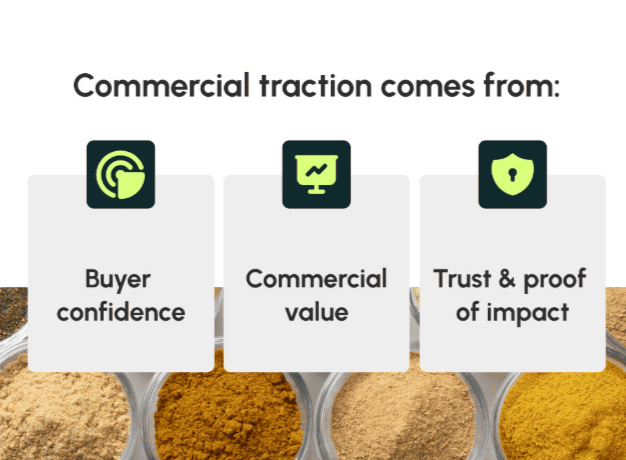
Trust is central. Emerging food technologies often ask corporates to take on perceived risk: technical risk, supply risk, regulatory risk, reputational risk and operational risk. Even when the innovation is exciting, buyers need confidence that the startup can deliver reliably.
Trust is not built through one pitch or one announcement. It is built through repeated proof points over time. That includes clear documentation, realistic timelines, technical support, transparency around what is proven and what is still developing, and visible signs of progress.
For food tech startups, this is particularly important because the market has moved from early enthusiasm to a more demanding phase. Buyers and investors are asking tougher questions.
Being honest about maturity is part of trust-building. Overpromising can damage credibility quickly. Clear, specific and evidence-based communication is much more powerful.
What are some of the biggest communication mistakes food tech startups make when approaching buyers?
The first mistake is leading too heavily with technical novelty without connecting it to buyer value. Scientific detail matters, but it needs to be translated into application, performance and commercial relevance.
The second is trying to sound too broad. Startups often want to communicate every possible application of their platform, but excessive flexibility can create uncertainty. Buyers usually want to understand the most mature, relevant use case first.
Another mistake is underestimating the importance of operational communication: documentation, application sheets, cost-in-use logic, regulatory status, production readiness and technical support. These materials are not just sales assets; they are trust assets.
Finally, many startups only communicate when they have a major announcement. In long food industry sales cycles, that creates gaps. Buyers need to see consistent, credible signs that the company is progressing.
Your report highlights visibility as a commercial tool. How can startups use channels like LinkedIn and trade media more effectively?
Visibility should not be treated as a nice to have. In B2B food tech, it can support commercial confidence when it is used strategically.
LinkedIn is useful because it allows startups to educate the market over time. Rather than only posting company updates, startups should explain the problem they are solving, the category they are helping to build, the application context, and the commercial implications of their technology.
Trade media plays a different role. It can provide third-party credibility and help place the company within a wider industry conversation. But the strongest media stories are rarely just “we launched something” or “we raised funding.” They connect the company’s progress to a broader shift in the market.
The key is consistency. Visibility should reinforce the same commercial narrative buyers are hearing in sales conversations: why this technology matters, why now, and why the company is becoming a credible partner.
During your interviews for the report, what insights or patterns surprised you the most?
One of the strongest patterns was how much the human side of corporate buying matters. We often talk about “corporates” as if they are single decision-making entities, but in reality innovation adoption depends on people inside those organisations.
The person engaging with a startup has their own priorities, KPIs, internal politics and professional risk. If they champion a new technology, they need to be able to defend that decision internally.
That means startups are not only selling a product or ingredient. They are helping an internal advocate build confidence across the organisation.
Another important pattern was the role of focus. Many startups assume that showing multiple applications makes them more attractive. But several interviewees suggested the opposite: a clear, mature entry application often builds more confidence than a very broad platform story.
What is one thing food tech founders should start doing differently if they want to improve commercial traction?
They should choose the most commercially urgent application and build their communication around that.
That means being very clear on what problem they solve, who has that problem, what the current alternative is, why their solution is better, what evidence supports the claim, and what the buyer needs to do next.
For many startups, the shift is from “this is what our technology can do” to “this is where our technology creates value for you.”
That may sound simple, but it changes the whole commercial conversation. It affects the website, the sales deck, the technical documentation, LinkedIn, media outreach, investor communication and buyer follow-up.
Food tech founders do not need to make their science less sophisticated. They need to make its commercial relevance easier to understand.
The full white paper can be downloaded here.