
A judge in Québec has authorised a class-action lawsuit against coffee chains over excessive plant-based milk levies, with Starbucks admitting it charged six times more than the cost.
Starbucks, Tim Hortons and Foodtastic have been dealt a blow in a legal action against their non-dairy milk surcharge in Canada.
A judge in the Superior Court of Québec has allowed a class-action lawsuit targeting these coffee chains to proceed, with the plaintiff seeking relief over excessive charges.
For instance, replacing cow’s milk with a plant-based option cost Starbucks just 12 cents a drink, but the company charged consumers 80 cents for the swap.
“By its own admission, Starbucks therefore charges consumers more than six times the cost it incurs when it replaces cow’s milk with plant-based or lactose-free milk in its beverages,” Justice Catherine Martel noted in her judgment.
Starbucks eventually removed the levy in fall 2024 in Canada and the US, while Tim Hortons and Foodtastic followed suit in January and February 2025, respectively.
The class action includes all consumers in the region who paid a premium for plant-based milk at these chains from December 30, 2021, until they scrapped the surcharge.
Coffee shops charged way more than the cost of plant-based milk

The main sticking point for the plaintiff in the new lawsuit was the impact on their wallets, arguing that the surcharge violated Québec’s Consumer Protection Act, since a study showed how non-dairy milk costs roughly the same as cow’s milk in retail.
“I think it’s unfair, I think it’s egregious, and that’s why we wanted to hold them accountable,” Joey Zukran, a lawyer at LPC Avocats, told CTV News.
“Individually, it might not appear as an astronomical level, but when you take the total sales figures on an aggregate basis for all coffees or beverages sold across Quebec, for which a non-dairy substitute was added at a cost of 80 cents per item, well, that could be an amount in the millions of dollars, potentially,” he added.
The judge rejected the argument based on the price study, stating that retail prices don’t reflect what restaurants pay suppliers, especially since cow’s milk is regulated in Québec.
However, she allowed the case to proceed based on the companies’ cost figures. Milk alternatives cost 16% more to Starbucks than cow’s milk, 63-67% more to Tim Hortons franchisees, and 98% more to Foodtastic
According to the court’s calculations, Tim Hortons charged Canadians 50 cents for a milk swap that cost the company 28 cents in eastern Québec, and Second Cup imposed an 80-cent levy for a substitution that cost about 43 cents. The gap was much lower than at Starbucks, but still enough to allow the claim to advance.
“It does not appear frivolous or manifestly unfounded to argue that it is disproportionate to charge the consumer more than six times what it costs the merchant to substitute cow’s milk with plant-based milk in their tea or coffee, and that this disproportion is sufficiently significant to cause serious harm to the consumer,” Martel wrote, in reference to Starbucks’s surcharge.
Plaintiff’s counsel hopes case could set precedent for other coffee shops
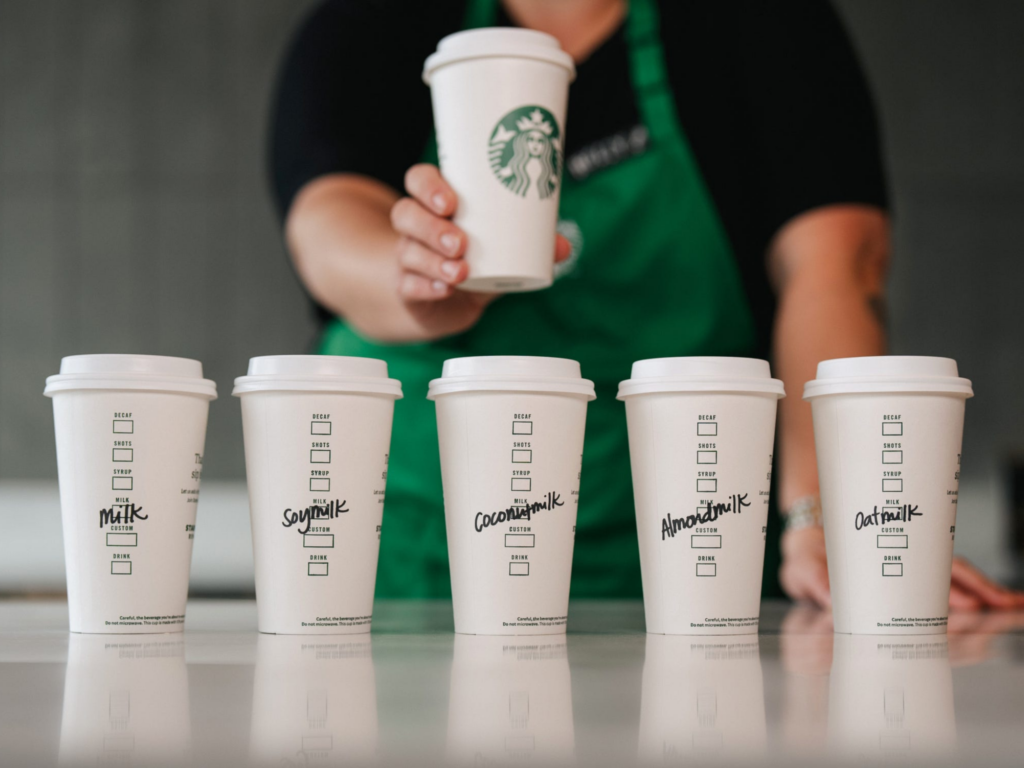
One of the major arguments against the non-dairy surcharge is that it’s discriminatory toward people with milk allergies or lactose intolerance. In Canada, around 16% of consumers suffer from the latter.
Milk consumption in the country has been on the decline for years, just as plant-based alternatives have gained ground – by 2024, 30% of Canadians were drinking plant-based milk.
Plus, milk alternatives are much better for the environment than dairy, whether that’s in terms of greenhouse gas emissions, water consumption, or land use. In fact, Starbucks has admitted that cow’s milk is the biggest contributor to its carbon footprint.
In the lawsuit, the judge rejected the plaintiff’s assertion that Tim Hortons’s 50-cent markup set the market value for the plant-based milk surcharge, as well as claims seeking remedies against the franchisors.
Martel said relief is generally available only against the merchants that directly sold the drinks, though she added that franchisors might be liable for damages if they set or encouraged unfair pricing.
While the three chains in question have let consumers swap cow’s milk for oat, coconut, soy or almond free of charge, the plaintiff’s lawyer, Zukran, said they should still be held liable for their previous business practices, and hoped the case could set a precedent for other coffee shops.
Starbucks was previously hit with a disability discrimination lawsuit for the surcharge in the US, with customers arguing that choosing oat milk shouldn’t be viewed as a chargeable customisation; instead it should be understood as a necessity for the large number of Americans who are lactose-intolerant or have dairy allergies.