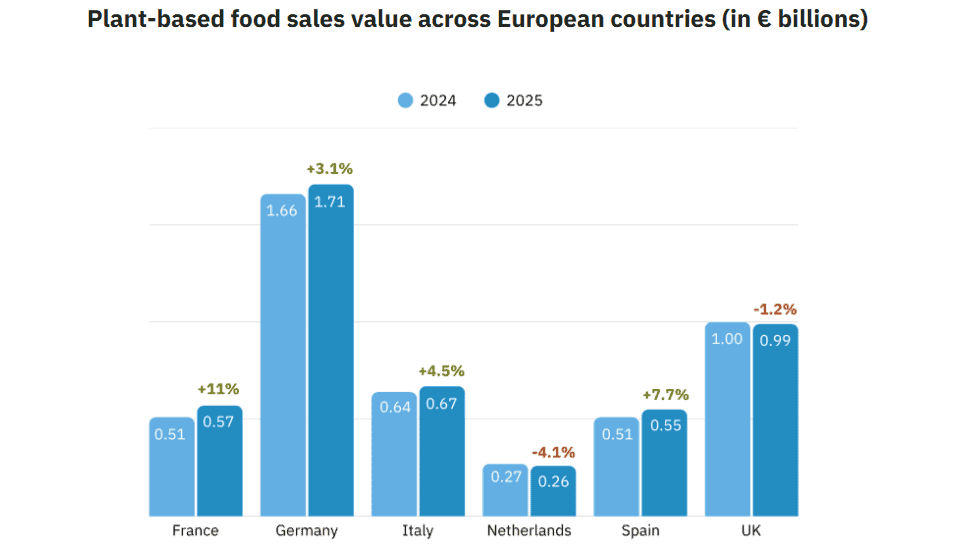
Plant-based food sales volumes grew in four of six major European markets in 2025, driven by narrowing price gaps with animal-based equivalents, according to a new analysis by the Good Food Institute Europe (GFI Europe) based on Circana and NIQ Homescan data. France, Germany, Italy, and Spain all recorded volume growth, while the Netherlands and the UK saw slight declines.
“Across leading European markets, we’re seeing clear evidence that consumers are interested in plant-based foods, but price and taste continue to shape purchasing decisions. While the price gap with animal products is closing in many categories, affordability alone is not sufficient for growth: a good eating experience is also crucial to reach larger audiences,” said Helen Breewood, Senior Market and Consumer Insights Manager at GFI Europe.
Volume growth concentrated in traditional plant proteins
Germany remained Europe’s largest plant-based market, with total retail sales across six categories reaching €1.71 billion, up 3.1% in value and 6.2% in volume Plant-based meat, the largest category, recorded sales of €751 million, with volume declining slightly by 1.7%. Private-label products were the primary drag, with volume falling 7% despite being 38% cheaper than branded equivalents, while branded product volumes edged up.
Traditional plant proteins told a different story: sales volumes of tofu, tempeh, and seitan rose 30% to 14 million kilograms. Price is a likely factor, with tofu averaging €6.57 per kg compared to €14.35 for plant-based meat alternatives. Plant-based meat volume nonetheless remained around 3.7 times greater than tofu, tempeh, and seitan combined.

Milk and yogurt categories post strongest gains
Plant-based milk and milk beverages generated €632 million, up 8.1% in value and 7.7% in volume, accounting for 9.2% of total milk market volume. Private-label products, now representing 60% of the category, were the biggest growth driver, alongside product diversification: 55 of the 275 products analyzed are now barista-style items.
Plant-based milk remained on average 10% more expensive than animal milk in 2025. GFI Europe attributes this gap entirely to a tax disparity: plant-based milk is subject to 19% VAT, while dairy milk is taxed at 7%. Plant-based yogurt also performed strongly, with sales up 9.8% and volume up 7.8%.
Smaller categories struggle on taste and texture
Plant-based cheese and fish continue to hold less than 1% market share in their respective categories. Cheese sales fell 7.4% in value, though volume held roughly steady at 7.5 million kg. Plant-based fish recorded a 29% decline in sales volume, the sharpest drop across all categories, with GFI Europe pointing to taste and texture as likely limiting factors.

France leads European growth
France posted the strongest growth among the six markets, with sales up 11.4% to €572 million and volume up 13.3%, with plant-based meat the fastest-growing category as prices fell and volume rose 16.8%. Spain and Italy also recorded positive trends, while the UK and the Netherlands saw slight declines in both value and volume. This follows GFI Europe’s 2025 analysis showing private-label products driving plant-based retail growth across four European countries.
GFI Europe called on policymakers to address structural barriers including VAT disparities on plant-based milk and EU-level labeling restrictions introduced in 2025.
“To unlock the full economic and environmental potential of plant-based foods, policymakers in Berlin and Brussels should invest significantly more in research and infrastructure and eliminate unfair competitive disadvantages, such as unequal taxation and the absurd labeling bans on plant-based options,” said Ivo Rzegotta, Head of Germany at GFI Europe.