
Ryszard Ciupek is a certification and market development specialist working in the plant-based sector across Latin America. Through his work with the Unión Vegetariana del Perú, he supports food companies in strengthening their access to international markets. He has several years of experience in nonprofit leadership, stakeholder engagement, and animal advocacy, and has participated in multiple international programs focused on the future of food systems.
In this opinion piece, Ryszard Ciupek argues that certification should be viewed as a market access tool rather than a marketing asset, and explores how gaps in certification infrastructure are limiting export opportunities for Latin America’s plant-based producers.
Latin America is moving beyond its “emerging” status in the plant-based sector and entering a phase of sustained growth. The problem is not production capacity. It is what happens just before crossing the border.
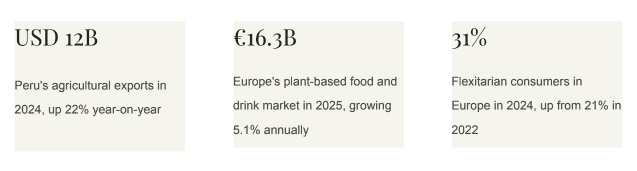
Across the region, companies are scaling up production of plant-based ingredients and finished products, from legumes and grains to increasingly sophisticated alternatives. Peru is a clear example: with agricultural exports surpassing USD 12 billion in 2024, a 22% increase from the previous year, the country has established itself as an export-oriented agricultural producer and is now beginning to develop its own branded plant-based products.
The opportunity on the demand side is equally significant. Europe’s plant-based food and drink market reached €16.3 billion across key markets in 2025, growing 5.1% year-on-year. Growth is increasingly driven by flexitarian consumers, whose numbers rose from 21% in 2022 to 31% in 2024.
But alongside this expansion, a less visible hurdle continues to limit Latin America’s export potential: certification infrastructure. Many producers in the region are ready on the supply side, yet remain underdeveloped when it comes to market access.
Where the real friction lies
In European markets, vegan certification has shifted from a consumer-facing label to a functional requirement within B2B supply chains. For retail buyers and distributors, a recognized certification replaces repeated ingredient-by-ingredient and process verification, accelerating listing decisions and reducing onboarding costs. It is no longer an added value; it is an entry ticket.
The scale of this infrastructure is already significant. Certification systems such as V-Label cover tens of thousands of products across thousands of companies globally and are widely present across European retail environments.
In much of Latin America, however, this layer remains inconsistent or absent. Products may meet vegan standards in practice, but without recognized certification, friction emerges at a critical point: trust. That friction rarely appears in production metrics. Instead, it surfaces in delayed negotiations and extended onboarding processes. Importantly, this operates alongside, not instead of, other critical compliance layers such as food safety standards, traceability, and pesticide residue controls, which remain fundamental for market access in the EU.
Implications for exporters
This gap has tangible consequences for producers entering European markets.
Without standardized labeling, companies often face longer onboarding processes, as buyers must independently verify ingredient sourcing, processing protocols, and cross-contamination risks. This verification process, which can take weeks or even months, consumes time and resources on both sides of the negotiation, time that certified suppliers simply do not need to spend. The result is higher transaction costs and reduced competitiveness compared to suppliers who already meet certification expectations.
In a market where speed and reliability matter, this becomes a structural disadvantage.
Operational insights from Latin America
This dynamic is consistently visible across the region.
Latin America has strong potential as a plant-based exporter, supported by agricultural capacity, biodiversity, and a growing base of companies entering the sector. However, certification uptake remains uneven, particularly among small and medium-sized producers.
Based on certification work led by V-Label Peru and across the region, a recurring pattern emerges: many companies only begin to consider certification after encountering friction in export or retail entry processes. As a result, similar bottlenecks tend to repeat. In practice, this often means that products which already meet vegan standards face avoidable delays, additional documentation requests, or extended verification processes when approaching international buyers.
An additional challenge observed through the Vegetarian Union of Peru’s work is that many companies have limited familiarity with the specific standards and requirements that define vegan and vegetarian labeling. This knowledge gap carries real risks: without a clear understanding of what qualifies a product for these categories, companies may inadvertently mislabel their products, exposing themselves to reputational damage, loss of consumer trust, and potential complications with buyers or regulators in destination markets. Certification, in this sense, also serves as a safeguard, ensuring that what appears on a label accurately reflects what is in the product.
Another consistent observation is that certification tends to be underestimated. While it is often perceived as a marketing tool, in export contexts it functions more as standardized documentation, helping streamline communication between suppliers and buyers across markets.
This suggests that the issue is not capability, but timing. Certification is often treated as a final step, rather than as part of an early-stage market access strategy.
Closing the gap
Closing this gap does not require rebuilding production systems. For most producers, the practices are already in place, what is missing is the documentation that makes those practices legible to international buyers.
The practical implication is straightforward: certification should enter the export conversation at the planning stage, not after the first rejected negotiation. For trade organizations and industry platforms, the opportunity is to treat certification infrastructure the way the sector already treats food safety standards, as a prerequisite, not an afterthought.
For producers ready to move, the first step is an honest audit: does your current process already meet vegan labeling standards? If yes, certification is closer than it appears.


