
German startup Bluu has scaled up production of its cultivated fish cells to 1,000-litre bioreactors in partnership with Dutch firm Cultivate at Scale, with the personal care sector its first target.
Months after expanding its focus beyond seafood into health and beauty, Hamburg-based Bluu has reached industrial-scale production of its cultivated fish cells.
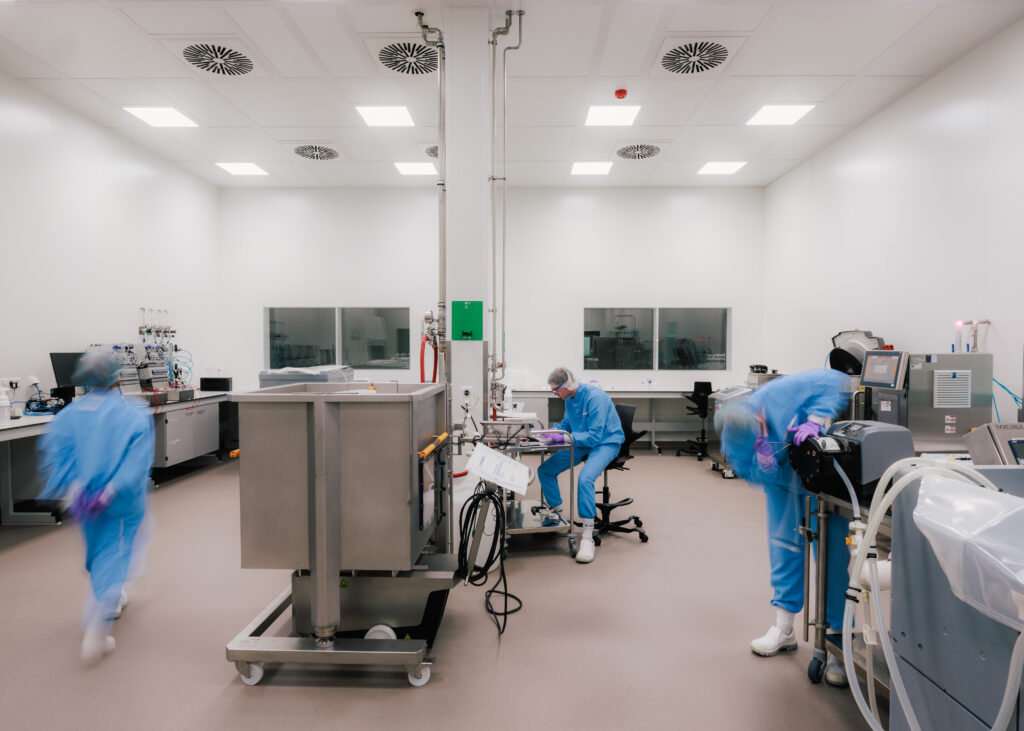
The startup achieved this breakthrough at the Maastricht facility of Dutch company Cultivate at Scale, which helps cellular agriculture scale up their production processes, supported by leading suppliers of cell feed, cell lines and bioreactors.
The two firms are establishing a joint industrial platform to produce cell-cultured marine ingredients, with Bluu bringing its expertise in cultivating Atlantic salmon and rainbow trout cells, and Cultivate at Scale supplying the infrastructure for large-volume bioreactor production.
As part of the partnership, they have produced fish cells in 1,000-litre bioreactors, which they claim is a first for the cultivated marine ingredient space.
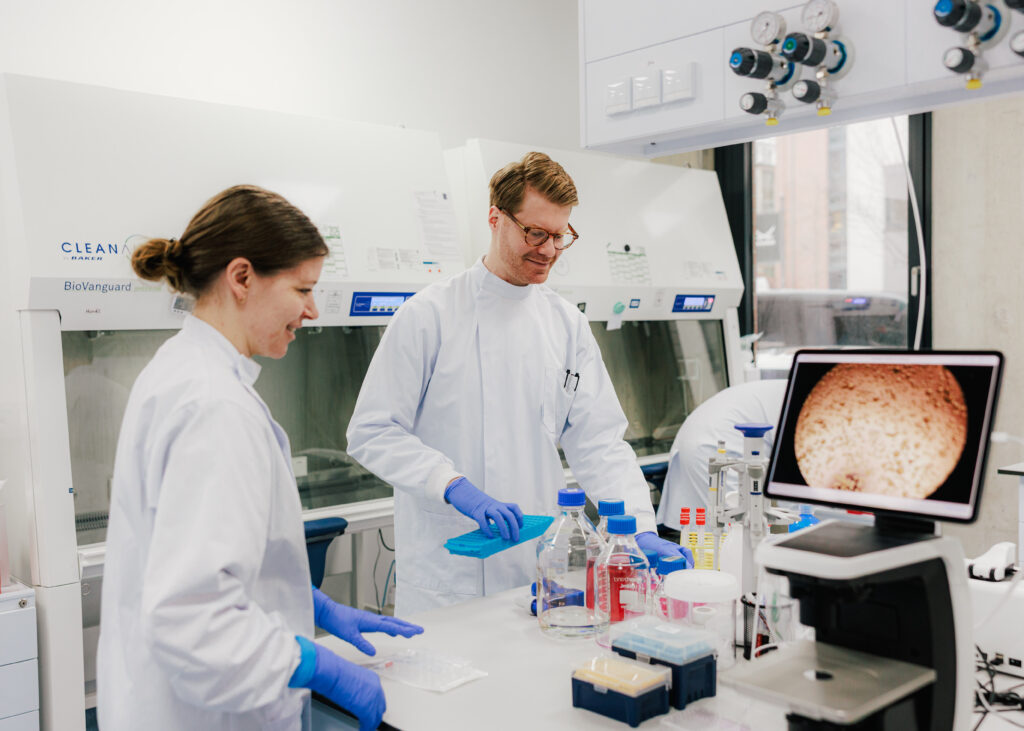
“We grow rainbow trout and Atlantic salmon cells in a nutrient medium outside the fish’s body in a bioreactor. The cells can then be harvested,” Cornelius Lahme, marketing and communications lead at Bluu, told Green Queen.
“For the first time, we’ve now been able to harvest a 1,000-litre reactor with rainbow trout cells. To our knowledge, no other startup has ever been able to harvest fish cells in bioreactors of this size.”
Industrial expansion will enable significant cost reductions
Bluu began with the aim of commercialising cultivated fish for seafood applications, then diversified into other categories with more immediate market potential last year.
“Our core expertise lies in the growth of fish cells outside the animal’s body in a bioreactor. These cells can be used for various purposes,” explained Lahme.
Under Bluu Seafood, it had already been working on salmon- and trout-derived seafood ingredients. Now, it’s working to produce pharmaceutical-grade bioactives under its Bluu Skincare line, and an all-in-one marine bioproduct with multiple benefits as part of the Bluu Health brand.
At the heart of its expansion is the startup’s Bluu Zone tech platform, which enables the controlled cultivation of fish cells to create bioidentical marine ingredients.
The company said the use of Cultivate at Scale’s facility in the Netherlands highlights the flexibility of its production approach and the robustness of its process.
“This is an important breakthrough for Bluu. Not only can we produce the ingredient, but we also ensure that our cells are produced consistently in real production environments,” said Bluu co-founder and CEO Sebastian Rakers.
The industrial expansion will enable further development and acceleration of its technology, particularly cell growth, ultimately leading to significant cost reductions.
“We have already impressively demonstrated our ability to grow fish cells in bioreactors in an ocean-friendly and animal-friendly manner in recent years. We are proud to be able to show that we can implement this on an ever-larger scale and serve our first market with personal care products,” Rakers said.
Slow regulatory process led Bluu to turn to personal care
The long-term production partnership with Cultivate at Scale is part of Bluu’s localised production strategy and sets the stage for potential expansion into other European markets.
“This joint project is a milestone in European cell cultivation and a significant step for us, and it is a fine example of efficient German-Dutch cooperation,” said Jaco van der Merwe, managing director of Cultivate at Scale.
The firm spun out of Dutch cultivated meat pioneer Mosa Meat in 2025, opening with a €25M injection from the government’s National Growth Fund and private investors.
Speaking to Green Queen, Lahme explained why Bluu diversified its strategy last year: “Our work and expertise focus on the cell culture of fish cells in bioreactors. This has not changed. However, due to the unfortunately still very lengthy approval processes in the food sector, access to other markets – such as the personal care sector – is significantly faster.”
This, he said, is currently “the most important factor” for Bluu as a business, which is why it’s initially focusing on cosmetics and beauty products. “However, this does not change our long-term strategy. The food sector will follow. Food product development is merely on hold,” said Lahme.
Asked about Bluu’s regulatory and launch strategy, he revealed: “We are currently aiming to operate as a manufacturer of ingredients (raw materials) for the personal care industry. To do so, safety and efficacy studies are first required to substantiate our claims. We are currently working on this.”
To date, the company has secured €30M in funding. “The next round of funding is currently underway. The money will be used to scale up the business,” Lahme confirmed.
Several other cultivated seafood startups have moved beyond food. Singapore’s Umami Bioworks has announced a move into marine bioactives for skincare, starting with regenerative compound PDRN. Meanwhile, Avant diversified from seafood into skincare in 2021, and has since released a regenerative peptide complex, ZelluGen, marketed under its recently unveiled Biotecq brand.