
Clean Food Group has raised £4.5M ($6.1M) in new funding, alongside a £700,000 ($950,000) grant from the UK government, to expand production of its sustainable yeast-derived fats.
UK biotech startup Clean Food Group has brought on new funding to scale up production of its waste-derived yeast oils and fats.
It has secured a £4.5M ($6.1M) investment led by Clean Growth Fund and New Agrarian, with participation from existing backers Seed Innovations and Döhler Group, as well as £700,000 in non-dilutive grant funding from Innovate UK, the national innovation agency.
The fresh capital will help Clean Food Group complete the scale-up of the Knowsley facility it acquired from the takeover of microalgae oil producer Algal Omega 3 last year, and accelerate the commercialisation of its fermentation-derived palm oil alternatives.
The support of its new investors, together with the Innovate grant, represents a “strong endorsement of Clean Food Group’s significant progress and the scale of the opportunity ahead”, according to co-founder and CFO Tom Ellen.
“The capital raised will enable the company to bring on stream the world’s largest yeast-derived oils and fats facility, and to deliver on our long-term vision for sustainable food manufacturing,” he said.
Clean Food Group readies for expansion at Knowsley facility
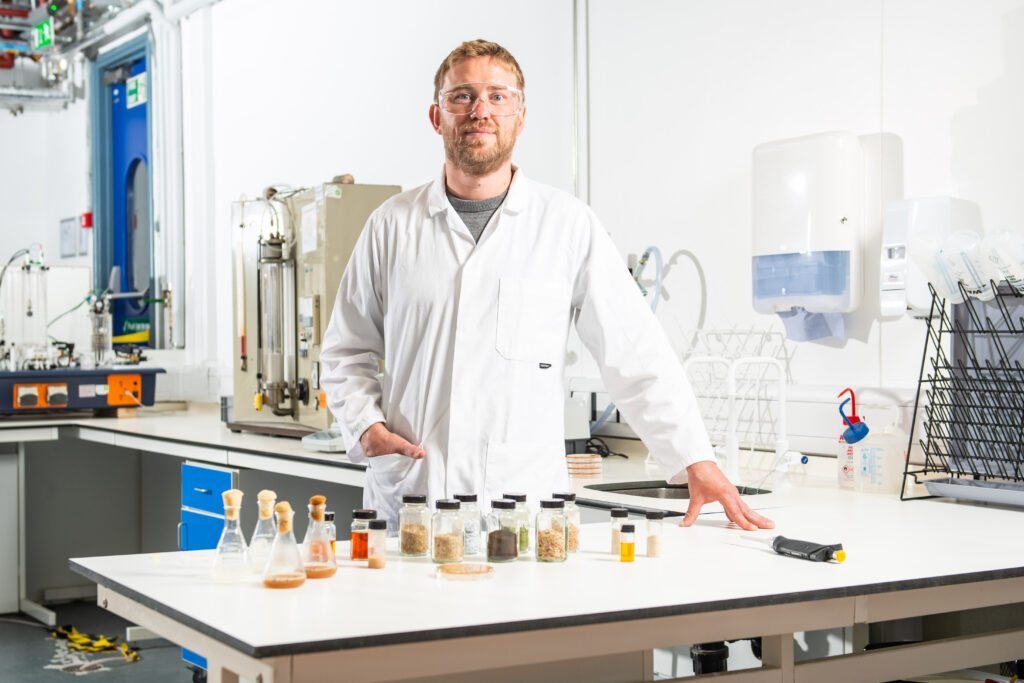
Clean Food Group has its roots in the University of Bath, where co-founder and technical lead Chris Chuck led a 10-year research effort that forms the base of the firm’s technology, aided by £7.5M in UK government funding.
Its proprietary CleanOil platform feeds scalable non-GMO yeast strains on circular feedstocks like surplus bread, turning it into high-performance, low-impact alternatives to tropical fats like palm and coconut oil, as well as petroleum-based mineral oils.
The platform has spawned several products that can be produced at price parity to farmed incumbents. CleanOil 40 is designed for confectionery and spreads, CleanFat 50 for bakery and dairy, and Clean Protein+ is an emulsifier for mayo and pet food.
Its debut ingredient is CleanOil 25, positioned as a base for sustainable products across the skincare, haircare, and wider personal care categories. It was co-developed with THG Labs, the product development arm of UK personal care giant THG, and specialty chemicals company Croda, as part of a partnership that began in October 2024.
Clean Food Group’s fermentation platform and manufacturing process have been validated at scale, with the startup completing a 60,000-litre production run to yield two tonnes of its oils in 2025, in an effort supported by Döhler Ventures.
It then acquired Algal Omega 3 and its 12-acre site in Knowsley, which has a fermentation capacity of one million litres. This complements the firm’s demo plant in Ledbury, and makes it the world’s largest manufacturer of yeast-derived fats.
“Clean Food Group has consistently demonstrated both the strength of its technology and the commercial potential of its sustainable oils and fats platform,” said Rodrigo Hortega de Velasco, managing partner at Döhler Ventures.
“The acquisition of the Knowsley facility marks a significant milestone, enabling production at a scale that brings these innovative products closer to widespread commercial reality,” he added.
Supply chain fragility ‘one of the defining risks of our time’

The startup is tackling some of the most problematic ingredients in the food and cosmetics supply chains. Palm oil, for instance, is present in around half of all supermarket products, and accounts for two-fifths of global oil production.
But it’s a driver of rampant tropical deforestation and has been directly linked to wildfires in Indonesia and Malaysia. It’s why the EU’s Deforestation Regulation, set to take effect this December after several delays, will ban the import of products like palm oil linked to deforestation. Violators face fines of up to 4% of their global turnover – currently, 34% of palm oil imports potentially come from deforested land.
Clean Food Group already has regulatory approval to sell CleanOil 25 for cosmetic use in the UK, the EU and the US, and debuted the ingredient at the ongoing In-Cosmetics Global show in Paris (April 14-16).
“Supply chain fragility is one of the defining risks of our time. War, climate volatility, and trade disputes are presenting a huge challenge to manufacturers; the ingredients we assumed would always be available are no longer guaranteed,” said Jim Mellon, chairman and founder of New Agrarian.
“Clean Food Group is addressing this problem head-on, using scalable science and technology to build genuine resilience and sustainability into the way we produce and source key ingredients used in everything from food to cosmetics. For me, this sits at a rare intersection: a compelling investment case and a genuine solution to one of the most pressing challenges of our generation.”
It is among a host of companies developing fermentation-derived fat alternatives for food and personal care. California’s Savor produces carbon-based fats to replace butter and tropical oils like palm, Estonia’s Äio makes tropical fat alternatives by upcycling industry byproducts, and Melt&Marble sells precision-fermented “designer fats” to replace animal and plant-based options.