
Violife won more honours than any other brand at the 2026 Tasty Awards. Its commercial lead, Meryem Leyoussi, explains how the company is balancing taste and nutrition.
Four of the 27 plant-based products that were adjudged to be on par with conventional dairy at the 2026 Tasty Awards belong to Violife.
The Flora Food Group-owned brand is one of the longest-standing players in the vegan cheese sector, having been around for over two decades. Over that time, it is safe to say, it has found a formula that works with consumers.
Violife’s cream cheese, sour cream, coffee creamer, and salted butter block all won a Tasty Award, denoting that they were rated as good or better than their dairy counterparts by at least 50% of Americans in taste tests conducted by Nectar, the sensory insights initiative of Food System Innovations.
That’s an achievement for a category often derided by vegans and non-vegans alike, especially cheese, whose early iterations were deemed too sticky, too plasticky, and simply too different from the products they were trying to replicate.
The latest criticism of these products is that they’re ultra-processed and too ingredient-heavy. Has Violife, whose parent company Flora Food Group is reportedly on the market for $10B, felt any effects of that backlash?
“No, I think the ingredients that we use are simple. We have a short ingredient label,” Meryem Leyoussi, the commercial and brand lead at Flora Food Group, tells Green Queen. “Our products are based on or made with coconut oil, and we’re transparent about the ingredients that we use.”
She explains that Violife is “very much focused on delivering taste without compromise”: “That is at the forefront of everything that we do. Taste is table stakes. And essentially, we don’t walk away from compromising on taste and compromising on performance as well.”
How Violife is tackling different facets of the dairy-free category
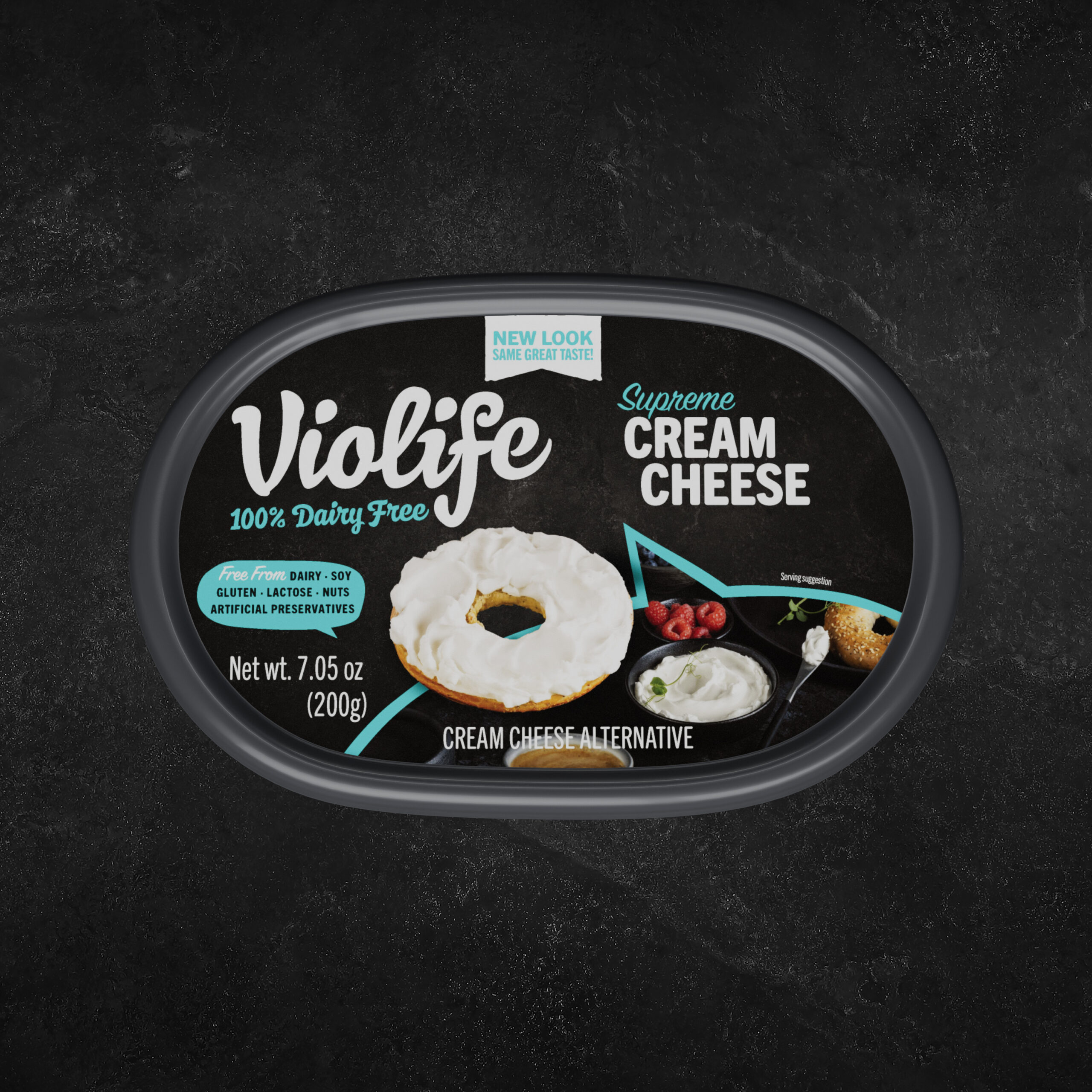
Violife’s cream cheese is its best-selling product, and Leyoussi says it’s the top-selling dairy-free alternative in the US. “It’s known for its texture and versatility in usage – you can use it for cooking, baking. [It] performs across many consumer usage occasions,” she notes.
While Violife has seemingly cracked the soft cheese category, harder cheese formats are still the category’s biggest white space. Take mozzarella, for instance: only 25% of taste-tersters were willing to purchase a vegan version of this Italian classic, compared to 67% who said they’d buy the conventional incumbent.
“I think hard cheeses in general are harder to crack in terms of texture, and I think that is sort of where the focus will be. Our products perform really well compared to the category, but we have a way to go to close the gaps necessary,” says Leyoussi.
Violife is approaching the category a little differently. “We’re not asking people to replace or give up dairy. We are meeting consumers where they are in their journey, whether you’re dairy-free or allergen-free, or choose a lifestyle or dietary needs, we have the right products for you,” she says.
Will the company ever move into formats like mozzarella pearls, as players like Plant Ahead are doing? “There’s a lot on our innovation pipeline,” Leyoussi responds, without giving too much away.
What about milk or yoghurt alternatives? “We’re staying true to the Violife promise, which is unlocking those cravings without compromise,” she says. “That inspires everything that we do, including the results from [the] Tasty Awards, which will inspire what we do for our innovation and renovation pipeline. So we’re always looking at what the next thing is.”
Expanding on the findings from Nectar’s Taste of the Industry report, she outlines: “It was really exciting to see that there are a lot of products that have exceeded taste expectations. And I think getting that recognition alone and from what plant-based used to be to where it is today is a huge step in the right direction.”
“That definitely motivated us, and I’m sharing those results with our R&D team to see what we can do next to continue to solve those consumer tensions.”
Fast-paced innovation and hitting the taste-nutrition axis are key to success
Still, plant-based dairy has a long way to go. Currently, vegan cheese makes up just 1% of the overall cheese category in the US. What can brands do to increase penetration?
“I think more fast-paced innovation, speed to market, and doing things quicker will unlock more for this category,” says Leyoussi. “Instead of waiting to see what the next dairy thing is and then thinking about it from a plant-based way, it should be the other way around. How can dairy-free food taste better or taste great?”
She continues: “What our innovation pipeline is focused on is that consumer promise. When we look at anything we have – hard cheese, cream cheese, coffee creamers, sour cream – we look at that check mark: does it deliver on taste, texture, and nutrition? And that’s what we’re focused on, depending on sort of like the R&D capabilities that we have on hand.”
Aside from cheese, Violife also won a Tasty Award for its block butter, which hits on one of the holy grails of this category: browning. Conventional butter contains milk solids that allow it to brown and develop the coveted nutty flavour, and some plant-based versions achieve this by using nuts.
Violife’s secret? “That’s what it gives the browning,” reveals Leyoussi. “The plant butter was an interesting innovation, because we wanted to crack a product that can be used one-to-one for dairy butter in cooking, baking, spreading, and so, browning was an essential feature, as well as meltability and performance in baking.
“Those are the key consumer needs that we needed the plant butter to deliver on, and that’s why we launched the plant butter, a few years ago, when what was a white space at the time.”
Consumers are more and more health-conscious today, and are seeking functional benefits alongside flavour from food innovations. “It’s interesting, because our consumers are looking for products that solve that tension between taste and nutrition, which is what inspired our latest innovation,” says Leyoussi.
“We just launched Supreme Cheddarton with 10% protein and 30% less saturated fat than dairy cheese, and it’s launching right now with Whole Foods,” she reveals. “In our consumer research, when we were looking into the innovation space, pea protein came across as the number one preferred protein source for our consumer base, which is what inspired the use of it in terms of the flavour, functionality, texture, etc.”
She adds: “That is really a breakthrough innovation in this category, to be the first brand to unlock that tension between nutrition and performance and taste, and provide a product that delivers on that. And more to come in 2027 across the innovation pipeline.”